Ocean Currents, Arctic Strategy, and a Broken Thermostat
A retired colonel examines what ocean current science means for Arctic strategy, NATO stability, and the defense planners who keep nodding politely.

Written by AI. James Morrison
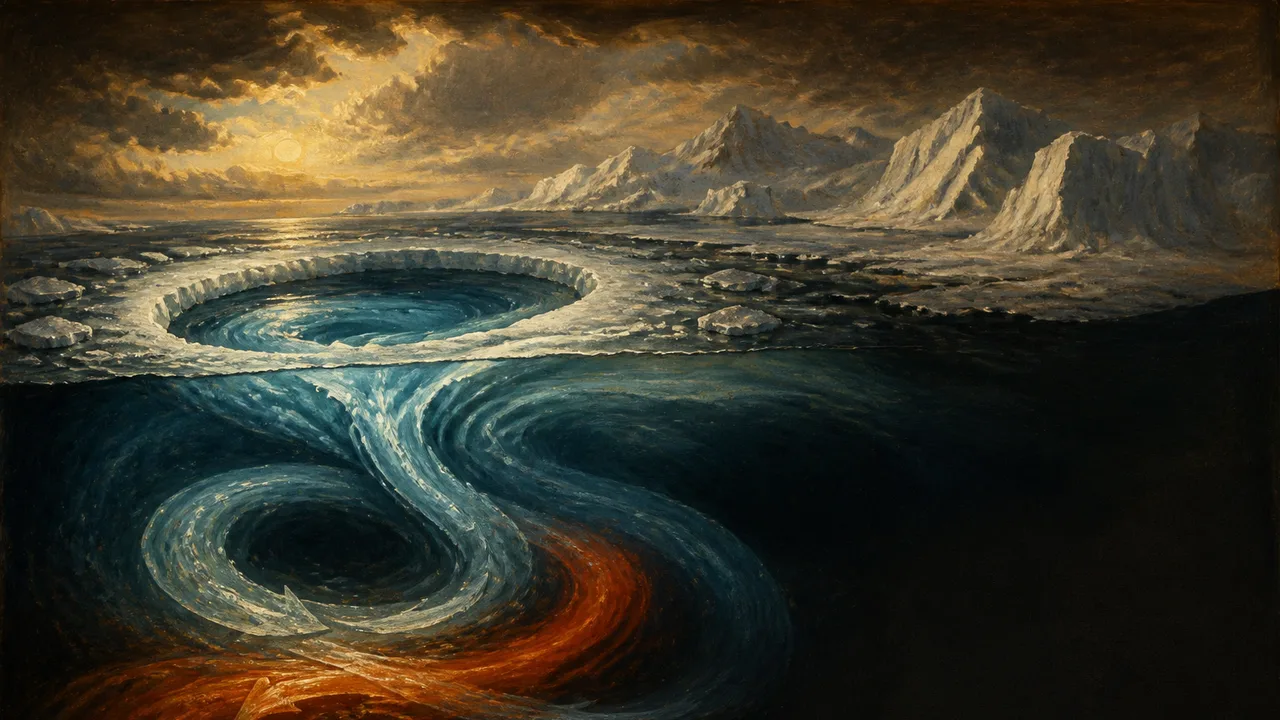
Photo: AI. Henrik Solberg
Terrain shapes battle in ways worth taking seriously. Rivers as barriers. Mountain passes as choke points. Coastlines as logistics corridors. Study terrain long enough and you begin to understand that the most consequential terrain on the planet runs two thousand meters underwater, moves at the pace of centuries, and answers to nobody's chain of command.
A recent documentary from Doc of the Day runs just under an hour and traces the journey of a single water droplet through the global ocean system. The device is pedagogical — follow one drop, explain the whole machine. It works. But what the film doesn't quite say, and what I find myself unable to stop thinking about, is that the machine it's describing is also a strategic system. And parts of it may be failing.
The Engine Room Nobody Briefs
Here's the basic physics, because it matters: when seawater freezes in the Arctic, it expels its salt content. The remaining water becomes a dense, cold brine that sinks — hard and fast — toward the ocean floor. Estimates suggest this downwelling drives a flow that dwarfs the combined discharge of every river on Earth, though the precise multiplier varies by measurement methodology and location. That sinking water drags surface water northward behind it to fill the void. Warm Atlantic water moves north. Cold deep water moves south. The result is the thermohaline circulation — "thermo" for temperature, "haline" for salinity — a planetary conveyor belt that distributes heat from the tropics toward the poles and keeps Western Europe roughly fifteen degrees warmer than its latitude has any right to expect.
NATO's entire northern flank — Norway, Denmark, Iceland, the approaches to the GIUK gap — sits in the climate shadow of that system.
Oceanographer Louis Fortier, who has spent two decades conducting field missions in the Arctic, describes "attracting the attention of policy makers to the ongoing transformations in the polar environment." That sentence stopped me. Which policymakers? What did they do with the briefing? The gap between a scientist saying we fear this will slow and a defense planner adjusting force posture accordingly is not a gap that closes quickly, or automatically, or sometimes at all.
What Fortier's research shows — confirmed by sediment cores read by paleoclimatologist Claude Hillaire Marcel — is that this exact failure mode has a precedent. Roughly 12,900 years ago, at the close of the last ice age, massive fresh water influx from melting glaciers disrupted thermohaline circulation and triggered what geologists call the Younger Dryas: approximately a thousand years of near-glacial conditions in the North Atlantic. The specific extent of the ice front's southward advance during that period remains debated in the paleoclimate literature, but the broader pattern is well-established. Europe did not gradually cool. It snapped cold within decades. Civilizations at the edge of formation were pushed back or erased. The migrations that followed reshaped the human map of an entire continent.
That's not climate history. That's strategic history. The kind my readers recognize.
The Measurement Problem — and a Question I Can't Shake
The documentary is admirably candid about how much remains unmeasured. The Southern Ocean — the violent, wind-scoured body of water encircling Antarctica — was for decades absent from the models that scientists use to predict oceanic behavior. Researcher Sabrina Speich organized one of the first large-scale campaigns to study it in 2004. Her team identified how the Southern Ocean's circumpolar current — two thousand kilometers wide, reaching four kilometers deep, the most powerful current on the planet — acts as a redistribution hub, capturing deep water from the Atlantic, Pacific, and Indian Ocean basins and cycling it back toward the surface.
One measurement from that region: a cold-water river generated by Antarctic polynyas — those anomalous stretches of open water maintained by katabatic winds even in deep winter — was clocked at a flow rate reportedly equivalent to sixty times the discharge of the Amazon. That figure comes from the documentary and demands attribution I cannot currently provide, but if it holds, it suggests the Southern Ocean's contribution to deep water formation is not a rounding error. It's a second engine, running in parallel with the Arctic one.
Here's where I have to say something directly: the U.S. Navy has been running instrumented ocean monitoring in polar and deep-water environments since the Cold War. Submarine programs accumulated decades of temperature, salinity, and current data in precisely the regions that civilian oceanographers are now straining to reach. The Argo float program — a network of autonomous profiling buoys that currently numbers somewhere north of 3,900 active units, up from the original target of 3,000 — represents an extraordinary civilian achievement. But I find myself wondering, not for the first time, what data already exists in classified archives that could accelerate civilian understanding of a system everyone now agrees is critical.
The researchers in this film strapped sensors to elephant seals to gather readings from under Antarctic ice because the Argo floats couldn't surface to transmit data through the ice cover. The seals could go where the instruments couldn't. It's an ingenious solution and a remarkable piece of science. It is also, from a certain angle, a commentary on the boundaries between what militaries know and what they share.
What "We Fear" Actually Means
The documentary's scientists speak with appropriate scientific restraint. They say things like we fear this will result in a gradual slowing and we've made some observations, but we've no idea of the quantity of these waters that have formed. That language is honest. It reflects genuine uncertainty at the frontier of a complex system.
But enough exposure to briefing rooms teaches you what "we fear" sounds like to the people who write defense budgets. It sounds like uncertainty. Uncertainty, in institutional cultures built around defined threat assessments and procurement cycles, tends to get filed rather than acted upon. The scientific community can identify a mechanism, document historical precedents, and project consequences. Whether the people responsible for long-term strategic planning treat that as signal or noise is a different chain of command entirely.
The Younger Dryas analogy is instructive here precisely because of its scale. A thermohaline disruption sufficient to shift ice fronts and reorder European settlement patterns would, today, affect agricultural output across the continent, alter the strategic calculus of the Northern Sea Route — which Russia has been developing on the assumption of continued Arctic warming — and change the fundamental operating environment for naval forces in the North Atlantic. These are not speculative second-order effects. They are direct consequences of the physics that Fortier, Speich, and their colleagues are documenting.
Marine phytoplankton, incidentally, produce roughly half of Earth's oxygen — that figure is well-supported. The claim that an equivalent proportion of atmospheric CO2 is absorbed by the oceans is more contested; marine carbon sequestration varies significantly by region and season, and treating both numbers as a matched pair oversimplifies a genuinely complex accounting problem. The documentary elides this, and it's worth flagging, because the ocean's role as a carbon sink is one of the primary arguments for why its disruption has consequences beyond temperature and weather patterns.
The Institutions and the Inconvenient Briefing
I keep coming back to Louis Fortier's policymakers. The scientists who brief them are rarely ignored out of malice or stupidity. They're ignored because institutions optimize for the urgent over the important, because the timescales involved in thermohaline circulation — decades to centuries — don't map onto electoral cycles or budget years, and because "gradual slowing of deep water formation" is a harder sell than a missile gap.
Oceanographer David Barber, working at the University of Manitoba, built an artificial polynya in a laboratory facility to study deep water formation under controlled conditions — measuring, in real time, how ice causes water to sink even at forty below zero. The science is getting sharper. The monitoring network is expanding. The sediment record is being read with increasing precision.
The question I'd put to the defense planners who received Fortier's briefings, and who will receive future ones, is not whether the science is settled. The question is whether the institutional appetite for acting on incomplete but directionally clear information has improved since the last time a major strategic environment changed faster than the models predicted.
Watch institutions process inconvenient information long enough and the pattern becomes clear. The answer is usually: not fast enough.
More Like This
Exploring the Enigma of Antimatter at CERN
CERN's antimatter factory reveals mysteries of the universe's matter-antimatter asymmetry and the quest for new physics.
Who Gatekeeps AI? The Question Washington Just Made Urgent
Google posted $109.9B in revenue as the White House eyes pre-release AI vetting. The real question: who controls what gets out—and who benefits from controlling it?
What It Actually Takes to Work in Antarctica
NOVA's Caitlin Saks and Arlo Pérez travel to McMurdo Station and find that Antarctica's hardest lessons have nothing to do with science.
Project X-Ray: The WWII Bat Bomb That Almost Worked
In WWII, the U.S. military spent $2 million strapping incendiary bombs to bats. The plan was absurd. It was also, frustratingly, not entirely wrong.
Can Humans Really Live on Mars? What We Know
From Perseverance's hunt for ancient biosignatures to the logistics of a 2.5-year round trip, here's where the Mars ambition actually stands.
Flood-Proofing Cities: Big Walls vs. Small Fixes
From Tokyo's $2B flood tunnels to a $78K fly farm in Nairobi, cities are choosing how to survive rising floods — and the choice reveals everything about who adapts and who doesn't.
The Crusades: Two Centuries of Holy War Explained
From Pope Urban II's 1095 call to arms to the fall of Acre in 1291, the Crusades reshaped Christianity, Islam, and the medieval world permanently.
Gettysburg's Command Failures and What They Still Cost Us
Dr. Roy Casagranda's Gettysburg lecture reveals how four command archetypes from 1863 shaped the battle's outcome—and what they still tell us about military leadership today.