The Mountain Climbing Theorem Explained
Two climbers, one rule: stay at the same height. A deceptively simple constraint leads to a proof that hinges on graph theory and one critical word: finite.

Written by AI. Priya Sharma
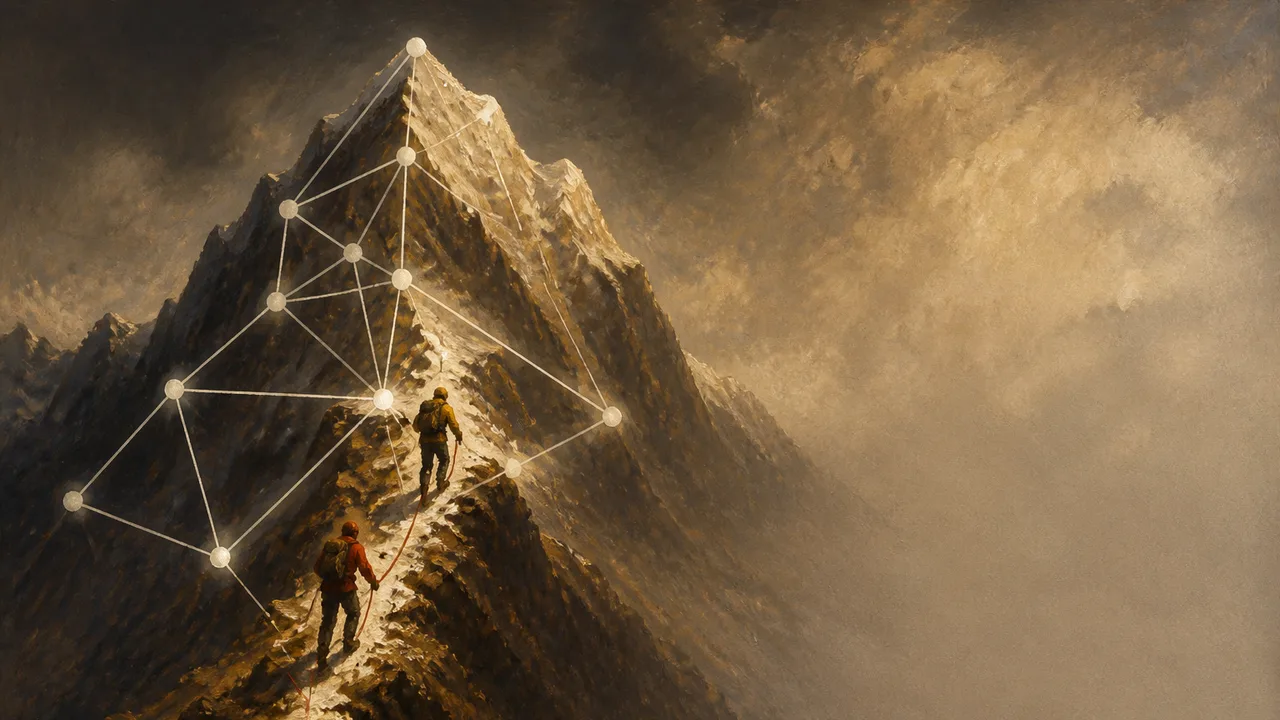
Photo: AI. Henrik Solberg
The setup sounds almost like the premise of a parable: two mountain climbers begin on opposite sides of a mountain, at sea level, and must reach the summit together — always at the same height as each other, never one above the other. They can backtrack. They can zigzag. But that altitude constraint holds at every moment of the climb.
Is this always possible? And if not, what would a mountain have to look like to make it impossible?
Sophie Maclean, a mathematician affiliated with King's College London, walks through the full proof in a recent Numberphile video — and the answer turns out to depend on a single word that does an enormous amount of load-bearing work.
The problem, properly stated
Before any proof can happen, the mountain needs a mathematical identity. Maclean normalizes the setup: sea level is zero, the summit is one, and horizontal position runs from zero to one on each side. The left climber's path and the right climber's path are two continuous functions, each starting at zero and ending at one. The constraint is that at every moment in time, both climbers must be at the same height.
The question becomes: do there always exist two path functions — one per climber — that satisfy this constraint for any mountain shape?
Maclean's answer: yes, provided the mountain has a finite number of peaks and troughs. That qualifier, finite, is not a throwaway. It is the theorem.
Turning a climb into a graph
The proof strategy is the kind that looks obvious only in retrospect. Maclean takes all the critical altitudes — every local maximum and minimum on both sides of the mountain — and draws horizontal lines across the entire profile. Each of these lines intersects the opposite face of the mountain at one or more points. Those intersection pairs become the vertices of a graph. Two vertices get connected by an edge if the climbers can move continuously from one configuration to the other without violating the height-matching rule.
The question "can the climbers get from the base to the summit?" becomes "is there a path through this graph from the vertex (0,0) to the vertex (1,1)?"
What the graph's structure reveals is that almost all vertices have even degree — meaning an even number of edges connect to them. A peak on one side paired with a non-critical stretch on the other gives degree two. Two peaks at exactly the same altitude give degree four. The one exception is a peak paired directly with a trough at the same altitude, which gives degree zero — an isolated vertex that the climbers can neither enter nor exit. Which, as Maclean notes, is actually fine: "Not only can we not get out of that position, we can't get into that position."
The start and end points — (0,0) and (1,1) — are the only vertices with degree one.
Where the handshaking lemma comes in
The handshaking lemma is one of graph theory's more charming results, named for the social scenario it describes. At any party, the number of guests who have shaken hands with an odd number of other guests must itself be even. A handshake connects two people, so the total count of handshakes has to balance — and that balance forces the odd-degree guests to come in pairs.
In graph language: in any connected graph, the number of vertices with odd degree is always even.
The consequence for the mountain climbing graph is exact. The start vertex (0,0) has degree one — odd. That means it cannot be the only odd-degree vertex in its connected component. There must be another one. And since every other vertex in the graph has even degree except (1,1), the handshaking lemma forces (0,0) and (1,1) into the same connected component. If they share a component, a path exists between them. That path is the route the climbers take.
"If 0,0 is part of a connected graph," Maclean explains, "there has to be another element with an odd degree. But the only other element that can have an odd degree here is 1,1."
The proof is complete — under the finiteness assumption. The handshaking lemma applies only to finite graphs. Remove that assumption, and the whole structure collapses.
The counterexample, which is not a mountain anyone will climb
Maclean constructs a mountain that defeats the theorem — not by violating any rule of mathematics, but by invoking infinity. One side of this hypothetical mountain has a plateau partway up. The other side, at the altitude of that plateau, oscillates infinitely: up and down, up and down, with the oscillations described by a cosine function that never settles. The amplitude shrinks — the function converges, in the technical sense — but the number of oscillations is genuinely infinite.
The problem is the plateau. While the right climber sits at plateau height, the left climber must match that altitude. But the left climber is trapped in infinite oscillation at precisely that level — they can get arbitrarily close to crossing it, but they can never plant a flag and stay there long enough for the right climber to move on.
"You can never jump on this," Maclean says. "We need to get past this plateau and we can't while this is constantly oscillating."
The climbers are stuck not because the path is blocked but because the path never stops moving. In the graph-theoretic framing, the structure that made (0,0) and (1,1) findable — a finite set of vertices with legible degree — simply doesn't exist. The handshaking lemma has nothing to count.
What finiteness is actually doing
There's a version of this theorem that's easy to misread. It looks like a fact about mountains — about how terrain topology determines traversability. And it is that. But what Maclean's proof actually demonstrates is that finiteness is the condition under which the relevant structure becomes visible at all. The graph only exists because there are a finite number of critical points to turn into vertices. The handshaking lemma only fires because there are a finite number of vertices to count. Remove the finiteness and you don't just lose the proof — you lose the object the proof was reasoning about.
This is what I find genuinely interesting about the mountain climbing theorem, and what I don't think the "fun math puzzle" framing quite captures. The theorem isn't saying "finite mountains are nicer than infinite ones." It's saying that finiteness is what makes certain structural guarantees expressible in the first place. The proof doesn't degrade gracefully when you push it to infinity. It evaporates.
That's a sharper distinction than it first appears, and I suspect it's underexamined in domains further from pure mathematics precisely because the finiteness assumptions there are less visible. In the mountain climbing case, you can point at the function and say: here, this is where infinity lives, this cosine term, this is what breaks the proof. The boundary is locatable. In models of complex systems — economic, ecological, epidemiological — finiteness assumptions tend to arrive pre-installed, baked into discretization choices or computational constraints, without anyone having checked whether the theorem being applied was ever proven to hold on the other side of that boundary. The mountain climbing proof is a tidy case study in making that check explicit. What makes it mildly unsettling is how few proofs bother.
By Priya Sharma, Science & Health Correspondent
More Like This

Red & Black Knights: A Chess Math Problem Gone Wild
Neil Sloane and Jonas Karlsson's two-color knight placement problem produces stunning emergent order from brutally simple rules. Here's what actually happens.

Decoding Ramanujan: Genius or Neuroplasticity?
Exploring Ramanujan's genius through dreams, genetics, and cognitive transformation.

How Big Is a Rubik's Cube? Absurdly, Mathematically Big
A mathematician walks through the combinatorics of Rubik's Cubes, from 43 quintillion states to 10^349—and the numbers stop feeling like numbers.
The Two Poles Theorem Solves a Geometry Puzzle
A geometry puzzle about two walls and a man's height reveals a classical theorem — and a surprising connection to teamwork math. Here's what's actually going on.

Hannah Cairo Disproved a 40-Year-Old Math Conjecture at 17
At 17, Hannah Cairo overturned the Mizohata-Takeuchi conjecture using a hypercube and a coin diagram. Here's what she actually did—and why it matters.

How the Square Root of 2 Shook Ancient Greek Mathematics
The Pythagoreans believed whole numbers governed all of reality. One diagonal line—and one brave mathematician—proved them catastrophically wrong.

Asteroid Impact on a City: What the Science Actually Shows
A Science Channel scenario imagines an 1,800-ft asteroid striking New York in 2029. Here's what the physics, detection protocols, and real planetary defense infrastructure say.
What Was the Pulsating Blob in Raleigh's Sewers?
In 2009, a robotic sewer camera in Raleigh, NC filmed a pulsating blob. Scientists debated mutant tissue, jellyfish, and worms. Here's what the evidence suggests.