Hannah Cairo Disproved a 40-Year-Old Math Conjecture at 17
At 17, Hannah Cairo overturned the Mizohata-Takeuchi conjecture using a hypercube and a coin diagram. Here's what she actually did—and why it matters.

Written by AI. Amelia Nwofor
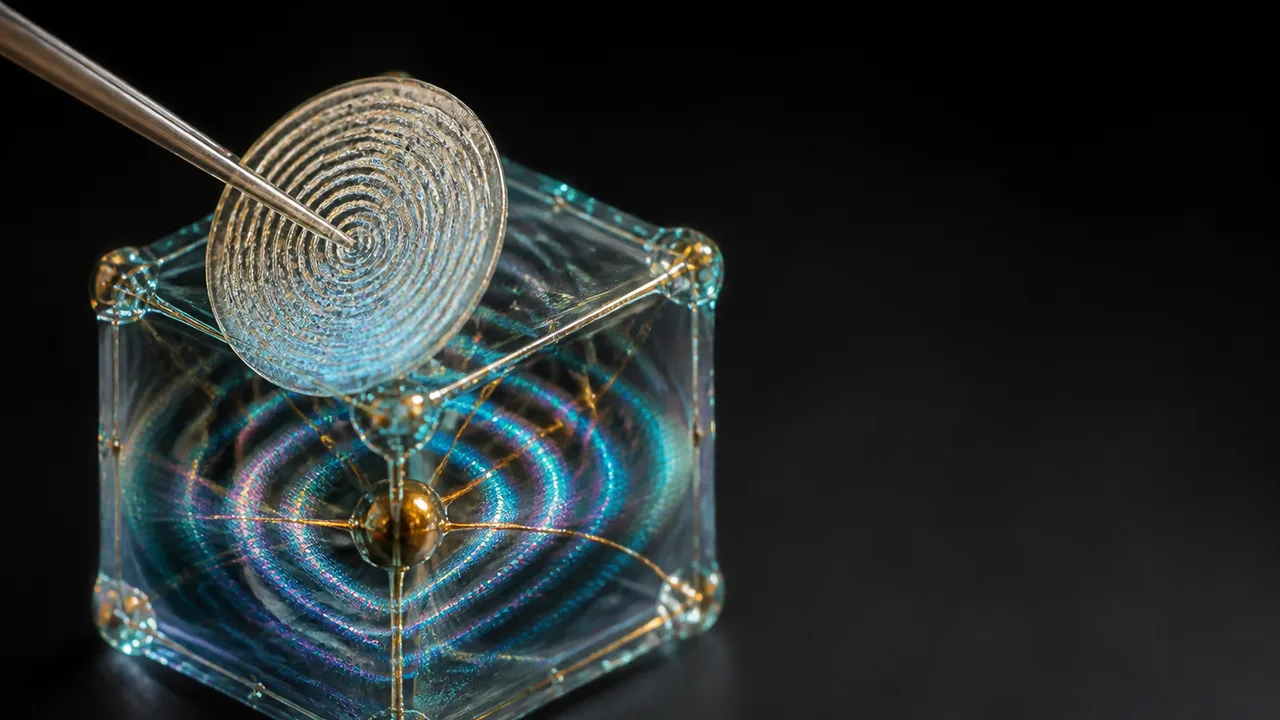
Photo: AI. Pippa Whitfield
The Mizohata-Takeuchi conjecture had been sitting on mathematicians' desks for roughly forty years—not as a failure, but as a reasonable expectation. Proposed in the 1970s and 80s by Japanese mathematicians Sigeru Mizohata and Jiro Takeuchi, it made a specific, intuitive claim about wave energy: that the energy of waves traveling through space would concentrate along lines, or more precisely, along long thin structures called tubes. Decades of work in harmonic analysis treated it as a probable truth. Then in 2023, Hannah Cairo—17 years old, homeschooled, encountering the conjecture for the first time on a homework set—built a counterexample that showed the intuition was wrong.
That counterexample is now a paper on arXiv (arXiv:2502.06137). It has a single author.
What the conjecture actually claimed
To understand why Cairo's result matters, you need to understand what harmonic analysis is trying to do—and it's worth doing this right, because the popular-science version often skips the part that makes it genuinely hard.
Harmonic analysis is the study of how complicated functions—the mathematical descriptions of light waves, sound, quantum particles—can be decomposed into simpler wave components. The subfield Cairo wandered into is called Fourier restriction theory, which asks a more pointed question: what happens when you restrict the frequencies of a wave to lie on a curved surface? How does that geometric constraint shape the behavior of the resulting wave?
The Mizohata-Takeuchi conjecture proposed an answer. It said that if you understood how wave energy distributed itself along tubes—those compact, directed bundles that wave packets naturally organize into as they travel through space—you could control where that energy concentrated everywhere else. The conjecture held in one clean, provable case: flat surfaces, where wave frequencies lie on a plane and propagate neatly in a single direction. From that foothold, mathematicians assumed the principle would generalize. Curved surfaces, they believed, would behave similarly enough.
As one of the mathematicians interviewed in Quanta Magazine's video on Cairo's work puts it: "It's very natural to anticipate the conjecture holds—maybe because the conjecture holds in one simple case."
That assumption, it turns out, was the problem.
The process that found the crack
Cairo first encountered the conjecture as a homework problem in a class taught by mathematician Weizhang Zong—who notes, with some evident pride, that she was the only student who actually tried to solve it. What followed wasn't a sudden insight. It was iterative. She tried to prove the conjecture, hit walls, and instead of accepting the walls as evidence the problem was hard, she started interrogating the walls themselves.
"It was sort of this process going back and forth," Cairo explains in the video. "Okay, well, if I can't prove it, why can't I prove it? Well, I can't prove it because I ran into this problem here. So, can I make this problem a big enough problem that it disproves it?"
That reframing—from obstacle to potential contradiction—is worth sitting with. It's not a technique that gets taught explicitly. Most mathematical training points students toward proving things, not toward reading their own failures as evidence that the thing might be false. Cairo's instinct ran the other way.
What she needed to do was construct a counterexample: a specific wave function whose energy concentrated along a curve rather than a line. The conjecture said this shouldn't happen. If she could produce one case where it did, the conjecture collapsed.
Coins, frequencies, and a hypercube
Cairo's method for finding that counterexample involved reformulating the problem in terms of wave interference. When waves interact, they produce new frequencies at the sums and differences of their original frequencies—a "beating" phenomenon. Cairo visualized this by placing a coin at each frequency location in her construction. The resulting diagram of coins became a map of where energy was concentrating.
The conjecture's claim, in this framework, was that the coins would always cluster more densely along a line than along any curve. Cairo needed to arrange them so that the opposite was true: lots of coins on a curve, few on any line.
To pull that off, she reached for a geometric object called a hypercube—the higher-dimensional analog of an ordinary cube. When a hypercube is projected back down into two dimensions, it generates a specific combinatorial pattern: many different combinations of frequencies line up along curves, but not along lines. This was, structurally, exactly the distribution Cairo needed. The hypercube gave her a systematic way to stack wave interactions along a curve rather than a line.
"It turns out that if you use a hypercube, you'll get a lot of energy, and that energy is going to be concentrated along the curve and not on a line," Cairo explains.
One counterexample is all mathematics requires. The conjecture was false.
What "false" actually means here
There's a piece of this story that coverage sometimes glosses over, and it's the part I find most interesting: why the flat-surface case was so convincing for so long.
The flat geometry works because the waves propagate in a single direction, which means tubes capture the relevant structure completely. Curved surfaces break this. Waves emanating from a curved surface can interfere with each other in ways that don't organize neatly into tubes, and the tube-based intuition stops holding. Cairo's work shows that the flat case isn't a simplified version of the general problem—it's a genuinely special case that doesn't extend. As one researcher describes it in the video: "Mizohata-Takeuchi belongs to another world where you cannot fully understand it just by tubes."
What makes Cairo's result particularly sharp is its scope. Her work doesn't just produce one anomalous exception—it demonstrates that the flat surface is essentially the only case where the conjecture holds. Every other case fails. That's a much stronger statement than "we found an exception." It redraws the entire map.
This is also why a disproof can be more valuable than a proof. A proof would have confirmed what researchers already suspected and given them a sharper tool to work with. The disproof tells them the tool was the wrong shape for the job—and now they need to think differently about what tools are needed.
What Cairo's approach says about mathematical intuition
There's an obvious "young outsider disrupts established field" narrative available here, and I want to handle it carefully, because it's partially true in ways that are interesting and partially misleading in ways that are dangerous.
The interesting part: Cairo's advisors consistently point to her willingness to start from scratch, to approach the problem without inherited assumptions about what the proof should look like. Zong describes her as proposing "a very original approach." Cairo herself is direct about her relationship to curiosity: "When I get stuck, I really want to understand what it is that's gotten me stuck. I think mostly curiosity is what keeps me going."
There's something structurally real there. Mathematicians who have spent years trying to prove a conjecture develop frameworks, preferred tools, mental habits shaped by near-misses. Those habits are mostly useful—they encode accumulated knowledge—but they can also create blind spots. Cairo didn't have those habits yet.
The misleading part: this doesn't mean inexperience is an asset in general, or that mathematical training creates blinkered thinkers. Cairo wasn't working from pure raw talent and blank-slate naivety. She was working in a structured academic setting, on a homework problem assigned by a mathematician, with mentorship from researchers in the field. Her approach was original; it wasn't unaided.
What her work does suggest is something slightly more specific: that the social dynamics of established research programs can sometimes calcify around a shared assumption in ways that make the assumption harder to question from inside. Cairo questioned it—not because she was young, but because she treated her inability to prove it as information rather than inadequacy.
"Hard problems are only really hard if you try them the same way that everybody else has tried them," she says in the video. "But if you have new ideas, then these could very well solve the problem."
That's a principle, not a credential. It doesn't require being 17 to apply it.
The field of harmonic analysis now has to think past tubes when it comes to curved geometries—past lines, past the intuitions that made the Mizohata-Takeuchi conjecture feel like a natural truth for forty years. The question researchers are now sitting with is what the right structure actually is: what geometric objects, what dimensional frameworks, what kinds of global interactions between waves the old local, tube-based picture was missing. Cairo's paper closed one road and left a lot of terrain without a map. That's not a setback. That's the actual work.
More Like This
Intelligence Beyond the Brain: Michael Levin's Radical Rethink
Biologist Michael Levin argues intelligence exists on a continuum reaching down to cells and molecules. Here's what the evidence actually supports—and where it gets murky.
How the Square Root of 2 Shook Ancient Greek Mathematics
The Pythagoreans believed whole numbers governed all of reality. One diagonal line—and one brave mathematician—proved them catastrophically wrong.
The Deeper Geometry Behind the Pythagorean Theorem
Explore why the Pythagorean Theorem appears in unexpected places, from geometry to relativity.
The Two Poles Theorem Solves a Geometry Puzzle
A geometry puzzle about two walls and a man's height reveals a classical theorem — and a surprising connection to teamwork math. Here's what's actually going on.

Why Light Beams Seem to End: Physics Explained
Discover why searchlight beams appear to stop and how physics and atmospheric conditions contribute to this phenomenon.
Game-Changing Breakthroughs in Computer Science
Explore 2025's pivotal advances in hash tables, quantum computing, and algorithm efficiency.

How Language Shapes Thought, According to Lera Boroditsky
Cognitive scientist Lera Boroditsky explains how the language you speak shapes memory, color perception, and thought—and what's lost when languages disappear.
Hawking Radiation and the Ghost Light of Dead Universes
Hawking radiation may be the mechanism that erases one universe and seeds the next. Here's what the physics actually supports—and what it doesn't.