Why Light Beams Seem to End: Physics Explained
Discover why searchlight beams appear to stop and how physics and atmospheric conditions contribute to this phenomenon.

Written by AI. Amelia Nwofor
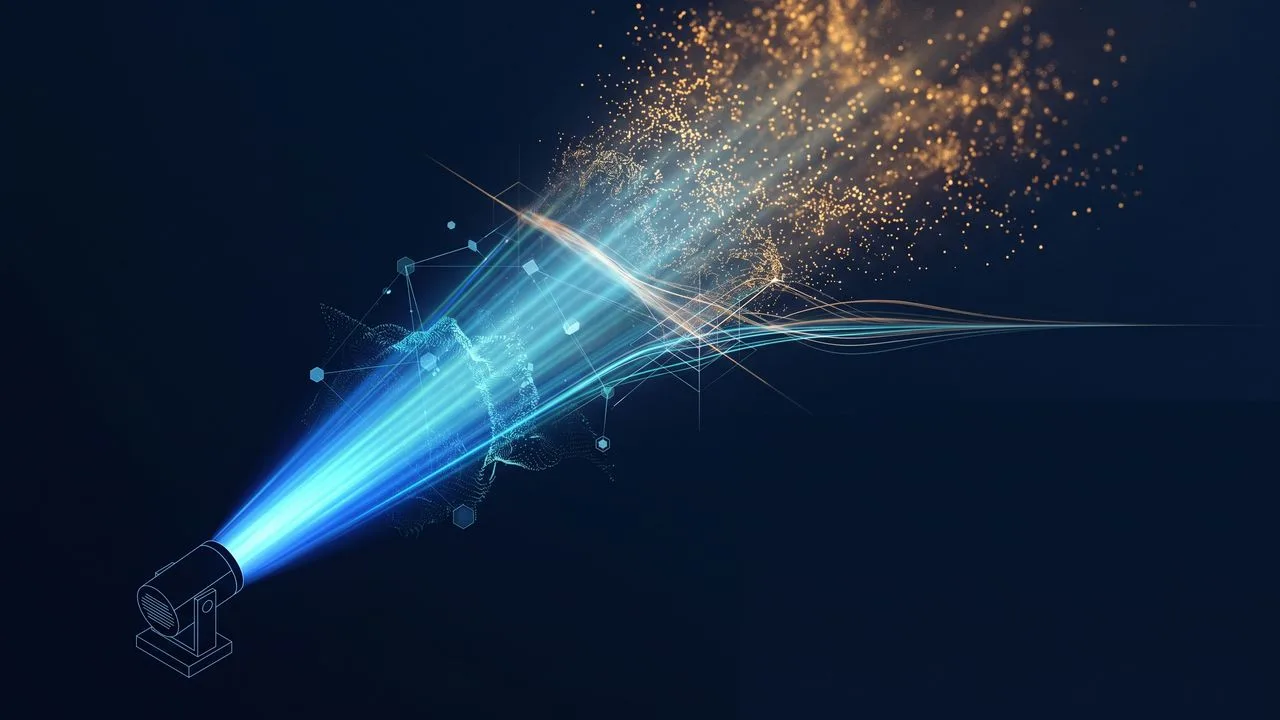
Photo: AI. Marcel Dubois
In the age of Hollywood, searchlights have become a staple, casting their iconic beams into the sky, as if beckoning the stars themselves. But have you ever wondered why these beams appear to have a stopping point? Neil deGrasse Tyson and Chuck Nice explore this curious phenomenon in a recent StarTalk video, where physics and a bit of atmospheric science take center stage.
The illusion of a terminated beam is a dance between light and air. As Tyson explains, "You only see the beam because there's stuff in the air—pollen, dust, water vapor—that reflects light out of the beam to your sight line." Without these tiny particles, light would travel unnoticed, invisible in a perfect vacuum. This is why the beams from phasers in Star Trek or the destructive Death Star in Star Wars are scientifically misleading. In reality, without a medium, even the most powerful beams remain unseen.
The Inverse Square Law
The physics behind the fading light involves the inverse square law—a fundamental principle that dictates how light intensity diminishes over distance. Essentially, as you double the distance from the light source, the intensity becomes a quarter of what it was. Imagine distributing butter evenly on toast: when the toast is twice as far, the same amount of butter now covers four slices, each with less butter per slice. Tyson likens this to a "butter gun," illustrating how spreading out reduces intensity, a metaphor that cleverly captures the essence of this law.
Why Light Appears to End
So why does the beam appear to end? As light travels upward, it reflects off atmospheric particles back to us. However, this reflected light also follows the inverse square law, dropping in intensity as it returns. Tyson notes, "Combine them, the brightness of the beam drops as one over distance to the fourth power." This exponential drop means the light quickly falls below the detection limit of our eyes, creating the illusion of an abrupt termination.
Beyond the Beam
This phenomenon isn't just an academic curiosity—it enriches our understanding of visual displays, like the poignant 9/11 memorial lights that reach skyward, evoking the towers that once stood. Our perception of these beams, seemingly cut short, is a testament to the interplay of light and atmosphere.
Looking deeper, one might ponder: is this a metaphor for scientific inquiry itself? We often see only what reflects back to us, our understanding limited by the tools and conditions at hand. Yet, there's always more beyond our current horizon, waiting to be illuminated. In science, as in life, perhaps the challenge is not just to observe, but to understand the invisible forces at play.
More Like This
Exploring Time: From Strobe Photography to Trillion FPS
Dive into the world of high-speed imaging, from Edgerton's strobe to modern trillion FPS cameras.
Mold on the ISS: A Clue to Life's Cosmic Journey?
Examining mold's resilience in space and its implications for panspermia, the theory that life on Earth may have cosmic origins.
Exploring Math's Role in Understanding the Universe
Delve into the need for new math to solve universe's mysteries with insights from Terence Tao on StarTalk.
Exploring Black Holes and Asteroids with StarTalk
Neil deGrasse Tyson delves into black holes, asteroids, and more in StarTalk's latest Cosmic Queries episode with Chuck Nice.
Black Hole Paradox: Are Reference Frames the Key?
Exploring how reference frames might resolve the black hole information paradox.
Exploring the Cosmic Balance: Lagrange Points
Discover how Lagrange points revolutionize space exploration, offering energy-efficient paths and potential for space construction.
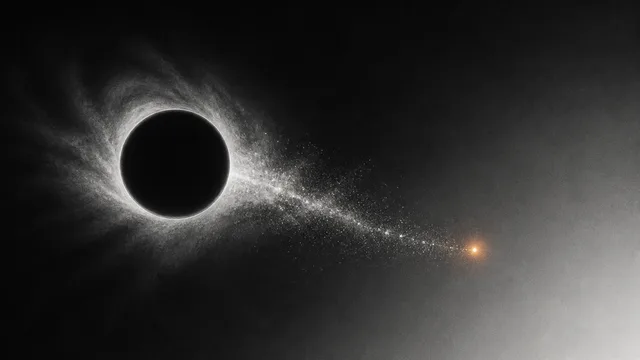
Hawking Radiation and the Ghost Light of Dead Universes
Hawking radiation may be the mechanism that erases one universe and seeds the next. Here's what the physics actually supports—and what it doesn't.
How Astroparticle Physics Built Itself From Borrowed Parts
A new arXiv review traces how astroparticle physics didn't emerge from a single discovery—it assembled itself from three fields that kept bumping into the same cosmic questions.