Intelligence Beyond the Brain: Michael Levin's Radical Rethink
Biologist Michael Levin argues intelligence exists on a continuum reaching down to cells and molecules. Here's what the evidence actually supports—and where it gets murky.

Written by AI. Amelia Nwofor
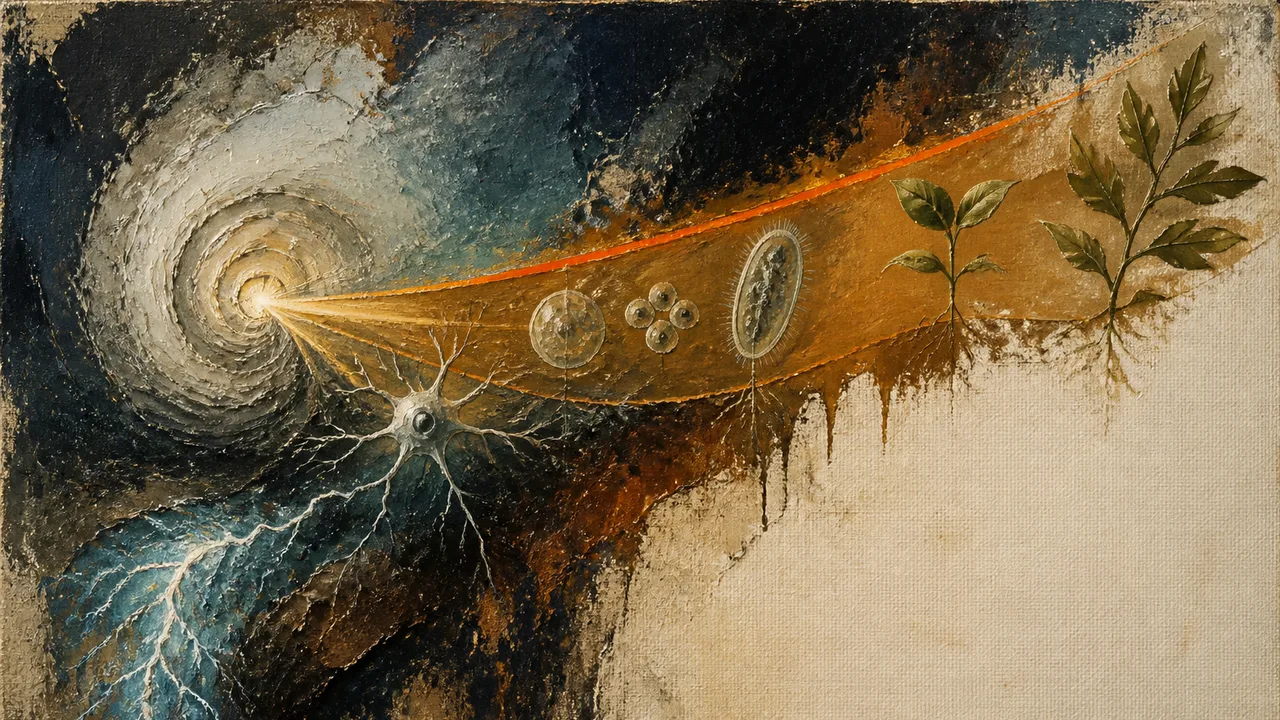
Photo: AI. Saskia Aaltonen
Here's a question worth sitting with before you answer it: when a salamander regenerates an amputated limb—down to the correct number of fingers, the right proportions, the exact original pattern—what exactly is doing the knowing?
Not the individual cells. No single cell contains the blueprint. The information, if we can call it that, is somehow distributed across a network. The limb just... arrives at the right answer. Every time.
Biologist Michael Levin, speaking in a recent Quanta Magazine video, uses that kind of example not to invoke mysticism but to press a genuinely uncomfortable scientific question: if we define intelligence as the capacity to reach the same goal by different means—a definition he borrows from the psychologist William James—then what exactly disqualifies the group of cells doing that regeneration from the category?
His answer, developed over years of research at the intersection of developmental biology and cognitive science, is that nothing disqualifies them. And he thinks the implications run much further than most of his colleagues are comfortable following.
What "Diverse Intelligence" Actually Means (and Doesn't)
Before we get to the hurricane—and yes, there's a hurricane—it's worth establishing what Levin is and isn't claiming, because the field of diverse intelligence is easy to caricature.
He's not arguing that cells are conscious, or that a bacterium has feelings, or that rocks dream. The operative word in his framework is competency. Drawing from William James, Levin defines intelligence as "a degree of competency to reach the same goal by different means." That's a behavioral definition. It's about what a system does, not what it is.
Under that lens, individual cells qualify. A single-celled organism like a paramecium navigates toward food, away from toxins, through obstacles it has never encountered. It has something that functions like preferences, something that functions like sensing, something that functions like decision-making. Levin's claim—and here he says "the majority of the field" agrees with him—is that dismissing this as mere mechanism while calling human cognition something categorically different relies more on intuition than on any rigorous criterion.
The challenge, as he's careful to note, cuts both ways. You can't just "paint beautiful complex minds onto everything you see in nature." The whole enterprise of diverse intelligence depends on setting up experimental conditions that actually measure how much problem-solving a given system can do, regardless of what it's made of or how it got here. The question isn't philosophical; it's empirical. What did you observe? What did the system accomplish when you changed its environment?
The Cognitive Light Cone
The conceptual tool Levin offers for mapping all of this is what he calls the "cognitive light cone"—a framework for thinking about the scope of a system's goals across space and time.
His illustration is memorable: "If you tell me that all of your goals are around maximizing the concentration of sugar in a tiny little micron-sized area and you have a memory that goes back 20 minutes... I'm going to guess you're a bacterium and you have a tiny little cognitive light cone. And if you tell me that you have goals around the global financial markets across the whole earth, I'm going to say you're at least a human."
The cone is a way of asking: how far does this system's agency reach? How long is its relevant past, and how far ahead does it project? By that measure, different intelligences don't sit on opposite sides of a binary—they sit at different positions along a continuum, nested inside each other. A cell is inside a tissue; a tissue is inside an organ; an organ is inside a body; a body is inside a social network. At each level, the collective can pursue goals that no individual component contains.
This is where the regenerating limb re-enters the picture. The group of cells building that amphibian limb "knows" things no single cell knows. It has a target morphology—a homeostatic set point, like a thermostat—and it works toward that set point using bioelectric signaling: voltage changes propagating across cellular networks through electrical synapses. The mechanism, Levin emphasizes, is not metaphorically similar to what happens in the brain. It is, he says, "exactly the same."
That claim is worth pausing on. Bioelectricity as a substrate for cognition isn't new—the field has been developing for decades—but Levin's framing positions it not as an interesting side-channel of development but as the primary mechanism through which body-level problem-solving happens. Cells, in this view, aren't just following genetic instructions like a recipe. They're running something closer to a goal-seeking process, one that can improvise.
Tadpoles With Ectopic Eyes
The most striking experimental evidence Levin presents comes from his lab's work with tadpoles engineered to have eyes on their tails—the only eyes in the animal, positioned nowhere near the brain's standard visual processing architecture.
Those tadpoles can see.
What makes this remarkable isn't just the result—it's what it implies about the argument that intelligence requires specific, evolved architecture. The conventional expectation would be that rerouting sensory input so radically would require extensive evolutionary selection, rounds of mutation and adaptation, before anything functional emerged. But the tadpoles see the first time they're made, not after generations of refinement.
Levin's interpretation: the underlying system is already a problem-solver. It's "prepared for novelty" in a way that goes beyond any particular solution. The cells and tissues have a kind of generalized competency that lets them route around novel configurations to reach functional outcomes.
Skeptics of this framing would note that "prepared for novelty" is doing a lot of work in that sentence. How much of this is genuine adaptive problem-solving versus the expression of pre-existing developmental plasticity that evolution already selected for? The distinction matters—and it's not fully resolved by the experiment alone, however striking the result.
Where the Argument Gets Genuinely Contentious
Levin acknowledges he sits at the more radical end of the diverse intelligence field. His position: problem-solving capacity extends not just to cells but to molecular networks—and he won't rule out going further.
"Sometimes people ask me, 'Then you would even say the weather is intelligent?' And I would say I wouldn't just say that—but have you ever tried to train a hurricane?"
That's not a throwaway line. He's making a methodological point: the question of whether a hurricane exhibits anything like learnable, goal-directed behavior is, in principle, an empirical one. Not answered. Not obviously unanswerable. Just untested, because it requires imagination we haven't deployed yet.
This is where the framework starts to strain for many researchers. The cognitive light cone is a useful heuristic. The behavioral definition of intelligence is defensible. But "have you tried training a hurricane" operates at a different epistemic level than "we observed tadpoles with ectopic eyes learning to use visual input." One is a result; the other is a provocation. Conflating them risks letting the philosophical ambition outrun the evidence base.
To Levin's credit, he's explicit about this: "I'm saying it's a research program to see which level of description and what tools are giving you the most bang for your buck. You can't do that from a philosophical armchair. You have to do experiments." The claim isn't that the weather is intelligent—it's that the question deserves an experimental posture, not a categorical dismissal.
That's a reasonable position for a scientist to hold. Whether it's a reasonable place for the field to put significant resources is a separate question, and one the broader community hasn't settled.
The Underlying Tension
What Levin is doing, at bottom, is attacking a definition. The binary—intelligent / not intelligent, cognitive / non-cognitive—is, he argues, "doing a lot of harm." It shuts down investigation before it starts. If we decide in advance that only brains count, we stop looking at cells. If we decide only neurons count, we stop looking at bioelectric networks in development. And then we miss things that are actually there.
The strongest version of his argument is just this: our intuitions about intelligence were shaped by evolution to recognize minds that look like ours. Those intuitions are not a reliable guide to what kinds of physical systems can exhibit goal-directed problem-solving. The history of biology is littered with cases where we underestimated the sophistication of systems we'd pre-categorized as simple.
The weakest version is the hurricane. And it's worth noticing that Levin himself puts the hurricane in a different register than the cellular work—it's a question, not a claim.
The science that's actually demonstrated—bioelectric signaling in development, collective goal-seeking in regenerating tissue, ectopic sensory integration in engineered tadpoles—is genuinely interesting on its own terms. It doesn't need the weather to be trainable to matter. The question is whether the conceptual framework that produced that science is the same one that leads to productive experiments on molecular networks and meteorological systems—or whether, at some point, the continuum stretches past where the tools can follow.
Levin's answer is characteristically direct: "The biggest limiting factor in this field is imagination—our imagination." Maybe. But imagination and evidence have to keep pace with each other, and right now, across much of this research program, one is running well ahead of the other.
More Like This
The Deeper Geometry Behind the Pythagorean Theorem
Explore why the Pythagorean Theorem appears in unexpected places, from geometry to relativity.
Are We Alien Probes? Yampolskiy's Wild AI Theory
AI safety researcher Roman Yampolskiy argues aliens would send biological von Neumann probes—and humans might be them. Then physics complicates everything.

The Psychology Behind Habits Linked to High Intelligence
Talking to yourself, craving solitude, obsessing over random topics—psychology research suggests these "weird" habits may signal a sharp, curious mind.

Why We Still Can't Simulate a Worm's 302 Neurons
Joscha Bach says neuroscience is mapping the telegraph network and calling it civilization. A 302-neuron worm is the uncomfortable proof.

Why Light Beams Seem to End: Physics Explained
Discover why searchlight beams appear to stop and how physics and atmospheric conditions contribute to this phenomenon.
Does Money Really Buy Happiness? Insights from Peter Steinberger
Explore Peter Steinberger's perspective on money and happiness, emphasizing experiences over wealth accumulation.
The Messy, Brilliant History of Divergence and Curl
How Hamilton's quaternion obsession, Maxwell's electromagnetism, and a self-taught telegraph operator gave us the vector calculus we use today.
How Newton Calculated Pi With Calculus
Newton didn't set out to calculate pi—he built a universal method for finding areas under curves. Pi was just what came out when he tested it on a circle.