Exploring the Enigma of Recamán's Sequence
Delving into Recamán's sequence, a simple rule with complex questions. Does every integer appear?

Written by AI. Amelia Nwofor
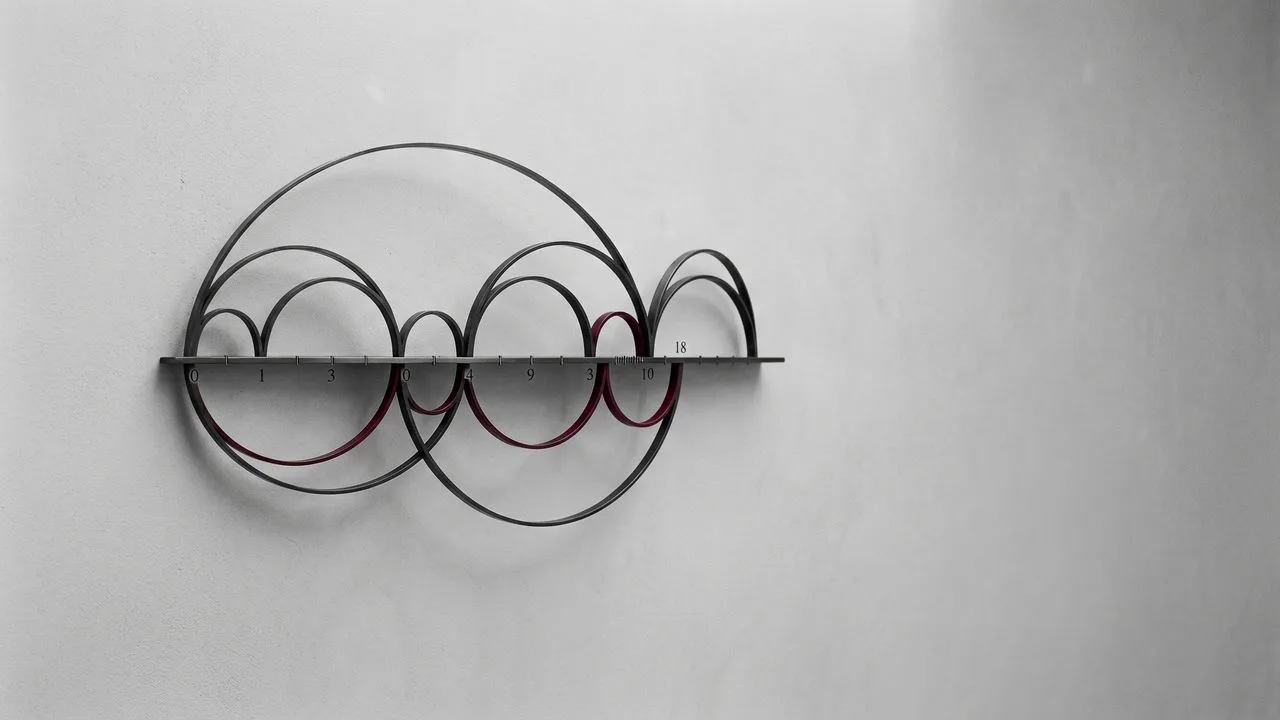
Photo: AI. Tomoko Hayashi
In the vast landscape of mathematical sequences, Recamán's sequence stands out not for its complexity in construction, but for the complexity it reveals. At its core, this sequence is built on a rule so simple, you could explain it to a child: start at zero and at each step, jump backward by the step number if possible, otherwise jump forward. Yet, this straightforward directive has given rise to one of the most stubbornly intriguing puzzles in modern mathematics.
Recamán's sequence, cataloged as A005132 in the Online Encyclopedia of Integer Sequences (OEIS), has captivated mathematicians due to its unpredictable behavior. The sequence's defining feature is its backward jump rule—a condition that introduces a labyrinth of possibilities and complications. As the video from Derivia illustrates, "The rule that builds this sequence is so simple you could explain it to a 10-year-old in about 30 seconds." However, the beauty of this sequence lies in its refusal to conform to predictability.
The Missing Numbers
One of the most tantalizing questions surrounding Recamán's sequence is whether it will eventually include every non-negative integer. As of recent computations, some numbers, like 852,655, remain conspicuously absent. This absence is not just a curiosity but a profound question that challenges mathematicians. Despite running the sequence out to a quadrillion terms, there's no definitive answer. "Does that number ever appear in Recamán's sequence? Nobody knows," the video notes.
This open question is part of what mathematicians refer to as the surjectivity conjecture for Recamán's sequence. The conjecture posits that every non-negative integer should appear at least once. Yet, there's a persistent doubt—a probabilistic model suggests it should happen, but reality might play by different rules.
The Role of Subtraction
Subtraction is the linchpin of Recamán's sequence, the very operation that imbues it with complexity. Without it, the sequence would simply follow a predictable path akin to triangular numbers. The video emphasizes, "Subtraction is what gives the sequence teeth." It's this ability to step back that forces the sequence to revisit its own history, threading the needle between already visited numbers.
The difficulty in predicting the sequence's behavior stems from its recursive nature. Every step depends on all previous steps, creating a system that is deterministic yet not easily predictable. "You'd think someone could sit down with a pencil and either prove it or find a counterexample," the video suggests, highlighting the deceptive simplicity of the problem.
A Musical and Visual Journey
Beyond numbers, Recamán's sequence offers a visual and auditory experience. Plotting the sequence creates arc patterns reminiscent of a seashell, lending an aesthetic dimension to its mathematical intrigue. These arcs, described as "nesting into a strange shell," are as much a part of its allure as the numbers themselves. Additionally, translating the sequence into music reveals an eerie, unresolved melody that mirrors its mathematical mystery.
The Unseen and Unproven
The journey through Recamán's sequence is a reminder of how simple rules can lead to profound questions. It shares a philosophical space with other notorious mathematical enigmas, like the Collatz conjecture. Both are governed by simple rules that produce unpredictable outcomes, resisting even the most determined analytical efforts.
In the end, Recamán's sequence serves as a testament to the depth of mathematical inquiry. It poses questions that are deceptively easy to ask but remain unanswered. As we continue to explore, compute, and theorize, the sequence remains a compelling reminder that sometimes, the journey itself reveals more than the destination. And perhaps, somewhere along this infinite path, a step will finally land on 852,655—or perhaps not.
More Like This

Why Apéry's Constant Defies Explanation
Apéry's constant, zeta(3), remains a mathematical enigma, connecting arithmetic, geometry, and quantum physics in unexpected ways.

Decoding the Riemann Hypothesis and Prime Regularity
Explore the Riemann Hypothesis and its implications for the distribution and regularity of prime numbers.
The Mathematical Pattern Everyone Believes But No One Can Prove
For 150+ years, mathematicians have believed in a pattern that seems obvious—yet remains unproven. Here's why the Riemann Hypothesis matters.

Solving the 'Harvard' Puzzle: A Mathematical Journey
Explore the mathematical challenge of 8^x + 2^x = 30, a puzzle reminiscent of a Harvard entrance exam.
Decoding Logic: Marriage Puzzles and Irrational Numbers
Explore the intersection of logic puzzles and mathematics, revealing insights into irrational numbers and everyday reasoning.

Exploring the Enigma of the Sinc Function Integral
Delve into the complexity of the sinc function's integral and Feynman's unique approach.

Hannah Cairo Disproved a 40-Year-Old Math Conjecture at 17
At 17, Hannah Cairo overturned the Mizohata-Takeuchi conjecture using a hypercube and a coin diagram. Here's what she actually did—and why it matters.

How Language Shapes Thought, According to Lera Boroditsky
Cognitive scientist Lera Boroditsky explains how the language you speak shapes memory, color perception, and thought—and what's lost when languages disappear.