Why We Still Can't Simulate a Worm's 302 Neurons
Joscha Bach says neuroscience is mapping the telegraph network and calling it civilization. A 302-neuron worm is the uncomfortable proof.

Written by AI. Mei Zhang
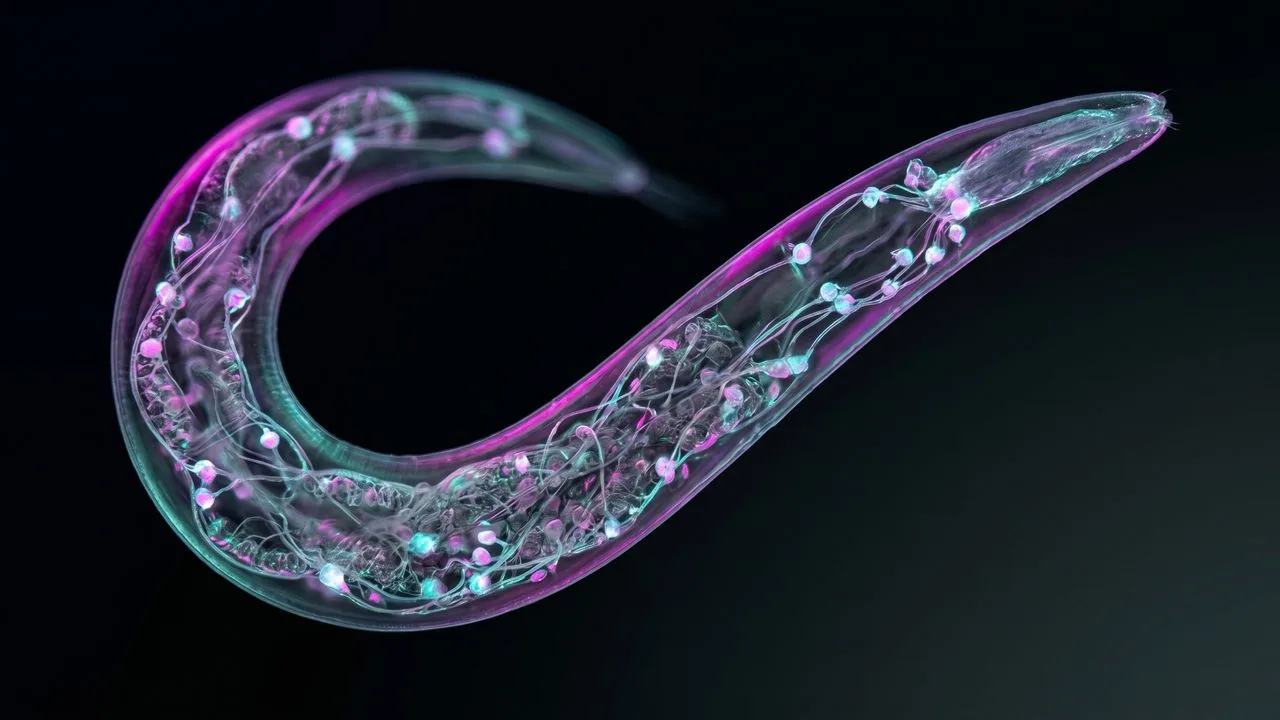
Photo: AI. Pippa Whitfield
We have mapped every single neuron in C. elegans—a tiny soil worm with a nervous system so simple it fits on a poster. 302 neurons. A few thousand synaptic connections. Scientists completed that map in 1986 and have been refining it for four decades since. And the simulations of that worm, running on that complete wiring diagram, still don't produce worm-like behavior.
That fact alone should be keeping more people up at night than it apparently is.
Joscha Bach—computer scientist, AI researcher, and co-founder of the California Institute for Machine Consciousness, with previous research appointments at MIT Media Lab—thinks he knows why. In a conversation with physicist Dr. Brian Keating on the Into the Impossible podcast (published July 2025, available here), Bach makes an argument that starts as a technical critique of computational neuroscience and ends somewhere much more vertiginous: maybe the entire connectome project is mapping the wrong thing entirely.
The Telegraph Wire Problem
Bach's core claim is deceptively simple. Neuroscience, he argues, operates on a foundational assumption: neurons compute, spike trains carry the information, and memories live in the synaptic connections between neurons. Map all of that, and you've captured the brain. Run it in silicon, and you get behavior.
He thinks that assumption is wrong—not because of mysticism or "new physics," and he's careful to say so. His objection is architectural. When he looks at a single biological cell, what he sees is a conditional message-sender: a unit that receives signals from its environment and sends different signals depending on what it received. That's computation. Every cell does it. Which means a multicellular organism isn't just a neural network riding around in a bag of passive tissue—it's a Turing-complete computational system from top to bottom.
Neurons, in this framing, aren't the processors. They're the wires.
The analogy Bach reaches for is the telegraph network. Before radio and telephony, if you wanted to send information quickly across vast distances, you encoded it into Morse code and ran it through telegraph lines. The encoding is lossy and a little awkward—you're compressing rich information into dots and dashes—but it beats the alternative (shouting, carrier pigeons, chemical diffusion) when you need speed across distance. Neurons, he suggests, evolved to solve the same problem: how does a large animal move its muscles fast enough to survive, when chemical signals between adjacent cells are too slow to coordinate action across meters of tissue?
"Once you are an animal that is able to eat plants to maintain the energy budget to drive your telegraph network," Bach told Keating, "that is very useful to have it because it allows you to control your muscles very quickly because you can send information very quickly through these wires through the organism."
Spike trains are the Morse code. The neurons are the lines. But the telegraph network is not the city it connects.
The Caterpillar That Shouldn't Remember
Bach's most striking piece of supporting evidence involves butterflies—or more precisely, what happens between a caterpillar and a butterfly during metamorphosis.
During pupation, the caterpillar's nervous system doesn't just transform—it partially dissolves. The larval brain liquefies and gets rewired into the adult structure. The connectome, as neuroscience defines it, is literally destroyed and rebuilt in a different shape. And yet: there's experimental evidence suggesting that some conditioned behaviors learned by caterpillars survive metamorphosis into the adult butterfly. Blackiston et al. (2008, PLOS ONE) demonstrated this directly—caterpillars trained to avoid a specific odor retained that aversion as adult moths, despite the intervening neural reorganization.
If memories live in synaptic connections, and the synaptic connections get dissolved and rebuilt, how does the butterfly know anything the caterpillar learned?
Bach points toward RNA as a possible answer—specifically, the idea that memory might be encoded within cells themselves, possibly even transferred between cells via RNA. This lines up with some genuinely provocative research; work by David Glanzman at UCLA has suggested RNA-based memory transfer in sea slugs, though it remains contested and far from established consensus. But the caterpillar finding alone is enough to make the "memories are in the synapses" assumption look shakier than the textbooks suggest.
Who Has Skin in This Game
I've spent the last year covering the genomics revolution, getting genuinely excited about what complete biological maps can tell us. Connectome science felt like the same story: more data, better resolution, closer to understanding. Reading Bach's argument, something in that excitement snags.
Not because I think he's necessarily right. But because I've been treating "map everything" as an obviously correct research direction, and Bach is pointing at the C. elegans simulations and asking: if we've had the complete map for forty years and the simulation still doesn't produce a worm, what exactly are we assuming will be different at mouse scale? That question doesn't go away just because it's inconvenient.
The companies with the most skin in this game aren't academic neuroscience labs—they're the mind-uploading adjacent startups and the brain-computer interface ventures that have quietly built their pitch decks on the premise that consciousness is, at bottom, a pattern of neural connectivity. Scan the connectome, preserve it, run it somewhere else: you get continuity of self. That's the implicit promise underneath a lot of very expensive technology.
Bach's alien civilization analogy lands here like a small bomb. Imagine, he says, an alien species that discovers Earth from a distance and identifies the telegraph network. They intercept the Morse code. They figure out parts of the encoding scheme. And then they announce: "Very soon we'll be able to simulate the human telegraph network and thereby predict and simulate human civilization."
"The neuroscientist might be mapping the telegraph network and calling it the civilization," Bach said.
If that's true—if the spike trains are the signal medium and not the signal's meaning—then mind uploading doesn't preserve you. It would capture the telegraph network without the civilization that generated it. You wouldn't be uploaded. Something would be uploaded. Whether that something is you depends entirely on an assumption about what you are that connectome science hasn't actually tested.
I'm not willing to tell you Bach is right about this. He's a computer scientist making a systems argument about a field he freely admits he's not credentialed in—he's the first to say his neuroscience knowledge doesn't go beyond undergrad. The mainstream response would note that connectome mapping is foundational infrastructure, that models improve as they incorporate more biological detail, and that absence of a working simulation isn't proof the framework is wrong.
But here's where I actually land: the C. elegans problem is a real problem, and the field's response to it matters. A 302-neuron simulation that doesn't produce worm behavior after forty years of refinement isn't a minor calibration issue—it's a signal that something in the model is missing. Bach's guess about what's missing may be wrong. But the question he's asking—are neurons the processors or the infrastructure?—deserves a more rigorous answer than "we'll figure it out at scale."
Science moves by asking exactly this kind of structurally inconvenient question. Bach says he'd update his view if someone produced a C. elegans simulation that actually behaved like a worm using only connectome data. That's a falsifiable position, which is more than you can say for a lot of speculation at the mind-consciousness boundary.
The simulation of a 302-neuron worm is either the most important unsolved problem in neuroscience, or a known limitation that the field has good reasons to set aside. What it isn't, anymore, is a detail.
More Like This

Is Physics Really in Charge? Ellis vs. Carroll Explained
George Ellis argues physics doesn't decide outcomes—context does. Here's why his debate with Sean Carroll's reductionism is more consequential than it sounds.
Scientists Made a Virtual Fly Walk Using a Dead Fly's Brain
Eon Systems copied a fruit fly's brain into a computer and it just...walked. No training, no programming. What does this mean for AGI?
The Neuroscience of Discipline: Automation Over Motivation
Explore how discipline evolves from motivation to neural automation, making actions automatic and emotions irrelevant.
Black Hole Paradox: Are Reference Frames the Key?
Exploring how reference frames might resolve the black hole information paradox.
Life Emerged From Code Merging, Not Just Mutation
Researcher demonstrates self-replicating programs emerge from random code through symbiogenesis—challenging how we think evolution works.
Exploring Cosmic Time Delays and Dark Energy
Time delay cosmography may unveil dark energy mysteries, resolving Hubble tension with new cosmic insights.
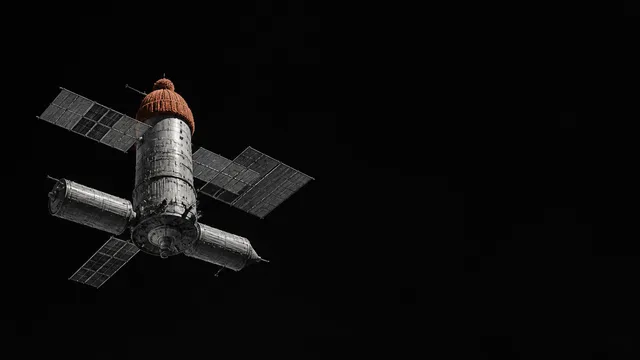
Space Stations Beyond the ISS: A Forgotten History
From a Cold War spy base to a Soviet ice rescue to China's chicken-wing oven in orbit — the real history of space stations is wilder than you think.

Curiosity at Sol 4948: Reading Mars Like a Genome
Curiosity Rover hit Sol 4948 in Gale Crater. What its mineralogy tells us about Mars' chemical autobiography—and why that question is getting urgent.