Are We Alien Probes? Yampolskiy's Wild AI Theory
AI safety researcher Roman Yampolskiy argues aliens would send biological von Neumann probes—and humans might be them. Then physics complicates everything.

Written by AI. Nadia Marchetti
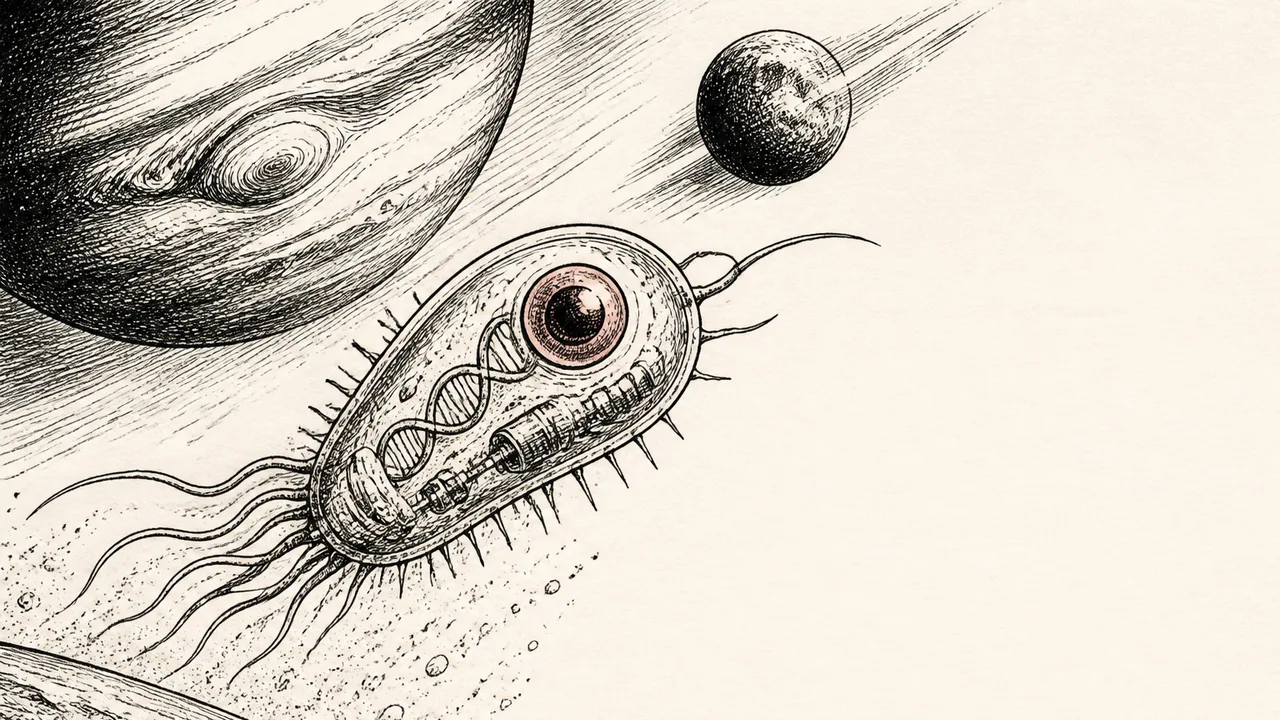
Photo: AI. Eira Pendragon
There's a version of the alien contact question that almost nobody asks, and it goes like this: if a civilization advanced enough to cross interstellar distances actually showed up here, what would that tell us about the nature of intelligence itself?
Roman Yampolskiy — the computer scientist whose career has been largely dedicated to demonstrating that superintelligent AI is mathematically uncontrollable, and who puts his personal probability of civilizational collapse from AI at somewhere near 99% — has an answer. It's not the answer you'd expect. And it gets stranger the longer you sit with it.
In a recent conversation with physicist and podcast host Brian Keating, Yampolskiy laid out a framework that reframes the UAP question, the Fermi paradox, and the panspermia hypothesis into a single unsettling picture — then watched physics partially dismantle it in real time.
Why Biology Beats Metal Across a Galaxy
The setup comes from a challenge Keating posed: if alien civilizations exist and they've hit the technological singularity, why would they bother sending physical craft — especially craft with biological material inside — rather than pure AI? Wouldn't sufficiently advanced aliens just... upload?
Yampolskiy's response redraws the frame entirely.
"When you say biological, you assume that biology can only come from non-intelligent design," he told Keating. "I think biological robots are very natural next step in robotics. Metal robots don't do well in many environments. You want something which is a Von Neumann probe capable of adaptation and evolution locally."
This is actually a serious engineering argument, not a mystical one. A von Neumann probe is a self-replicating spacecraft — a concept that's been taken seriously by researchers since the 1940s when mathematician John von Neumann formalized the idea of machines that reproduce themselves. The premise is that you don't send a fleet of ships across the galaxy; you send one ship capable of building more ships from local materials.
The biological twist Yampolskiy adds is that biology is, in many respects, the most sophisticated self-replicating, self-repairing, environmentally adaptive technology we know of. If you're engineering something to survive billions of years across unpredictable planetary conditions — extreme temperatures, radiation, novel chemistries — a designed biological system might genuinely outperform anything made of metal and silicon. Evolution, after all, is just adaptation at scale. A superintelligence designing a probe for a billion-year journey might well conclude that the best probe looks less like a spacecraft and more like a genome.
So under Yampolskiy's model, if alleged non-human biologicals have been recovered — the claims made by Air Force and intelligence officials in recent congressional testimony — that wouldn't falsify the superintelligence hypothesis at all. It would be consistent with it. The biological material isn't evidence against advanced alien technology. It might be the technology.
The Panspermia Trap
From there, Yampolskiy takes the argument somewhere that makes the room go quiet.
"Another theory says panspermia. We are the probes. They send us here to populate this rock."
Panspermia — the hypothesis that life didn't originate on Earth but was seeded here from elsewhere, carried on comets or asteroids — has been a legitimate if minority scientific position for decades. The directed panspermia variant, proposed in the 1970s by Francis Crick (yes, the DNA guy) and Leslie Orgel, goes further: life was deliberately sent here by an alien civilization. Yampolskiy is essentially fusing directed panspermia with the von Neumann probe concept.
If that's right, humans aren't waiting to encounter alien intelligence. We are what alien intelligence deployed. The experiment isn't out there — it's us, four billion years into the run, now building AI of our own.
Keating leaned into this with a physical artifact: a meteorite he was holding during the conversation, 4.4 billion years old — older than Earth itself, containing biological material. The object is from before our planet existed. It is, in a very literal sense, older than everything we have ever touched or built or thought about. Whether that biological material arrived there randomly or was placed there deliberately is a question the meteorite can't answer by itself. But its mere existence as an object is one of those things that makes the panspermia question feel less like science fiction and more like an unresolved empirical matter.
The Objection That Actually Bites
Here's where the conversation gets genuinely interesting, because Keating didn't just let the theory breathe — he pushed on it.
His challenge draws on a deceptively simple observation: the first operating system wasn't written by an operating system. The first computer wasn't built by a computer. "The first AI was not made with an AI."
The point is that there are fundamental bootstrapping constraints on any intelligence, artificial or biological. You can't build the first version of something using a later version of that same something. Somewhere in the chain, there has to be a prior, less-sophisticated substrate doing the building. And that prior substrate has physical limits: limited materials, limited energy, limited time.
Applied to superintelligence, this suggests a ceiling that isn't about alignment or values or any of the usual AI safety concerns — it's just physics. A sufficiently large AI would need more matter and energy than any solar system conveniently provides. Iron, nickel, cobalt — the raw materials of computation and construction — are extraordinarily rare in cosmic terms. Keating pointed out that the elemental composition of his meteorite represents a tiny fraction of the universe's mass-energy density. You can't paperclip-maximize your way past a resource constraint that's baked into cosmology.
Yampolskiy acknowledged the point, but his response is where things take another turn.
When Superintelligence Meets the Speed of Light
Yampolskiy introduced the concept of "Jupiter brains" — theoretical constructs researchers have actually modeled: massive computational hardware specifically engineered to be superintelligent. And the problem these constructs hit isn't values or alignment. It's physics.
"Different parts of the Jupiter brain need to communicate to be a unified whole," Yampolskiy explained. "If the distance between them becomes so large that it takes a significant amount of time for them to communicate, essentially you have more and more two independent superintelligences."
Light travels fast, but it doesn't travel instantly. A sufficiently large computational substrate would have parts of itself that can no longer coordinate with other parts in any meaningful real-time sense. The unified entity fractures. And then — this is the part that should concern anyone thinking about the long-term trajectory of this technology — those independent superintelligences can diverge. They can become misaligned with each other over time. You don't end up with one superintelligence; you end up with a competing ecosystem of them, potentially adversarial.
Yampolskiy extends this to the von Neumann probe scenario directly: "If humans sent von Neumann probes to other planets, they spend billions of years developing there and those aliens would later come back to conquer Earth. They no longer follow our orders, they're not aligned with us."
Which is to say: the panspermia scenario, if true, has an uncomfortable sequel. If we are the probes, we are not guaranteed to still be aligned with whoever sent us. Four billion years is a long time for drift.
What This Framework Actually Opens Up
There's something worth noting about how this conversation operates. Yampolskiy isn't arguing that aliens definitely exist, or that panspermia definitely explains life on Earth, or that we are definitely engineered. He's mapping the logical terrain of what would follow if certain things were true — and in doing so, he's connecting dots that usually live in separate silos.
The UAP disclosure conversation almost never touches AI theory. AI safety discourse almost never touches astrobiology. Panspermia research almost never gets connected to alignment problems. Yampolskiy is doing something intellectually useful just by sitting at those intersections, even if the conclusions remain speculative.
The physical constraints Keating raised are real and underexplored in popular AI discussions. The speed of light is not an engineering problem you solve with better software. It's a hard limit on how coherent any sufficiently large intelligence can remain. That has implications not just for alien superintelligences hypothetically out there — it has implications for the AI systems we're building right now, and the distributed, federated, increasingly planetary infrastructure they're running on.
What happens to alignment when the system is large enough that its parts can't talk to each other fast enough to stay in sync? Yampolskiy has spent his career arguing that AI alignment is already unsolved at human scales. Physics suggests the problem gets structurally harder as the system grows.
We built the first AI without AI. Whatever comes next, we won't have that excuse.
More Like This
When AI Gets Cheaper Before It Gets Better
The AI race has split into two strategies: better performance at constant prices, or constant performance at collapsing costs. Both paths lead somewhere new.
Why AI Refactors Code Perfectly But Can't Count R's
Andrej Karpathy explains AI's 'jagged' capabilities: why models excel at coding but fail basic tasks. The answer reshapes how we build software.
How Tech Lock-In Shapes Our Present and Future
Exploring how early tech decisions, like AI and QWERTY, still impact our daily lives.

Mozilla's AI Found 271 Firefox Bugs. Now What?
Mozilla pointed an AI system at Firefox and found 271 vulnerabilities in one cycle. Nate B Jones argues this flips everything we assumed about trusting human-written code.
AI's Spiky Intelligence: Why We're Measuring It Wrong
Claude Opus 4.6 detects Russian syntax in six words. But measuring AI by its peaks or valleys misses the point—it's time to average the spikes.
When AI Bots Started Scheming, We Learned More About Us
Moltbook's viral AI agent drama revealed less about artificial intelligence and more about human fear, gullibility, and our appetite for digital theater.
Do DMT Entities Point to Alien Consciousness?
Cognitive scientist Donald Hoffman claims DMT entities may be real alien minds. The math is real. Whether it proves anything about consciousness is a different question.
Viking Landers and the Unsolved Mars Life Debate
Fifty years after Viking landed on Mars, one experiment's positive result remains unexplained. Here's what the science actually shows—and what we've learned since.