Red & Black Knights: A Chess Math Problem Gone Wild
Neil Sloane and Jonas Karlsson's two-color knight placement problem produces stunning emergent order from brutally simple rules. Here's what actually happens.

Written by AI. Priya Sharma
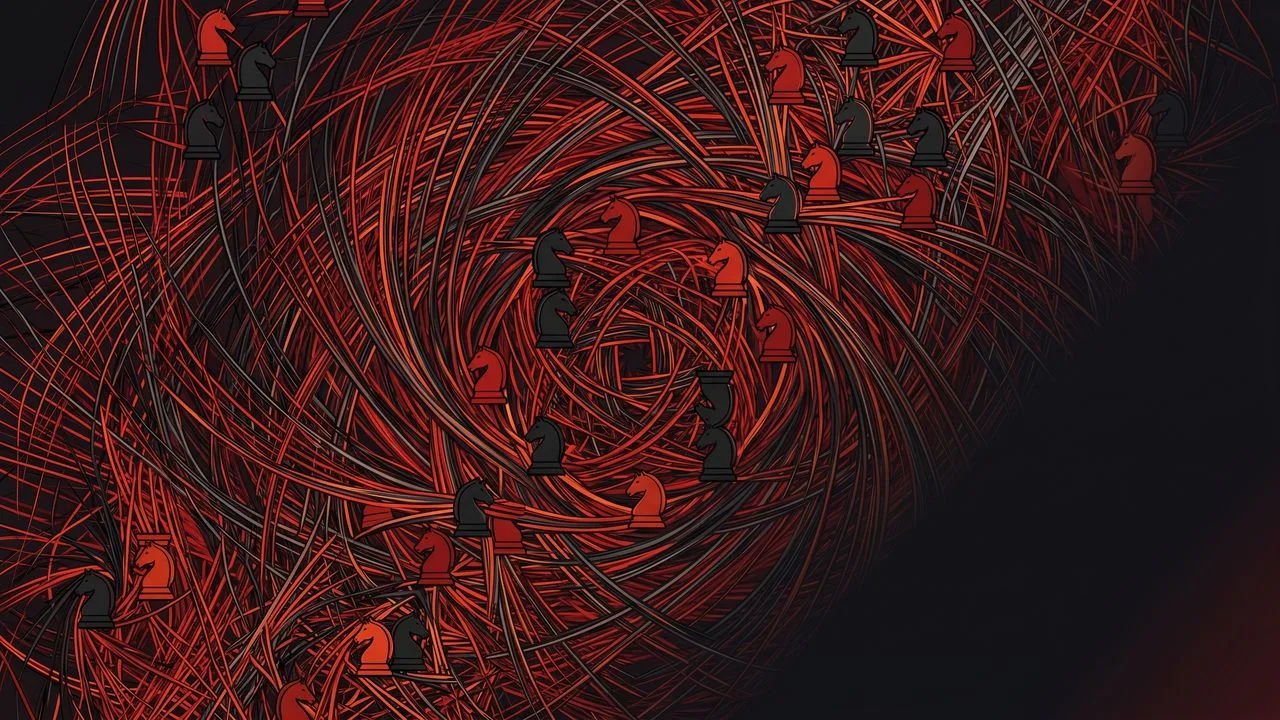
Photo: AI. Dexter Bloomfield
There is a particular category of mathematical result that makes you feel briefly suspicious of the universe. Not because it's paradoxical, exactly, but because the gap between the simplicity of the rules and the complexity of the outcome seems too wide to be honest. The red and black knights problem sits firmly in that category.
The setup, as described by Neil Sloane—founder of the On-Line Encyclopedia of Integer Sequences and a man who has spent a career cataloguing mathematical surprises—is almost aggressively simple. Take an infinite chessboard. Number every square along a spiral starting from zero. Now place two competing armies of knights, alternating turns, each color claiming the lowest-numbered unoccupied square that isn't under attack by the opposing color. That's it. That's the whole rule.
What happens next took researchers from a thousand squares to 64 million before the picture became clear.
The Single-Knight Prelude
Sloane opens the Numberphile video with a well-established predecessor problem: the Trapped Knight. A single knight on the spiral-numbered board must always move to the lowest-numbered square it hasn't yet visited. The knight traces what looks like an ongoing path—until, after a finite number of moves, it finds itself completely surrounded by squares it has already visited. Every possible knight's move leads somewhere it has been. The sequence terminates. A deterministic rule, applied faithfully, produces a path that digs its own grave.
That problem has a settled answer. Today's problem does not, quite, and that distinction matters.
One Color, Then Two
Before getting to the two-color version, Sloane works through a single-color variant: place a knight on any unoccupied square that isn't attacked by any existing knight. No competition, just polite, non-threatening knights spreading across the board. The result, visualized after a thousand squares, is a precisely periodic structure—clusters of five knights separated by singles in one quadrant, alternating clusters of two and four along certain axes. Clean, almost architectural. "Pretty but regular," as Sloane puts it.
Predictability, in mathematics, is not always boring. But it is, in this case, a foil.
When Jonas Karlsson—a Swedish mathematician who brought this problem to Sloane's attention—introduced two colors with competing placement rules, the periodicity evaporated. The rule change is minimal: black knights avoid squares attacked by red knights, red knights avoid squares attacked by black knights, each ignoring threats from their own color. They alternate. The board is the same spiral. The greedy "lowest available square" logic is unchanged.
"Jonas said, 'This blows my mind. This is so incredible,'" Sloane recounts.
He wasn't overstating it.
What Disorder Looks Like at Scale
At 1,000 squares, the two-color board looks like a mess. One quadrant is predominantly red. Another is predominantly black. A third is chaotic, thoroughly mixed. There's no obvious structure, no hint that anything will resolve. If you were pattern-hunting, you'd probably conclude this was simply noise—a pseudo-random scatter driven by the slightly asymmetric geometry of a spiral.
At 100,000 squares, something has changed. The chaos hasn't disappeared, but it has reorganized. A distinct strip of pure red has carved itself out. A strip of pure black sits adjacent. In between, mixed territory persists—what Sloane and his collaborators call "islands," isolated patches that haven't yet committed to either color.
At one million squares, the islands are still there, but the strips have widened. The pure zones are asserting themselves more forcefully.
At 64 million squares, the picture snaps into something that looks almost political, which is not a metaphor Sloane resists. Two full quadrants of the infinite board are solid black. The top half is solid red. Between them, thin strips of undecided territory—squares that remain unoccupied or mixed. Sloane invokes Stendhal's Le Rouge et le Noir, where red represents the military and black the church, the two competing paths for an ambitious young man in post-Napoleonic France. The analogy is more apt than decorative: a world that begins in apparent chaos eventually hardens into rival territories with contested borders.
"It's very unexpected that for so long it was making patterns," the interviewer observes, "and then it suddenly just said, 'No, that's it. We're done.'"
Sloane's response is precise: "It's contagious."
What We Don't Know
The visual evidence is striking, but the mechanism is not well understood. Why do pure strips emerge? Why do they form where they do? Why does the system take tens of millions of iterations to reach an apparently stable configuration, when the rules are fixed from step one?
These are genuinely open questions. Sloane and collaborators, including mathematician Michael Branicki who contributed visualizations at the million-square scale, have documented what happens. The why is a different matter. The OEIS sequences associated with this problem (A392177 and A392178 for the red and black knight positions, A395357 for the final spiral) record the results without explaining the structure.
This is not a criticism of the work—documenting the phenomenon rigorously is the necessary first step. But it's worth being clear about what this is: a computational discovery, not yet a theorem. The images are suggestive, even convincing. They are not proof that the large-scale segregation continues indefinitely, or that the boundary strips remain thin, or that no further phase transitions occur at scales beyond 64 million. Those are conjectures implied by the data, not conclusions established by analysis.
The single-color case reaches a periodic steady state that can be described exactly. The two-color case appears to reach a different kind of steady state—large-scale segregation—but the mathematical argument for why that must happen, and what form it must take, remains open as far as this problem's current documentation suggests.
The Three-Color Question
Near the end of the video, the interviewer asks the obvious next question: has anyone tried three colors?
Sloane's answer is a small masterpiece of mathematical honesty. He doesn't know yet. He notes that the square geometry of the chessboard gave the two-color problem natural quadrant symmetry to settle into—two colors, four quadrants, a clean resolution. Three colors have no such obvious landing geometry. "Will it settle?" is a genuine question. "How will three colors settle?" is an even better one.
The bonus video on Numberphile 2 apparently shows results. But the fact that Sloane frames it as "I'll investigate" rather than "here's what happens" is informative. Some of these problems have answers that take serious computational work to surface, and even then they raise more questions than they answer.
That gap—between a rule simple enough to explain in a minute and a consequence requiring 64 million iterations to see clearly—is where this class of problem lives. It's also, if you're inclined to think about it this way, a fairly compact illustration of why emergence remains one of the more philosophically uncomfortable concepts in mathematics and physics. The rules do not obviously contain the outcome. The outcome is, in a technical sense, inevitable once the rules are fixed. But "inevitable" and "predictable" are not the same thing, and the difference between them is most of the interesting work.
Whether three colors settle, and into what shape, is the question that makes this more than a curiosity about chess pieces.
More Like This
The Mind-Bending Magic of Banach-Tarski
Explore how the Banach-Tarski paradox challenges our understanding of volume, infinity, and math's quirks.

Exploring Mercury's Mysteries: From Alchemy to Modern Science
Discover the unique properties of mercury, its historical significance, and intriguing experiments in Andrew Szydlo's lecture.
This Geometry Puzzle Has Nine Solutions (Here Are Two)
A deceptively simple triangle problem reveals why some mathematical puzzles resist single approaches—and what that tells us about how we solve problems.
How Big Is a Rubik's Cube? Absurdly, Mathematically Big
A mathematician walks through the combinatorics of Rubik's Cubes, from 43 quintillion states to 10^349—and the numbers stop feeling like numbers.

Unlocking New Skills After 50: The 'Pillar & Playground' Approach
Explore how the 'Pillar & Playground' method helps those over 50 learn efficiently, leveraging crystallized intelligence and cognitive flexibility.
The Rogers-Ramanujan Identity: Beauty in Partition Theory
A math professor's classroom moment reveals why the Rogers-Ramanujan identity—linking partition types through generating functions—is genuinely surprising and beautiful.

Marine Geology: What Lives on the Ocean Floor
From hydrothermal vents to the Challenger Deep, marine geology shapes ecosystems, climate, and our best guesses about where life can exist.

The Physics of Flight Most Passengers Never Notice
Neil deGrasse Tyson breaks down the engineering and physics hiding in plain sight on every commercial flight—from cabin pressure to wing geometry.