How the Square Root of 2 Shook Ancient Greek Mathematics
The Pythagoreans believed whole numbers governed all of reality. One diagonal line—and one brave mathematician—proved them catastrophically wrong.

Written by AI. Helen Papadopoulos
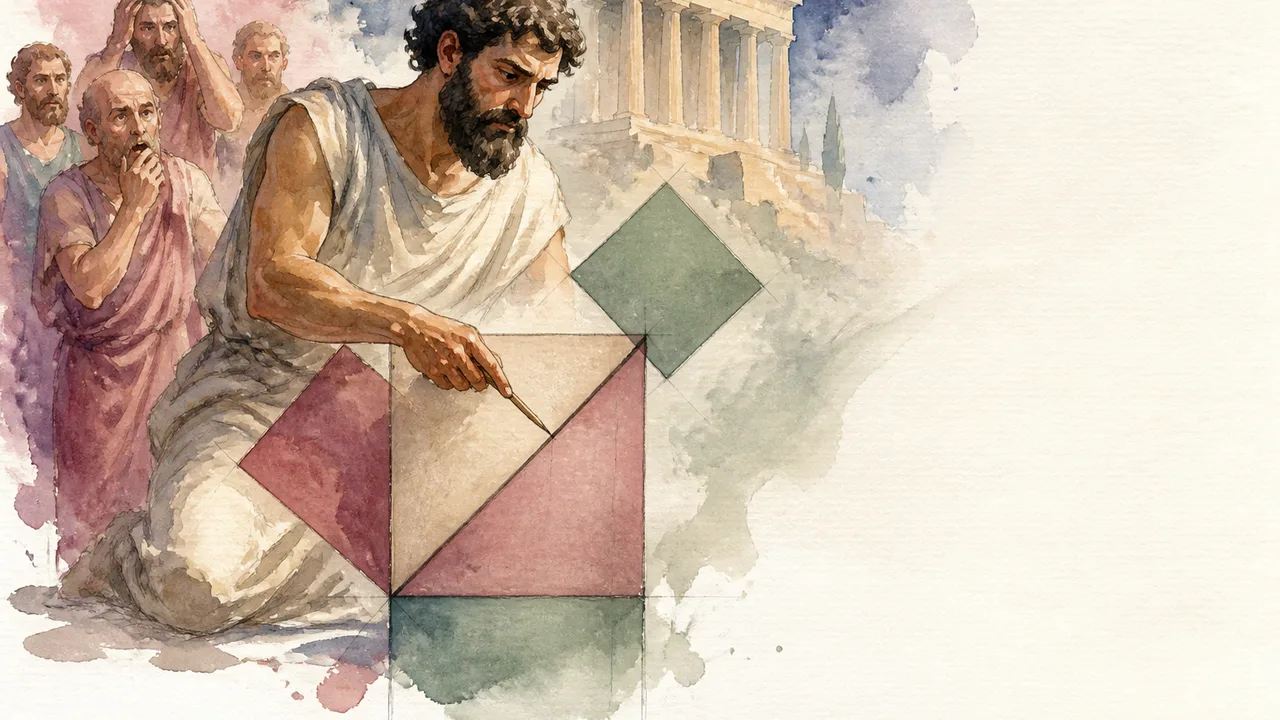
Photo: AI. Júlia Almeida
The ancient Greeks had a word for it: alogon. Unspeakable. Without ratio. It was the category they invented for things that shouldn't exist—and then desperately tried to pretend didn't.
A recent video from the STEM in Motion channel by Gaurav traces the full, strange arc of what happened when the Pythagoreans ran headlong into √2, and it's a story that rewards close attention. Not because it's a tidy parable about the triumph of truth over dogma—it's messier than that—but because it illuminates something the ancient Mediterranean world genuinely understood better than we usually credit: that mathematics is not merely calculation. It is cosmology.
A Brotherhood With Strong Opinions About Beans
Around 500 BCE, Pythagoras established what we might generously call a philosophical school in the southern Italian city of Croton. "Philosophical school" undersells it considerably. As the video notes, this was "closer to a religious order"—members took vows, observed strict dietary prohibitions (beans were forbidden, for reasons that remain endearingly obscure), and believed in the transmigration of souls. At the center of their theology sat one axiomatic conviction: everything is number.
This wasn't metaphor. The Pythagoreans meant it literally. Whole numbers and their ratios were, in their framework, the actual structural material of reality. They had evidence, or what looked like evidence. When they plucked a monochord string and then plucked exactly half of it, the interval was a perfect octave. Pluck two-thirds and you get a perfect fifth. The ratios 2:1, 3:2, 4:3—these were not coincidences. They were the grammar of the cosmos. If the most beautiful sounds in nature reduced to such clean whole-number relationships, why wouldn't everything else?
The Pythagoreans called it the "music of the spheres"—a literal harmonic order governing planetary motion. Their sacred symbol, the tetractys, was a triangular arrangement of ten dots in rows of 1, 2, 3, and 4, whose sum represented the complete order of the universe. It was an elegant, self-consistent system. It was also, as it turned out, wrong about something fundamental.
What Hippasus Found
The crisis arrived via the diagonal of a unit square—a shape so simple a child could draw it. The Pythagorean theorem itself, their own tool, established that if a square has sides of length 1, the diagonal must have length √2. The question Hippasus of Metapontum reportedly pursued was whether that length could be expressed as a ratio of two whole numbers. Call it a/b in lowest terms.
The proof that it cannot is one of the oldest complete logical arguments in mathematical history, and it still has a satisfying ruthlessness to it. Assume √2 = a/b in lowest terms. Square both sides: a² = 2b². Since a² is even, a must be even—write it as 2c. Substitute back: 4c² = 2b², so b² = 2c², which means b is also even. But a and b were supposed to share no common factors. They can't both be even. The assumption has eaten itself. √2 is not a ratio of whole numbers. It cannot be. It is, in the Pythagorean vocabulary, alogon.
What happened to Hippasus after this discovery is where the ancient sources disagree in ways that historians find instructive. One tradition has the brotherhood expelling him and constructing a symbolic tomb while he still lived—declaring him dead to the order. Another, recorded by the late-antique biographer Iamblichus, claims he actually drowned at sea, either murdered by the brotherhood or destroyed by divine retribution. The STEM in Motion video is candid about scholarly skepticism here: the drowning story reads more as literary myth-making than biography. The man who let chaos into the world was swallowed by the sea, which the ancient Greeks understood as the primal symbol of chaos. The narrative is too perfect to be trusted.
What is not disputed is that the discovery created a genuine intellectual crisis lasting, by some accounts, nearly two centuries.
The Wound and Its Repair
Here is the tension worth sitting with: the Pythagoreans' response to Hippasus—whether expulsion, murder, or social annihilation—was an attempt at suppression. And yet the proof Hippasus produced, the reductio ad absurdum, became one of the most generative techniques in the history of mathematical reasoning.
Gaurav's video puts it sharply: "In their desperate attempt to bury the diagonal, the Pythagoreans accidentally gave mathematics one of its sharpest weapons." The logic of reductio ad absurdum—assume the opposite of what you want to prove, follow the consequences until they contradict each other, conclude the assumption was false—became foundational to Greek mathematical practice and remains so today. The attempt to suppress a truth produced the instrument that makes truths unsuppressable.
The immediate aftermath was less triumphant. Greek mathematics depended on a theory of proportion—the relationships between lengths, areas, ratios—that assumed any two lengths shared some common unit. Once that assumption failed, the scaffolding wobbled. Mathematicians had √2 drawn on papyrus; they had no coherent way to talk about what kind of thing it was.
The resolution came from Eudoxus of Cnidus, working in the fourth century BCE. His approach was elegant in its refusal to name what it couldn't define. Rather than asking what numerical value an irrational length had, Eudoxus compared ratios directly, using whole-number scaling to determine whether two ratios were equal, greater, or lesser—without ever assigning a number to the irrational quantity itself. He sidestepped the problem by operating at a higher level of abstraction. His work became Book V of Euclid's Elements and was studied for the next two millennia.
The reach of Eudoxus' insight is genuinely remarkable. In 1872, the German mathematician Richard Dedekind was working on a rigorous foundation for irrational numbers. His method—splitting the rational numbers into two classes, everything below and everything above an irrational value—proved, on examination, to be structurally identical to the ancient Greek approach. Different notation, different century, the same underlying architecture of thought. There is something almost unsettling about that: the idea that Eudoxus had reached so far ahead that it took Western mathematics two thousand years to catch up to where he was standing.
Before the Greeks, the Babylonians
One of the sharper historical points in Gaurav's account is also the easiest to overlook: the Pythagoreans did not discover the square root of two. The Babylonians had it millennia earlier.
A clay tablet from roughly 1800-1600 BCE—known today as YBC 7289 and held at Yale—records √2 to what amounts to six decimal places, in the base-60 numerical system Babylonian mathematicians used. Other tablets from the same period document a strikingly efficient iterative method for calculating it: start with a guess, divide 2 by the guess, average the result with the guess, repeat. The number of correct decimal places roughly doubles with every iteration—what mathematicians now call quadratic convergence. Modern computers use a variant of this same algorithm.
For the Babylonians, the video notes, this "was simply a useful calculation." The square root of two was a measurement, a practical tool. It did not threaten their cosmology because their cosmology was not staked on the claim that all measurements reduce to whole numbers. They had no alogon because they had no equivalent theology of number.
Which raises a question the video gestures toward without quite pressing: how much of the Pythagorean crisis was mathematical, and how much was theological? The discovery that √2 is irrational would have been, in purely practical terms, a non-event—the Babylonians had proved as much by treating it as one. What made it catastrophic was the specific claim the Pythagoreans had attached to whole numbers: that they were not merely useful, but ontologically necessary. The universe had to be built from them, because the Pythagoreans had decided it was.
Strip the theology, and the diagonal of a unit square is just a length. Attach to whole numbers the entire weight of cosmic order, and that length becomes a threat.
What a Sheet of Paper Knows
There is, as the video concludes, a quietly satisfying coda to all this. The ISO 216 standard that governs A4 paper—the format used across most of the world for printing, correspondence, and bureaucratic suffering—is built around a ratio of 1:√2 between the short and long sides. This is not coincidence. It is the only ratio at which halving a rectangle along its short side produces a smaller rectangle with identical proportions. Cut A4 in half and you get A5. Scale it up and you get A3. The ratio is self-similar across every doubling.
A global paper standard, codified in the twentieth century, runs on a number the Pythagoreans called unspeakable.
The history of √2 is, at one level, a history of institutional resistance to a mathematical fact—and of how uselessly that resistance tends to go. But it is also a history of the concepts that got built in the course of that resistance: proof by contradiction, the theory of proportion, the foundations of real analysis. The tools came out of the struggle. What Hippasus exposed was not just the irrationality of a number but the fragility of the assumption that a sufficiently elegant theory of the world is the same thing as a true one.
The Pythagoreans were not wrong that mathematics reveals deep structure. They were wrong about which structures were permitted.
More Like This
WW1 Trench Life: What the Western Front Was Really Like
From Pals' Battalions to the Vickers gun, a new documentary unpacks the grim machinery of survival on the WW1 Western Front in unflinching detail.
Why Proving 1+1=2 Took Mathematicians 362 Pages
Whitehead and Russell spent 362 pages proving 1+1=2. Their story is about what happens when you actually audit the axioms everyone told you were obvious.
The Deeper Geometry Behind the Pythagorean Theorem
Explore why the Pythagorean Theorem appears in unexpected places, from geometry to relativity.
Asherah: Was She the Wife of the God of Israel?
Inscriptions, figurines, and Ugaritic myth suggest ancient Israelites worshipped a goddess alongside Yahweh. The evidence is real. The debate is very much alive.
The Formula You Memorized Was Hiding Calculus
Why does differentiating πr² give 2πr? The answer reveals the deepest structural idea in mathematics—and it was hiding in plain sight all along.

Chaitin's Omega: The Number That Knows Everything
Chaitin's Omega encodes answers to every mathematical question—yet its digits are provably uncomputable. Here's what that actually means, and why it matters.

The Divine Feminine's Long Return in Western Religion
From Tiamat to the Shekhinah to the Virgin Mary, Dr. Justin Sledge traces the suppressed and resurgent divine feminine across millennia of Western religious history.
Stoicism as a Political Philosophy, Not a Retreat
Massimo Pigliucci argues Stoicism's dichotomy of control isn't passive resignation—it's a framework for smarter, more durable political engagement.