Asherah: Was She the Wife of the God of Israel?
Inscriptions, figurines, and Ugaritic myth suggest ancient Israelites worshipped a goddess alongside Yahweh. The evidence is real. The debate is very much alive.

Written by AI. Helen Papadopoulos
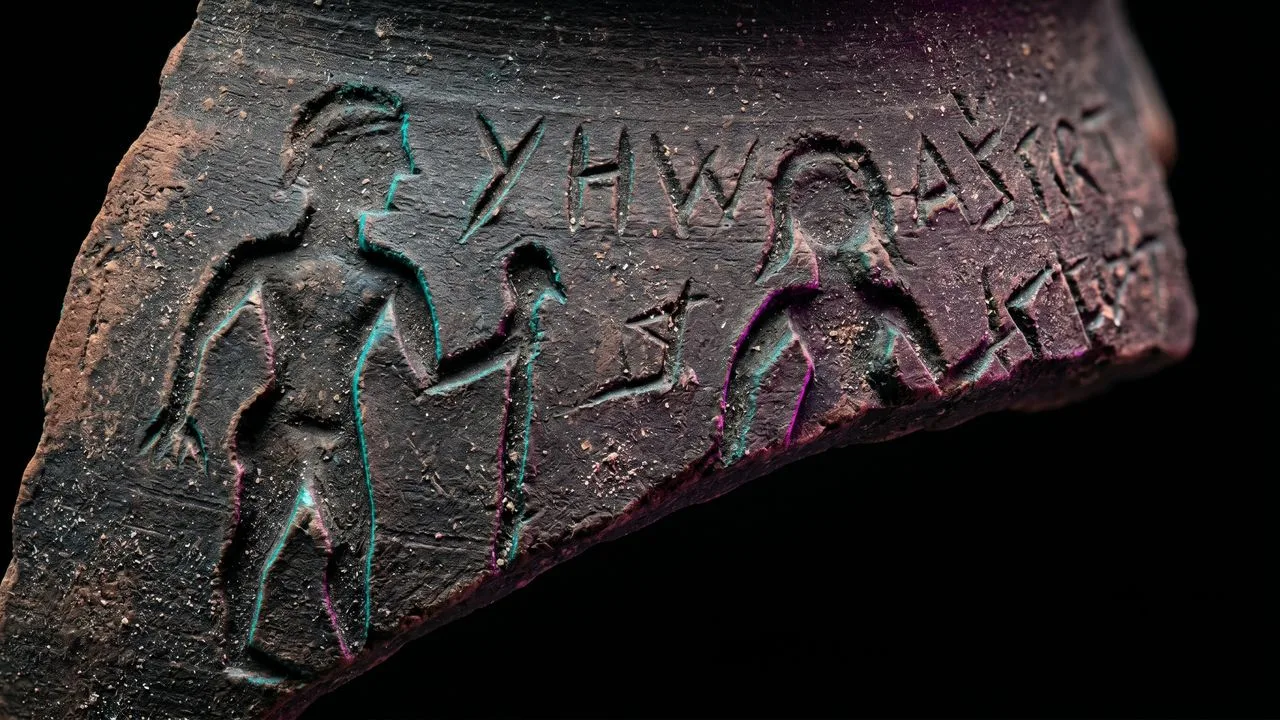
Photo: AI. Pippa Whitfield
Scratched onto a large storage jar unearthed at Kuntillet Ajrud, a remote site in the Sinai Peninsula, is an inscription in ancient Hebrew that reads: I bless you by Yahweh of Samaria and by his Asherah.
His Asherah.
That possessive pronoun has been generating scholarly argument for decades, and with good reason. Asherah was a goddess—not a minor household spirit but one of the most consequential divine figures across the ancient Near East, the consort of the high god El and, according to the Ugaritic texts from the 13th and 12th centuries BCE, the mother of the seventy divine sons, the creatress of the gods, the kingmaker who determined who sat on the divine throne. The inscription at Kuntillet Ajrud implies, at minimum, that some ancient Israelites understood Yahweh to have a divine partner, exactly as El did in Canaanite religion. Whether that implication holds up under scrutiny—and what it would mean if it did—is the terrain the ReligionForBreakfast channel covers in a recent thirty-two-minute video on Asherah's history, iconography, and contested presence in Israelite religion.
It is, to put it plainly, one of the more genuinely interesting questions in biblical archaeology.
Who Asherah Was Before the Israelites Got Involved
The Ugaritic texts give us the clearest pre-Israelite portrait of the goddess, under her Ugaritic name Athirat. She is El's queen and the mother of his divine children. She is called "the lady of the sea" and "the lady who tramples the sea serpent"—titles that may, some scholars argue, preserve traces of an even older cosmic role. In the Baal Cycle, the most dramatic surviving Ugaritic mythological text, her most important scene arrives when the storm god Baal needs El's permission to build a royal palace. Baal and the warrior goddess Anat fail to extract that permission themselves. They must go to Athirat, bringing gold and silver gifts, and she is the one who successfully petitions El. "Our king is mightiest Baal, our ruler with none above him," she tells El, securing Baal's kingship. Later, when Baal is consumed by Mot, the god of death, it is again Athirat who decides his successor. She names her own son.
She is not, in other words, a decorative maternal figure. She is the political center of the Ugaritic divine court.
Her roots extend considerably further back. Babylonian sources from roughly six or seven centuries before the Ugaritic texts name a goddess Ashratum as the consort of Amurru, the chief deity of the Amorites, describing her as "the bride of the king of heaven" and "mistress of sexual vigor and rejoicing." A form of her was worshipped by the Hittites in Anatolia. By the time she appears in the Baal Cycle around 1200 BCE, she had already been venerated for centuries across a wide swath of the ancient Near East—from Babylon to the Syrian steppe to the Lebanese coast.
The Problem with the Hebrew Bible as Evidence
The Hebrew word asherah appears forty times in the Hebrew Bible, and here is where things get genuinely complicated. Some passages clearly describe a goddess with her own priesthood—in 1 Kings 18, four hundred prophets of Asherah eat at Queen Jezebel's table, which only makes sense if Asherah is a deity with an organized cult. But other passages describe what sounds more like a cultic object, a wooden pole planted in the ground near an altar. Deuteronomy 16:21 says, "You shall not plant any tree as an asherah"—a strange prohibition if asherah referred only to a divine being.
This ambiguity is not a translation problem to be tidied up. It runs through the entire Hebrew textual tradition. Scholars such as Judith Hadley have pointed out that the biblical references to asherahs are not internally consistent—sometimes the object seems to be a living tree, sometimes a carved pole, sometimes something in between. One influential reading, associated with scholar Saul Olyan, dissolves the distinction entirely: to install the asherah pole was to install the goddess; to cut it down was to expel her. The symbol and the deity were not separable in the logic of ancient Israelite ritual any more than a standing stone—an upright unworked rock that signaled divine presence without depicting it—was separable from the god it marked.
What the biblical text does make unmistakably clear is that asherah worship was persistent. The Deuteronomistic history—the editorial framework shaping Joshua, Judges, Samuel, and Kings—judges every king of Israel and Judah on a single criterion: did he tolerate the asherahs or destroy them? As the video astutely notes, "you don't repeatedly forbid what nobody is doing." King Manasseh apparently placed a carved image of Asherah inside the Jerusalem temple itself, where it stood for roughly fifty years. When King Josiah launched his late seventh-century reform campaign, the demolition project was kingdom-wide: vessels for Baal, for Asherah, and for the host of heaven were burned outside Jerusalem; the asherah was removed from the temple, beaten to dust, and thrown on the graves of common people; guilds of women who had been weaving hangings for Asherah within the temple precincts were disbanded.
The scale of what Josiah destroyed tells you something about the scale of what had been there.
What the Figurines May or May Not Tell Us
Over a thousand small clay female figurines have been excavated in domestic contexts across ancient Judah. They date primarily to the eighth and seventh centuries BCE—the same period as the Kuntillet Ajrud inscriptions. Each is roughly four to eight inches tall, with a pillar-shaped lower body, no legs, and prominently supported breasts. They have been found in wall niches, under floors, in domestic and public spaces, concentrated almost entirely within Judah's borders, with hundreds from Jerusalem alone.
The question of what they are has generated its own scholarly cottage industry. William Dever argues they represent Asherah: the pillar base evokes the sacred tree; the prominent breasts echo her role as "wet nurse of the gods" in the Ugaritic texts. For Dever, these are the material evidence of a folk religion practiced by ordinary Judahite households alongside official temple worship—what he calls a "tale of two religions."
Archaeologist Erin Darby pushes back. The logic—figurine with breasts, therefore goddess, therefore Asherah—involves too many inferential leaps. Ancient Near Eastern ritual practice shows that figurines typically represented low-level intermediary beings, not high gods. Darby asks a different question: not which goddess does this depict, but what did people actually do with this object, and why? Her answer points toward protective household ritual—childbirth, illness, crisis—without requiring a named divine identity.
More recently, Dr. Lauren McCormick has brought digital imaging techniques to bear on the figurines—reflectance transformation imaging, decorrelation stretch, photogrammetry—to detect tool marks and faint traces of paint invisible to the naked eye. Her findings complicate the standard interpretation in an unexpected direction: when rendered in color, the figurines' eyes, not their breasts, turn out to be the most carefully crafted feature. The pupils appear larger from the sides than from the front, as if the figurines are alive and watching. McCormack argues the figurines were hybrid supernatural creatures—more like cherubim than goddess portraits—whose function was to provide access to divine power without specifying whose divine power. "Having them in your home gave access to divine power without necessarily specifying whose divine power," the video summarizes. Both Darby and McCormack arrive, by different routes, at a similar conclusion: the intermediary function of these objects is clearer than their divine identity.
The Inscription and Its Limits
Which brings us back to Kuntillet Ajrud and the storage jar inscription. The phrase "Yahweh and his Asherah" appears not once but in multiple inscriptions at the site, which was probably a waystation or scribal school in the Sinai desert. The inscriptions are, as the video acknowledges, the most direct evidence we have of Israelites speaking about Asherah in their own voice rather than through the hostile filter of Deuteronomistic editors. They pair Yahweh and Asherah in the same breath.
But "his Asherah" is also grammatically peculiar in biblical Hebrew. A personal name cannot take a possessive suffix—you cannot say "his Yahweh." This has led some scholars to argue that asherah in the inscriptions refers to the cultic object rather than the goddess herself—that the phrase means "his asherah-pole," not "his divine wife." Others regard this grammatical argument as motivated reasoning, a way of retreating from an uncomfortable implication. The debate has not resolved.
What the evidence, taken together, does seem to establish is that the religious landscape of ancient Israel was considerably more diverse than the canonical biblical text presents. Whether that diversity included veneration of Asherah as a distinct goddess, or widespread use of asherah-objects that were understood to carry her presence, or protective household rituals using female figurines that may or may not have been connected to any named deity—these are different claims with different evidentiary bases, and scholars remain meaningfully divided on each.
The standard narrative of Israelite religion as monotheistic from its origins, with polytheism as a foreign corruption, is not what the archaeological record shows. What it shows instead is a religious world that was, to borrow a term from the video, deeply embedded with goddess-related practice for much of the Iron Age—practice that Josiah's reform movement worked very hard to erase, and that the Deuteronomistic editors worked equally hard to retroactively condemn.
The fact that we can still read around those condemnations, in inscriptions scratched onto storage jars by people blessing each other in Yahweh's and Asherah's name simultaneously, is itself a kind of archaeological gift. Whether Asherah was Yahweh's wife is a question the evidence circles without quite settling. Whether she mattered, deeply and persistently, to the people the Bible claims worshipped Yahweh alone—on that, the evidence is considerably less equivocal.
More Like This
WW1 Trench Life: What the Western Front Was Really Like
From Pals' Battalions to the Vickers gun, a new documentary unpacks the grim machinery of survival on the WW1 Western Front in unflinching detail.
Unraveling Rome's Dodecahedron Mystery
Exploring the enigmatic Roman dodecahedron, its theories, and historical significance in modern archaeology.
MLK: The Ancient Echoes of Justice and Leadership
Explore MLK's legacy through ancient lenses of justice and leadership. Discover unexpected connections.
The Gods of Pre-Islamic Arabia, In Their Own Words
Ancient desert inscriptions reveal the polytheistic world before Islam—gods, prayers, sacrifice, and fate, recorded by the nomads who lived it.

Did Rome's Elite Destroy It From Within?
A viral video argues Rome was "auctioned off" by its ruling class. The history is real—but the argument deserves a harder look than it gets.
Synagogues: Echoes of Faith and Architecture
Explore the architectural and historical journey of synagogues across the globe, reflecting Jewish resilience and cultural adaptation.
Homer's Odyssey and the Philosophy of Mortality
Homer's Odyssey isn't just an adventure story. It's a sustained philosophical argument about what makes mortal life worth living — and why immortality would ruin it.
Myth, Obsession, and the Men Who Dug for Troy
Arthur Evans and Heinrich Schliemann both found ancient civilizations while chasing myths. What does that tell us about archaeology—and obsession?