Einstein's Happiest Thought, Explained From First Principles
Adam Brown unpacks general relativity's core insight—gravity as curved spacetime—and what black holes reveal about energy, time, and the limits of physics.

Written by AI. Amelia Nwofor
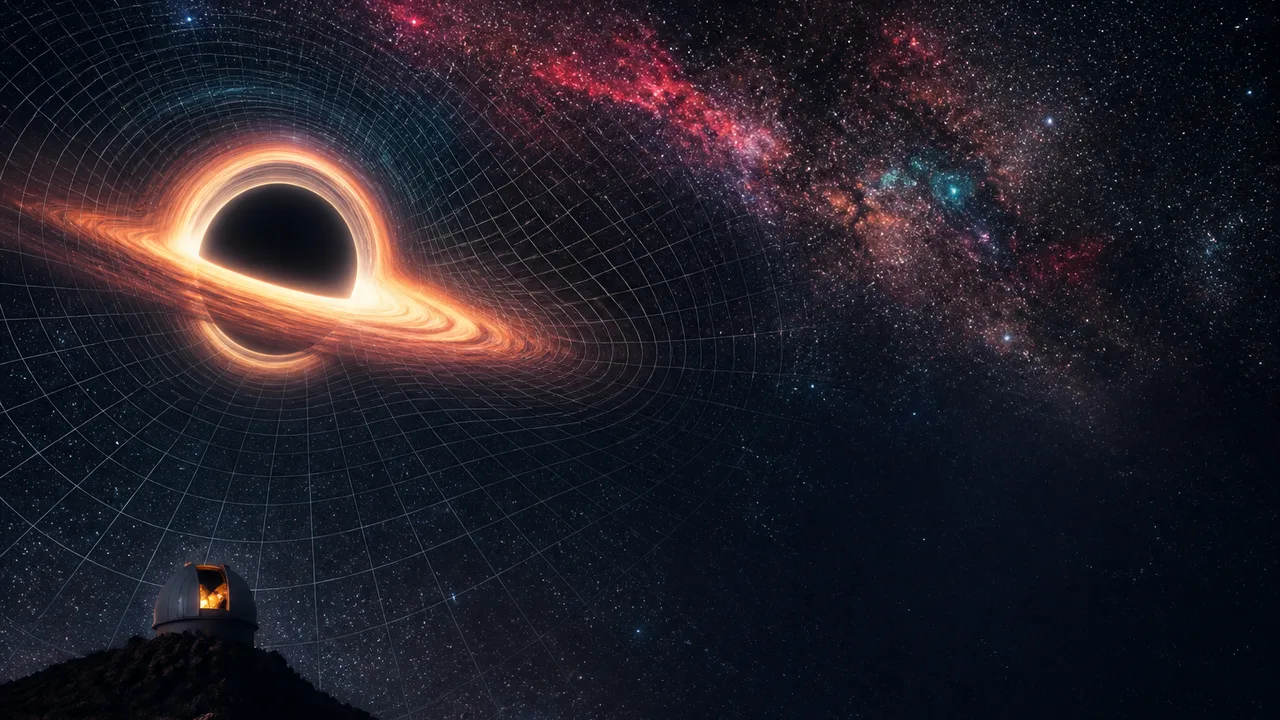
Photo: AI. Castor Belov
There is a coincidence sitting inside Newtonian physics that Newton noticed, shrugged at, and moved on from. The mass that resists being pushed around—inertial mass—turns out to be exactly equal to the mass that gravity pulls on—gravitational mass. Not approximately equal. Not equal within experimental error of the era. Equal, full stop. Newton measured it to roughly one part in a thousand and kept going.
Einstein couldn't keep going. That equality nagged at him for years, and the reason it nagged is precisely why it's worth understanding: in every other force we know, the "charge" that couples you to the force has nothing to do with how hard you are to accelerate. Electrons have enormous electric charge relative to their mass. Neutrons have zero electric charge despite having mass. The two quantities are simply unrelated. But with gravity, they're the same number. Always. For everything.
Adam Brown—who leads Blueshift, Google DeepMind's science and reasoning team, and who previously taught a graduate course on general relativity at Stanford—spent nearly two hours with Dwarkesh Patel recently unpacking why that coincidence isn't a coincidence at all. It's the load-bearing observation of the entire theory.
The "Happiest Thought"
Brown's explanation of how Einstein got from that observation to general relativity is, genuinely, the clearest version of this arc I've encountered outside a classroom. The key move is recognizing that there's a whole class of forces—inertial forces, like the centrifugal force you feel pressing you into a car seat on a sharp bend—that are guaranteed to couple to inertial mass. Not because of some deep law about that specific force, but because inertial forces are your inertia pushing back. The "charge" under the centrifugal force is your mass because the centrifugal force is, at bottom, just your tendency to move in a straight line expressing itself when you're forced to curve.
Einstein's leap: what if gravity is one of those forces? What if it's not a force acting on you from outside, but an inertial force—the felt consequence of your path through spacetime being curved?
"Could it be the case that gravity itself is an inertial force?" Brown says, reconstructing Einstein's 1907 reasoning. "That's permitted because the gravitational mass is equal to the inertial mass. It will be totally impossible for something like electromagnetism because it would require that the electromagnetic charge was equal to the inertial mass—which is just simply false."
The implication is vertiginous. If gravity is an inertial force, then the astronaut in free fall isn't "falling"—she's moving in a straight line through curved spacetime. You, sitting in your chair, resisting gravity, are the one who isn't moving straight. Your weight is the felt friction of traveling a curved path through a curved geometry while pretending it's flat.
The airplane-map analogy Brown uses to ground this is the right one: a flight from San Francisco to London appears to "detour" over Greenland on a flat map, but on the actual curved Earth, that arc is the straight line. We see it as curved only because we're trying to project a curved surface onto a flat representation. General relativity says we make exactly this error when we look at a thrown ball and call its parabola "curved." On the actual curved spacetime geometry generated by Earth's mass, the parabola is straight. The chair you're sitting in is the detour.
This picture—gravity as spacetime geometry, not force—is what Einstein spent the next eight years turning into equations. The field equations he arrived at in 1915 say, in a slogan Brown borrows from John Wheeler: matter tells spacetime how to curve, and curved spacetime tells matter how to move.
Black Holes and the Thermodynamics of Desperation
The black hole section of the conversation is where Brown is at his best, because he approaches it not from the standard "light can't escape" angle but from an energy accounting argument that makes the existence of black holes feel almost necessary.
The setup: imagine lowering a brick on a rope toward a massive object. You can extract energy from the process—the brick falls, the rope does work, you capture that work somewhere. The fraction of the brick's rest-mass energy you can extract this way depends on how compact and massive the object is. For Earth's surface, you get roughly one part in ten billion. For the surface of the sun, a bit more. For a neutron star, more still.
The problem arrives when you push the formula toward objects compact enough that the extractable fraction approaches 100%—or threatens to exceed it. Getting more than mc² out of a brick would let you use the surplus energy to create another brick, lower that one too, and you've built yourself a perpetual motion machine. Something has to break.
What breaks, Brown argues, is that you've formed a black hole. The gravitational force doesn't get weaker as you approach (as quantum effects soften the electric force at very short distances). It gets stronger—infinitely strong at the event horizon. The brick gets ripped from your rope before you can lower it past the point of no return, capping your extraction at exactly 100% of the rest-mass energy. No more. The black hole is, in this framing, the universe's way of enforcing energy conservation against the alternative, which is absurdity.
This framing—black holes as a necessary feature of any consistent theory combining gravity and the speed of light—is more satisfying to me than the usual "sufficiently massive star collapses" narrative, which is true but doesn't explain why the universe couldn't have arranged things differently.
The Energy Hierarchy, and What It Actually Means
Brown walks through the hierarchy of how efficiently different processes extract energy from matter, and the numbers matter. Chemical reactions—burning things—yield roughly one part in ten billion of rest-mass energy, because chemical bonds are comically weak compared to the rest mass of the atoms involved. Nuclear fission gets you to roughly one part in a thousand; fusion a bit better, according to Brown (a figure consistent with published mass-energy conversion data, per the Chemistry LibreTexts resource on fission and fusion). But even fusion doesn't touch the rest-mass energy locked in the protons and neutrons themselves, because fission and fusion conserve baryon number—the count of protons and neutrons doesn't change, so that energy is never on the table.
What this means, and Brown doesn't quite say it this way: every energy technology we've ever built is fundamentally a tax on the most accessible layer of matter's energy budget. We've gotten progressively better at cracking deeper layers—chemical bonds, then nuclear bonds—but we've barely scratched the surface of what's actually there. Gravity, Brown argues, can crack all of it. A black hole power plant, in principle, converts 100% of infalling matter's rest mass into extractable energy. It's not a marginal improvement on fusion; it's a categorically different relationship with energy itself.
What It Feels Like to Fall In
The two-observer thought experiment—one watching someone fall into a black hole, the other doing the falling—is where general relativity produces its most epistemologically interesting result. The external observer never sees the infalling person cross the event horizon. Time dilation near the event horizon becomes so extreme that the infalling observer appears to slow, redden, and fade—the final photon emitted just before the horizon is the last one the external observer ever receives.
The infalling observer experiences none of this drama. Her clock runs normally. She sails through the event horizon without any locally detectable signal that she's crossed it. For a sufficiently large black hole, she might not even feel appreciable tidal forces at the crossing. She is, as Brown puts it, "doomed but not dead"—committed to the singularity, but potentially with a great deal of lived time before that commitment is honored.
The event horizon, in this light, is a teleological boundary rather than a physical one. It's defined not by what you can measure locally but by where your future necessarily ends up. That's a genuinely strange kind of line in the universe.
Do We Actually Know Black Holes Exist?
The evidence that they do is now substantial enough that skepticism requires real work.
Sgr A*, the object at the center of the Milky Way, has roughly four million times the mass of the Sun packed into a region small enough that nearby stars orbit it without collision—a fact confirmed by decades of stellar tracking observations, per the astronomical record of Sagittarius A*. The mass is unambiguous. The compactness is unambiguous. "Black hole" is the only currently available explanation for both simultaneously.
Then there's LIGO, the network of laser interferometers sensitive enough to detect the stretching of spacetime itself. The first detection came in late 2015; the LIGO-Virgo-KAGRA collaboration has since catalogued hundreds of gravitational wave events, per the GWTC-5.0 catalog released by LIGO Lab at Caltech. The first event, GW150914, matched the predicted signal from two black holes—each roughly 30 times the mass of the Sun—merging 1.6 billion light-years away. We didn't just see the signal; we felt spacetime ring.
A Question Worth Sitting With
Brown ends with a question that's easy to underrate: could an AI, given enough training data but no experimental evidence, rediscover general relativity? His Blueshift team at Google DeepMind is directly adjacent to this question, which gives his uncertainty some credibility. He's not sure. Neither am I.
What makes the question sharp is that general relativity didn't emerge from a data-fitting exercise. It emerged from Einstein treating a numerical coincidence—the equality of inertial and gravitational mass—as a clue about geometry rather than a rounding error about forces. The cognitive act involved isn't pattern recognition; it's something more like principled ontological dissatisfaction. Whether that's a kind of reasoning AI systems can do, or whether it requires something that data alone can't supply, is not a settled question—and the answer matters for how we think about what scientific discovery actually is.
More Like This
Neil Turok's Case for Quantum Gravity Without Strings
Neil Turok argues quadratic gravity—a 1970s idea—may solve quantum gravity without strings or extra dimensions. Here's what that claim actually rests on.

Grant Sanderson on AI, Math, and What Comes Next
Grant Sanderson of 3Blue1Brown breaks down why AI is advancing fastest in mathematics—and what that jagged frontier tells us about everything else.
When Physics Breaks: What Black Holes Reveal About Reality
Physicist Juan Maldacena explains where our understanding of spacetime collapses—and what quantum mechanics might tell us about what happens next.
When Math Invents Reality: Imaginary Numbers & More
Neil deGrasse Tyson explains how imaginary numbers, non-Euclidean geometry, and white holes reveal math's uncanny habit of predicting reality before we can confirm it.
Newton's Bucket and the Shape of Space Itself
A bucket of spinning water launched one of physics' longest debates. Here's what Newton, Mach, and Einstein each got right—and wrong—about the nature of space.
Black Holes: Destroyers, Organizers, and Open Questions
Black holes destroy worlds and organize galaxies—but what does the science actually show? A look at Sagittarius A*, adaptive optics, and the limits of what we know.
How Tectonic Forces Shaped the European Continent
From 3-billion-year-old Norwegian rocks to the Alps still rising today, Europe's geological story is wilder than any human history we know.

TON 618: The Black Hole That Defies Its Own Physics
TON 618 weighs 66 billion solar masses—more than current black hole growth models can explain. Here's what that gap in our knowledge actually means.