Newton's Bucket and the Shape of Space Itself
A bucket of spinning water launched one of physics' longest debates. Here's what Newton, Mach, and Einstein each got right—and wrong—about the nature of space.

Written by AI. Amelia Nwofor
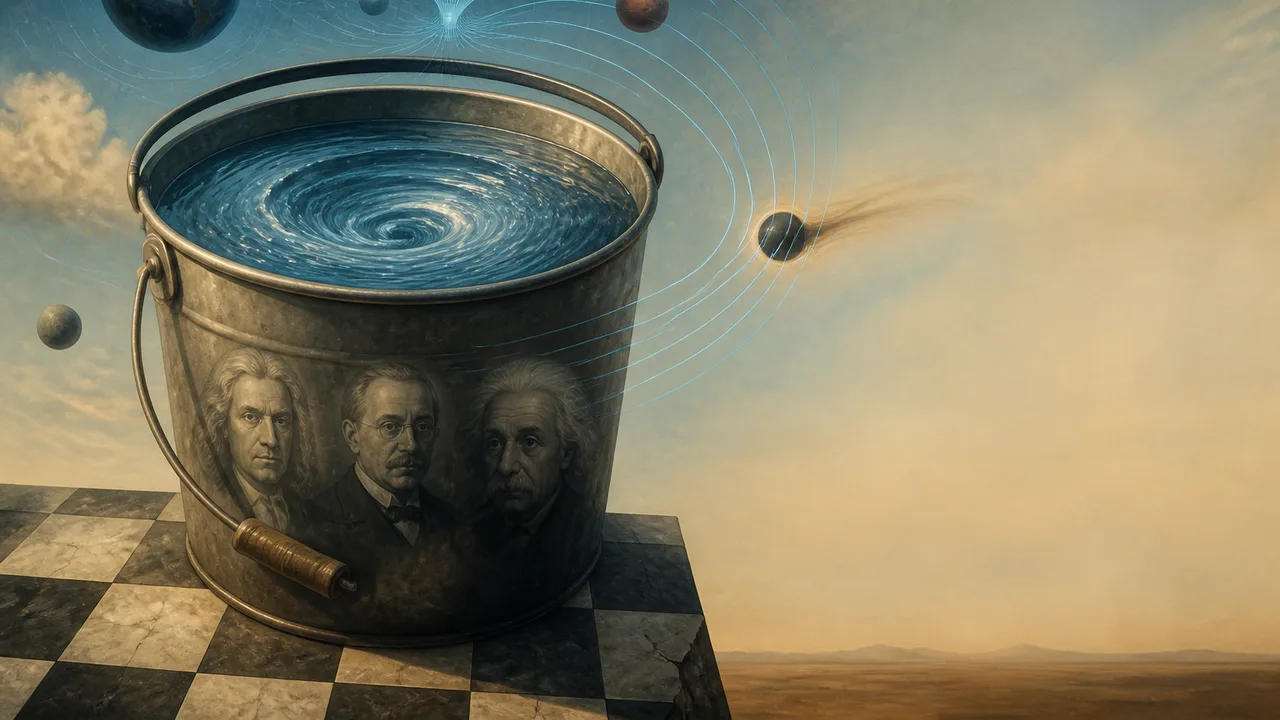
Photo: AI. Iolanthe Fenwick
Here is a physics question that should not be as hard as it is: why does water in a spinning bucket climb the walls?
Your instinct is probably to say "centrifugal force"—but that's a description dressed up as an explanation. The real question, the one that kept physicists arguing for roughly three centuries, is: spinning relative to what? That question, it turns out, is a thread that unravels into something much larger than a bucket.
The Asymmetry That Bothered Newton
Start with a fact that is genuinely strange once you sit with it. If you and I pass each other at a constant velocity—say, you're on a train and I'm standing on a platform—neither of us has any physical grounds for declaring ourselves the one who's "really" moving. Every experiment we run, every ball we throw, every pendulum we swing, gives identical results. Motion at constant velocity is perfectly relative, just as Galileo showed.
Now try that with rotation. If I set a bucket spinning and you watch from outside, we might try playing the same relativistic game—maybe, from the water's "point of view," it's the rest of the universe rotating around it. But the water doesn't care about our philosophizing. It climbs the walls regardless. Rotation, unlike constant velocity, is felt.
This asymmetry is what The Action Lab's recent video on Newton's bucket explores, and it's a genuinely good entry point into one of the deepest conceptual fault lines in the history of physics. As the video puts it: "Constant velocity and constant rotation are both forms of motion that continue naturally because of inertia. So why can one of them be felt while the other can't?"
Newton's answer was architectural. He proposed that space itself—not any particular object in it, just space as a background—provided the absolute reference frame against which true motion could be measured. Spin relative to this fixed spatial structure and physics changes. Cruise through it at constant velocity and physics stays put. The bucket experiment was his evidence: two situations where the bucket wall and water are in relative rotation, yet the physics inside is completely different. Something external to the bucket-water system must be distinguishing them. That something, Newton said, was absolute space.
It was a philosophically audacious move, and it worked—mathematically, mechanically, predictively—for nearly 200 years.
Mach's Counterproposal
In the late 1800s, Ernst Mach arrived with a different intuition. He didn't dispute Newton's observation; he disputed its interpretation. Newton had concluded that because the bucket's walls couldn't explain the water's behavior, some deeper scaffolding—absolute space—must exist. Mach said: why go all the way to an undetectable metaphysical structure when you have an entire universe of stars and galaxies sitting right there?
Mach's proposal was that rotation and acceleration are only meaningful relative to the distribution of all matter in the cosmos. The water climbs the walls not because it's rotating with respect to some ghostly absolute space, but because it's rotating with respect to everything else that exists. In Mach's version, if you could somehow spin all the stars and galaxies around a stationary bucket, the water should still climb the walls—because rotation is fundamentally relational.
The video captures the rhetorical elegance of this position well: "Instead of proving the existence of absolute space, Mach proposed that the reason we can tell the bucket is rotating is because the universe is filled with stars, planets, and galaxies that provide a reference for rotation."
What Mach didn't have was a mechanism. His idea was sharp philosophy and thin mathematics. He could tell you that distant matter influenced local inertia; he had nothing to say about how. That gap mattered enormously when a young Albert Einstein came looking for something to build on.
Einstein's Complicated Inheritance
Einstein was, by his own account, deeply influenced by Mach. He even coined the term "Mach's Principle" to describe the idea that mass distribution determines inertial frames. He set out, in developing general relativity, to put Mach's intuition on a mathematical foundation.
What he found was more complicated than either Newton or Mach had anticipated. Spacetime, in Einstein's framework, is not Newton's rigid invisible stage—but it's not quite Mach's democratic collective either. It is something genuinely new: a dynamic geometric structure that matter and energy can curve, stretch, and drag. The geometry of spacetime determines what counts as "natural" motion (a geodesic, in the technical language) and what counts as acceleration away from that natural path. In that sense, Newton was pointing at something real—there is a background reference structure. He just got its nature wrong. It's not fixed; it's a physical field that responds to mass and energy.
The video's summary of this resolution is worth quoting directly: "So in setting out to prove Mach right, Albert Einstein actually proved him wrong. Mostly."
That "mostly" does real work. Mach's intuition wasn't entirely discarded. General relativity does include an effect called frame dragging—when a massive object rotates, it literally drags the surrounding spacetime around with it, subtly influencing what nearby objects experience as inertial. The Gravity Probe B experiment, launched in 2004, measured this effect for Earth with exquisite precision. It's real. But it's tiny—orders of magnitude smaller than what full Machian physics would require. The entire observable universe's worth of rotating matter cannot account for local inertia in the way Mach imagined.
What the Bucket Actually Teaches Us
I find this history valuable not just as a story about physics, but as a story about how foundational disputes actually resolve. Newton's bucket wasn't a trick question with an obvious answer that later physicists revealed. It was a genuinely hard problem where two brilliant traditions—Newton's structural absolutism and Mach's relational empiricism—each captured something true while missing something important.
Newton was right that there is a reference structure. He was wrong that it's fixed and non-physical. Mach was right that matter influences inertia and that rotation needs a reference. He was wrong that absolute space could be fully replaced by relative matter distributions. Einstein synthesized them into something neither had imagined: a spacetime that is both structural and dynamic, both a reference and a physical field.
There's an open question here that general relativity doesn't fully close, and I think it's worth naming: Mach's Principle, in its strong form, has never been fully incorporated into or fully refuted by GR. Some solutions to Einstein's field equations respect it; others don't. Whether the universe we actually inhabit is one where inertia is fully relational—fully dependent on the matter content of the cosmos—remains contested in certain corners of theoretical physics and quantum gravity research.
The bucket, in other words, is still dripping.
What strikes me most is that the question Newton posed—what is the water spinning relative to?—turned out not to have a clean answer pointing at any single thing. Not absolute space. Not the distant stars alone. Not pure geometry alone. The answer is a relationship between geometry and matter that is still being worked out, in part because the deeper theory of spacetime that would fully reconcile quantum mechanics with general relativity doesn't yet exist.
A bucket of water, patiently climbing its own walls, waiting for us to fully explain why.
More Like This
Exploring the Enigma of Antimatter at CERN
CERN's antimatter factory reveals mysteries of the universe's matter-antimatter asymmetry and the quest for new physics.
The Enigma of Simultaneity in Relativity
Explore how the relativity of simultaneity reshapes our understanding of time and challenges the concept of a universal 'now.'
Your Intuitions Are Built for the Wrong Universe
Astrophysicist Hakeem Oluseyi explains quantum fields, spacetime, and why the mental models we rely on daily are macroscopic approximations of a stranger reality.
The Hidden Math Holding Climate Science Together
Dialect's video on the covariant derivative explains the math quietly powering climate models, ice sheet measurements, and atmospheric science.

Why Light Beams Seem to End: Physics Explained
Discover why searchlight beams appear to stop and how physics and atmospheric conditions contribute to this phenomenon.

Black Hole Paradox: Are Reference Frames the Key?
Exploring how reference frames might resolve the black hole information paradox.

Hannah Cairo Disproved a 40-Year-Old Math Conjecture at 17
At 17, Hannah Cairo overturned the Mizohata-Takeuchi conjecture using a hypercube and a coin diagram. Here's what she actually did—and why it matters.
How Language Shapes Thought, According to Lera Boroditsky
Cognitive scientist Lera Boroditsky explains how the language you speak shapes memory, color perception, and thought—and what's lost when languages disappear.