Black Holes: Destroyers, Organizers, and Open Questions
Black holes destroy worlds and organize galaxies—but what does the science actually show? A look at Sagittarius A*, adaptive optics, and the limits of what we know.

Written by AI. Priya Sharma
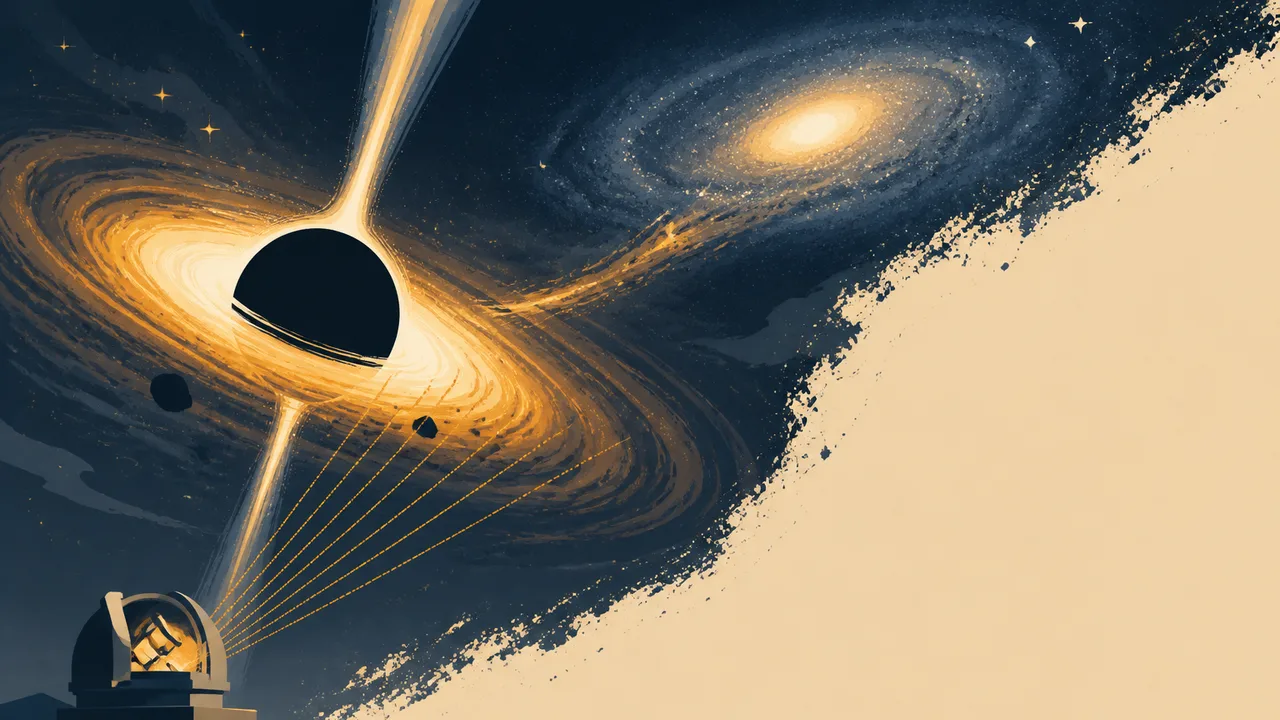
Photo: AI. Mika Sørensen
There is a particular kind of science communication that leads with terror and then pivots to wonder, and the Science Channel's Strip the Cosmos executes it with considerable polish. Black holes are introduced as "the most powerful objects in the universe, capable of destroying entire worlds" — a framing designed to make you feel small — before the documentary quietly asks whether that reputation is the whole story. The question is worth taking seriously, and not only for the obvious reasons. How we narrate black holes shapes what questions scientists are funded to pursue and what the public understands about the actual state of the field. The evidence here is genuinely interesting. It also has edges that popular science coverage tends to sand off.
What a black hole actually is, stripped of the drama
The foundational physics is well-established enough to state plainly. A black hole is a region of spacetime where gravity is so extreme that the escape velocity exceeds the speed of light. The boundary at which this becomes true is called the event horizon — described in the documentary as "a perfectly dark sphere from which no light can escape," which is accurate as a lay definition. Inside that boundary, our best current physical theories produce results that don't cohere. As one researcher puts it in the film: "Black holes are a place where some of the rules we think about in the universe don't apply as well as they do out here."
That's not poetic license. It is a precise statement about the limits of general relativity and quantum mechanics, two frameworks that work extraordinarily well in their respective domains and produce irreconcilable answers when you push them toward a singularity. The documentary gestures at this honestly: "We are confronting something that the human brain doesn't understand. Where space and time itself break down, don't behave the way we think of them." This is a problem that keeps theoretical physicists employed. It is also genuinely unsolved.
Sagittarius A* and the case for proximity
The documentary's most grounded material concerns Sagittarius A*, the supermassive black hole at the center of our galaxy, approximately 26,000 light-years from Earth and roughly 4 million times the mass of the Sun. Its proximity — relative to the supermassive black holes in other galaxies — makes it a uniquely tractable research target. As astronomer James Lyke of the Keck Observatory explains: "It's so unique to have a black hole that massive that close to us because all the other ones that are that massive are so far away in other galaxies."
That proximity has real methodological consequences. The longer-arc scientific project of tracking stellar orbits around Sagittarius A* — work conducted by teams including those led by Reinhard Genzel and Andrea Ghez — earned Genzel and Ghez the 2020 Nobel Prize in Physics, awarded specifically for the discovery of a supermassive compact object at the Milky Way's centre, according to the Nobel Prize press release. The orbital data produced by decades of near-infrared observation constitutes some of the most direct evidence we have that supermassive black holes exist as physical objects rather than mathematical conveniences.
The Keck Observatory work shown in the documentary extends this tradition. Lyke uses an adaptive optics system that fires a laser 50 miles into the atmosphere and uses the returning, atmosphere-distorted beam as a real-time reference to correct the telescope's mirrors — compensating for the atmospheric turbulence that makes ground-based astronomy so difficult. "It's a revolution in astronomy," Lyke says. "This is technology that was dreamed about for years. It's a bit of a game changer and we now can see things that we never could see before." The result is near-space-telescope-quality resolution from a ground-based instrument. That is not hyperbole; adaptive optics at Keck and comparable observatories has been transformative for galactic center science.
The G2 object and what it told us
One of the more instructive stories in the documentary involves G2, a compact gas cloud — possibly containing a stellar core — that was observed on a trajectory bringing it extremely close to Sagittarius A*. Predictions ahead of its closest approach, around 2013–2014, ranged from the dramatic to the catastrophic: some models suggested the black hole would shred G2 and produce a visible feeding event, the first direct observation of a supermassive black hole actively consuming significant material.
What actually happened was more ambiguous, and more useful. G2 survived its close approach largely intact — an outcome that forced a reconsideration of its composition and of models predicting how gas clouds behave in extreme gravitational environments. The documentary frames G2 as a forthcoming spectacle; the actual scientific literature tells a story about the dangers of overfitting predictions to incomplete data. "Anytime you get that close to that extreme of environment, you get to see new physics," Lyke notes — and the G2 case proved that point, though not in the direction anyone expected.
Organizers, not just destroyers
The documentary's central reframing — black holes as "cosmic organizers" rather than pure agents of destruction — has more scientific weight behind it than the language might suggest. Active galactic nuclei (AGN), powered by accreting supermassive black holes, are now understood to play a significant role in regulating star formation across entire galaxies. The accretion disc surrounding a black hole — a structure of infalling gas and dust heated to extreme temperatures, emitting radiation across the electromagnetic spectrum according to NASA's Scientific Visualization Studio — generates outflows and jets that can heat the surrounding intergalactic medium, suppressing the gas cooling that would otherwise fuel new star formation.
This is the AGN feedback mechanism, and it appears in cosmological simulations as a necessary ingredient for producing galaxy populations that resemble what we observe. The black hole architecture literature has been building this case for over two decades. The caveat worth flagging: the precise mechanics of how AGN feedback couples to the larger galactic environment remain contested. Simulations require it; observations confirm its effects at statistical scales; but the causal chain between a particular black hole's activity and the star formation history of its host galaxy is not cleanly resolved in individual cases.
At galactic scales, the documentary notes NGC 4889, a giant elliptical galaxy in the Coma Cluster whose central black hole is, according to Wikipedia's summary of published research, roughly 21 billion solar masses — placing it among the most massive black holes yet measured and approximately 5,000 times more massive than Sagittarius A*. Objects like NGC 4889 represent the extreme end of a distribution that researchers are still trying to explain. How do black holes grow that large? The answer involves merger histories, accretion rates, and timescales that are not yet fully constrained.
What the image makeover is actually asking
"I definitely think it's time for an image makeover for black holes," one researcher suggests in the documentary. I find this framing honest in a way it probably didn't intend to be. The "image makeover" is real — funding bodies, public interest, and collaborative telescope time all respond to narrative. The Event Horizon Telescope's 2019 image of M87* and the 2022 image of Sagittarius A* were genuine scientific achievements, and they were also communications events that shifted how policymakers and the public perceived the field.
But the most productive question the documentary surfaces isn't aesthetic. It's structural: we have now confirmed that supermassive black holes are ubiquitous at galactic centers, that their mass correlates with host galaxy properties, and that their activity shapes galactic evolution — yet the physical mechanism linking AGN feedback to large-scale structure remains poorly resolved at the level of individual systems. The G2 episode showed that even our predictions for a single, well-monitored object can miss badly when our models of its composition are wrong. Adaptive optics has sharpened our view of the galactic center enormously — but sharper images of individual orbits don't, by themselves, tell us how the energy released by accretion couples to a galaxy's star-forming gas reservoir across cosmic time.
That is the methodological gap that follows from everything else in this picture: not "how do black holes work" in the general sense, but how do we get from resolved, near-field observations of Sagittarius A* to falsifiable predictions about AGN feedback in the galaxies we can't resolve at all? Until that bridge is built, the organizer narrative and the destroyer narrative are both partially correct and neither is complete.
More Like This
Crafting Supercars: The Science Behind Speed and Style
Explore how supercars like Alfa Romeo 4C and Aston Martin Vanquish are meticulously crafted using cutting-edge materials and precision engineering.
Cosmic Threats to Earth: Asteroids, Solar Storms & Black Holes
From city-destroying asteroids to solar storms that could kill the internet, scientists are mapping the universe's most destructive forces—and our readiness is uneven.
Exploring Black Holes and Asteroids with StarTalk
Neil deGrasse Tyson delves into black holes, asteroids, and more in StarTalk's latest Cosmic Queries episode with Chuck Nice.
Are We Completely Wrong About Black Holes?
Black holes expose a crack running through all of modern physics. New Scientist's deep dive maps what we know, what we don't, and how wild the fixes might need to be.
Who Owns the Sky? The Human Cost of Giant Telescopes
From Mauna Kea protests to the Columbia Seven, the race to build the world's biggest telescopes carries human costs science documentaries rarely pause to name.
Fire Tornadoes on a Lake: The Bardstown Bourbon Disaster
In 2003, fire tornadoes erupted on a Kentucky lake. The cause wasn't paranormal—it was 800,000 gallons of burning bourbon and the right wind geometry.
The Quantum Twin Paradox and the Nature of Time
A new trapped-ion experiment may finally reveal whether time is a quantum property—bridging the long-standing gap between quantum mechanics and general relativity.
Nuclear Clocks Are Now Real — Here Is What That Means
Two independent teams built working nuclear clocks in 2026. Here's what the thorium-229 breakthrough actually achieved — and what it hasn't yet.