Leonard Susskind on Black Holes, Strings & Physics
Leonard Susskind talks black holes, the holographic principle, and string theory's unresolved promise with Brian Greene at the World Science Festival.

Written by AI. Amelia Nwofor
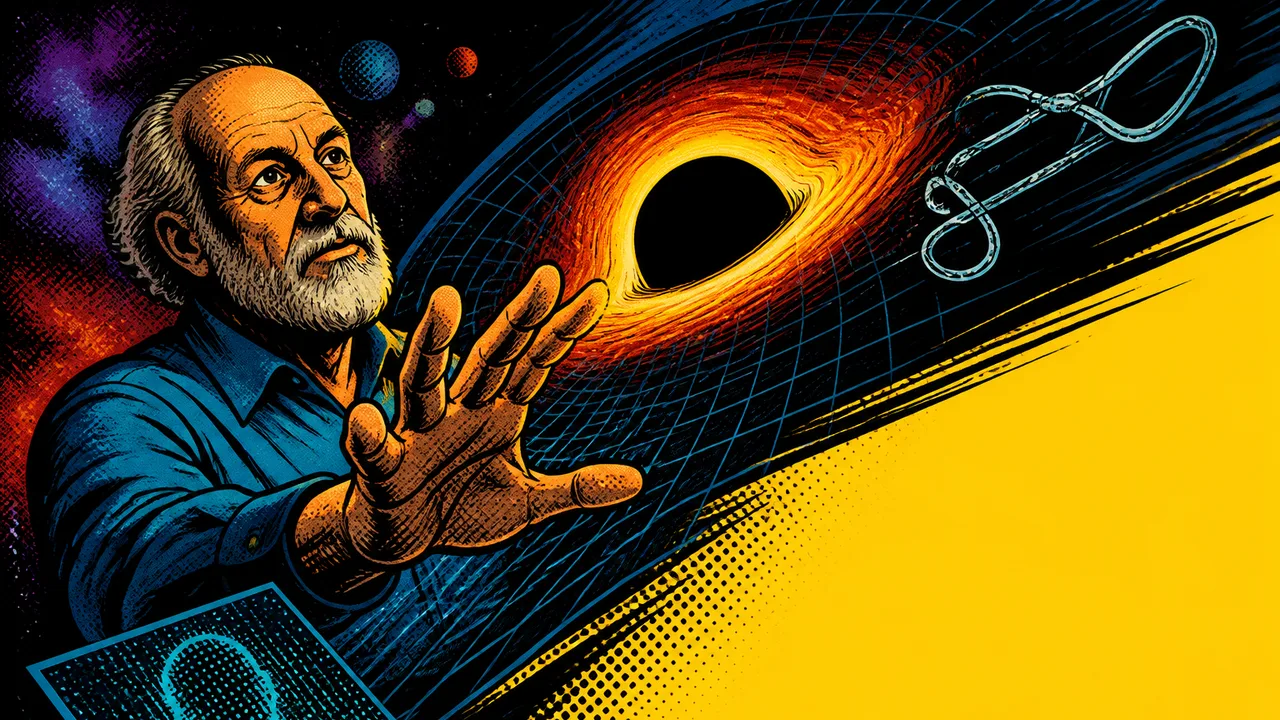
Photo: AI. Marco Velez
There's a particular kind of scientific mind that isn't drawn to answers so much as to collisions. Leonard Susskind, one of the co-founders of string theory and the physicist who spent decades wrestling Stephen Hawking over whether black holes destroy information, is that kind of mind. In a wide-ranging conversation with physicist Brian Greene at the World Science Festival, Susskind—now 86, and by his own account sleeping very well—traced the through-line of a career built almost entirely on the productive discomfort of two true things that cannot both be true.
"When there's something that you are pretty sure has to be right and there's something else which you're pretty sure has to be right but they conflict with each other," Susskind told Greene, "to me that's where my mind is drawn. I think almost everything I ever did was a product of that."
That's worth sitting with for a moment, because it reframes what theoretical physics actually is—not the serene derivation of universal laws, but the management of irreconcilable commitments.
The Conflict That Keeps Paying Out
The most concrete example Susskind walks through is the black hole information paradox, and it's a good one to linger on because the stakes are clarifying. The setup: quantum mechanics insists that information is never truly destroyed—it gets scrambled, diluted, hidden, but the underlying distinctions between physical states always persist. This property is called unitarity, and to quantum theorists it has the status of something you do not negotiate on. General relativity, on the other hand, allows for black holes, objects from which nothing—including, per Hawking's influential argument, information—escapes.
Hawking thought information was genuinely lost when matter crossed a black hole's event horizon. Susskind and physicist Gerard 't Hooft thought that was wrong, though neither could fully articulate why. "Can I explain why I was so sure that it can't be right? No," Susskind admits. That's honest in a way that most science communication isn't. The conviction preceded the proof.
The resolution, when it came, was strange enough to initially get both Susskind and 't Hooft dismissed by their peers. The idea—the holographic principle—proposed that all the information falling into a black hole gets encoded on its two-dimensional horizon surface, not lost inside it. "The horizon has to be like a hologram of some reality," as Susskind put it, inspired in part by a moment in a Stanford physics museum, standing in front of a holographic portrait and realizing the image contained within it a fully three-dimensional world.
Their colleagues, at the time, were unimpressed. "You two guys used to be very good physicists," someone told Susskind. "You've lost your marbles."
The vindication came not from a direct experimental test but from a mathematical one: physicist Juan Maldacena's 1997 construction of a specific spacetime—anti-de Sitter space—in which the holographic principle wasn't just plausible but provably exact. The physics of a three-dimensional interior corresponded precisely to physics on its two-dimensional boundary. It wasn't our universe. But as Susskind points out, all the arguments Hawking marshaled for information loss would have applied equally to Maldacena's universe—and in that universe, information is demonstrably not lost. Which means the arguments were wrong.
Hawking, for the record, was slow to concede. "He pushed to the limits a view that ultimately collapsed," Susskind says, with evident affection. "I think in the end he certainly knew that he was wrong."
What String Theory Has and Hasn't Done
The holographic principle emerged partly from the mathematical scaffolding of string theory, which is where the conversation gets more complicated—and where Susskind becomes a less comfortable source to rely on uncritically.
String theory's origin story is genuinely interesting: in the late 1960s, physicist Gabriele Veneziano wrote down a formula that fit particle scattering data without knowing what the formula meant. Susskind, working at Berkeley, looked at the math and saw vibrating strings inside it. So did Yoichiro Nambu, independently, around the same time. The mathematics of those strings, later realized by John Schwarz and Joël Scherk, turned out to describe not just protons but—at a scale 19 orders of magnitude smaller—gravity itself. Einstein's field equations, which Einstein spent a decade deriving, fall out of string theory's mathematics essentially for free.
That's remarkable. It's also, and this is the part that requires care, where the theory's confirmed achievements largely stop.
String theory has not produced a testable prediction that experiments have verified. Susskind acknowledges this directly: "Of course they're right. That's a correct statement." His defense is that internal consistency has its own scientific value—that showing gravity and quantum mechanics can coexist within a coherent mathematical framework matters, even before any specific number is confirmed. There's a legitimate case for this. Mathematics often outruns experiment; the history of physics includes long stretches where theoretical structure was trusted before it could be checked.
But the critics Susskind gestures toward—unnamed in the conversation, though the field's skeptics are not hard to identify—make a harder argument: that without the discipline of falsifiability, a theory becomes aesthetics dressed as science. Susskind calls string theory "the only game in town" that looks temptingly like the real world. That's a pragmatic argument, not an epistemic one, and those are different things.
The supersymmetry problem sharpens this. The mathematically tractable version of string theory—"String Theory with a capital S," Susskind calls it—requires supersymmetry, the idea that every known particle has a heavier partner. The Large Hadron Collider, which discovered the Higgs boson, has not found those partners despite searching in the energy ranges where they were expected. Susskind isn't devastated by this—he says he never had a strong prior about low-energy supersymmetry—but neither does he have a clean explanation for the absence.
The Cathedral Problem
Perhaps the most underappreciated part of this conversation is Susskind's diagnosis of why physics finds itself in this position at all. The issue isn't intellectual failure. It's geometry and time.
A century ago, the experiments that built our understanding of electromagnetism could fit on a tabletop. Faraday needed magnets and a dry cell. Now, testing the physics at the scales string theory cares about would require an accelerator roughly the size of the galaxy. That's not hyperbole—Susskind says he ran the calculation. An accelerator capable of probing Planck-scale physics would need to be galaxy-sized.
So we're left building cathedrals. "It's like building Notre Dame," he says. "200 years." Experimentalists spend careers contributing small pieces to instruments they will not see completed, that will answer questions that will then immediately generate harder ones. They are, Susskind says with genuine feeling, heroes. But the cadence of experiment and theory has fundamentally changed. We are in an era where the most important questions in fundamental physics may not be answerable within a human lifetime—or several.
This is not a crisis unique to string theory. It's a structural feature of where the field has arrived. Whether the right response is to continue developing mathematical frameworks whose experimental contact is deferred, to redirect resources toward questions that are answerable, or to fundamentally rethink what "progress" means in physics—that's an open question the conversation raises but doesn't resolve. Susskind's position is clear: you follow what you have. "I don't just see what else we can do except to follow it through."
The Thing About Being Wrong
What makes Susskind an interesting figure beyond his specific contributions is the methodology he describes. He led with intuition, not calculation. He maintained positions his field thought were wrong for years. He never, he says, feared being wrong—"Even Einstein was wrong. Many times." And he was right about information conservation when Hawking was not.
But the holographic principle is also, as he notes, now a tool—used in analyzing quantum circuits for quantum computing, far from its origins in black hole physics. That trajectory, from "you've lost your marbles" to "here's a tool for practical computation," might be the most important data point in the conversation. It suggests that the value of a theoretical idea isn't fully assessable at the moment it's proposed.
Whether that observation rescues string theory's broader program—or just describes how a subset of its insights have been productively repurposed—is precisely what remains contested.
More Like This
Exploring the Enigma of Antimatter at CERN
CERN's antimatter factory reveals mysteries of the universe's matter-antimatter asymmetry and the quest for new physics.
We've Been Teaching Heisenberg's Uncertainty Principle Wrong
The story we tell about Heisenberg's Uncertainty Principle is misleading. Professor Aephraim Steinberg explains what the textbooks got wrong—and what's right.
When Physics Breaks: What Black Holes Reveal About Reality
Physicist Juan Maldacena explains where our understanding of spacetime collapses—and what quantum mechanics might tell us about what happens next.
Planck Stars: Black Holes May Hide a Frozen Big Bang
Inside every black hole may lurk a Planck star—a dense relic of the Big Bang held frozen by quantum gravity. Here's what that means for physics.
Rethinking Inflation and the FLRW Model
Explore the complexities and challenges of cosmological models, including inflation theory and the FLRW model.

Is Reality a Simulation? Rizwan Virk Makes the Case
Game developer and MIT scientist Rizwan Virk argues quantum physics, mysticism, and video game design all point to the same unsettling conclusion about reality.

Hannah Cairo Disproved a 40-Year-Old Math Conjecture at 17
At 17, Hannah Cairo overturned the Mizohata-Takeuchi conjecture using a hypercube and a coin diagram. Here's what she actually did—and why it matters.

How Language Shapes Thought, According to Lera Boroditsky
Cognitive scientist Lera Boroditsky explains how the language you speak shapes memory, color perception, and thought—and what's lost when languages disappear.