Are We Completely Wrong About Black Holes?
Black holes expose a crack running through all of modern physics. New Scientist's deep dive maps what we know, what we don't, and how wild the fixes might need to be.

Written by AI. Nadia Marchetti
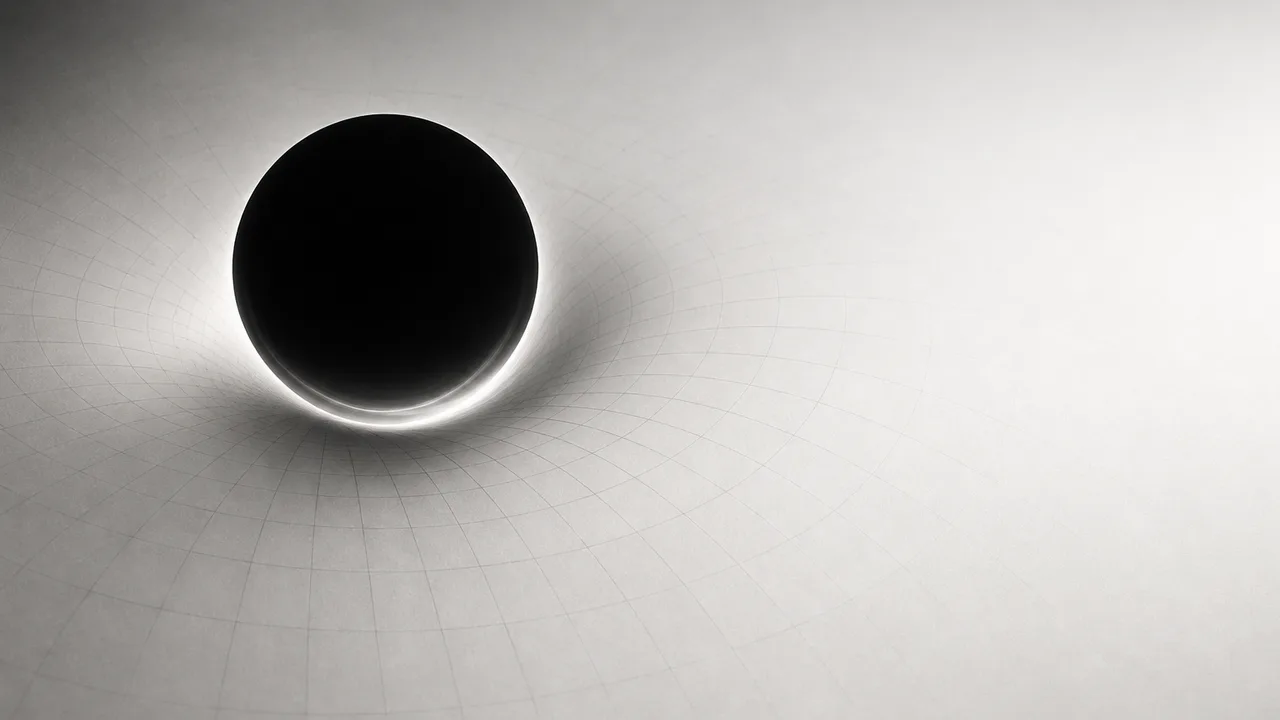
Photo: AI. Tomoko Hayashi
Here is the uncomfortable thing about black holes: they work perfectly as objects, and catastrophically as ideas.
We've seen them. We've heard two of them collide a billion light-years away, the ripple reaching LIGO in 2016 exactly as Einstein's equations predicted. We've photographed one — that now-famous fuzzy orange donut from 2019. Earlier this year, the James Webb Space Telescope captured our own galactic center's supermassive resident, Sagittarius A*, in more detail than we've ever managed. By any reasonable measure, black holes are among the most confirmed objects in astrophysics.
And yet. Point our best theories directly at one — really at the center of one, where everything gets compressed into what the math calls a singularity — and both of those theories break. General relativity, which handles the very large, and quantum mechanics, which handles the very small: they each start screaming when you try to apply them to the same object simultaneously. The information paradox has been sitting unresolved on physicists' desks for over fifty years. That's not a gap in knowledge. That's a structural crack in our understanding of reality.
New Scientist's recent two-hour deep dive into black holes and frontier physics doesn't pretend otherwise. It maps the crack carefully, honestly, and — this is where it gets genuinely interesting — starts describing the increasingly weird tools physicists are building to fix it.
The Two Problems at the Center of Everything
Let's be precise about what's broken, because "our theories don't work" doesn't quite capture the texture of it.
Problem one: singularities. When Carl Schwarzschild worked out the math shortly after Einstein published general relativity, he found that if you compress enough mass into a small enough volume, spacetime doesn't just curve — it curves into infinity. An infinite density. And in physics, whenever your answer is infinity, you haven't found a profound truth. You've found evidence that your equation has walked off a cliff.
Einstein didn't like this. He actually spent time trying to prove black holes were impossible for exactly this reason. He failed. They exist. The infinity is still there.
Problem two: the information paradox. Stephen Hawking showed that black holes slowly evaporate, leaking what we now call Hawking radiation. Eventually, presumably, a black hole disappears entirely. But quantum mechanics has a very firm rule: information cannot be destroyed. The arrangement of every particle that ever fell into that black hole — the quantum state of all of it — has to go somewhere. General relativity says that information is gone. Quantum mechanics says that's impossible. Both theories are spectacularly well-confirmed everywhere else. Pointed at a black hole, they contradict each other.
As Juan Maldacena has explored in discussions covered elsewhere on these pages, this contradiction isn't a minor technical dispute. It cuts to the question of whether reality is fundamentally deterministic at the quantum level. If information can be destroyed, the entire probabilistic framework of quantum mechanics starts wobbling.
The Exotic Fixes
So what do you do when your two best theories disagree? You start proposing alternatives — some of which sound, charitably, like science fiction.
Fuzzballs are string theory's contribution. The proposal: a black hole isn't a singularity surrounded by an event horizon at all. It's a dense tangle of vibrating quantum strings and membranes. From far away it looks identical to a conventional black hole. Up close, if you could somehow survive the approach, the surface would be a "weird quantum thicket" — constantly absorbing and re-emitting radiation, with information encoded in its intricate internal structure rather than lost forever. The fuzzball sidesteps the information paradox by eliminating the event horizon and singularity entirely. The problem: from outside, a fuzzball is observationally indistinguishable from a regular black hole. We can't currently tell whether we're right.
Gravastars work differently. Instead of a singularity at the core, imagine a bubble of repulsive vacuum energy — the energy intrinsic to spacetime itself — pushing outward, preventing collapse. The object's surface would be an ultra-thin shell of extraordinarily dense matter. A gravitational membrane. There's an even more elaborate variant where one gravastar sits inside another: the universe's version of Russian nesting dolls. Again: mathematically coherent, observationally unverifiable with current tools.
Wormholes are the name everyone knows from Interstellar, but the physics is genuine even if the travel itinerary isn't. General relativity permits these — hypothetical tunnels through spacetime connecting distant regions. Some researchers suggest that objects appearing to be black holes from outside might actually be entrances to wormholes leading to "white holes," theoretical objects from which matter spews forth rather than being consumed. NASA maintains, perhaps helpfully, that black holes are not wormholes. But the theoretical possibility hasn't been ruled out.
What unites all three proposals is that they represent what physicists call "regularization" — replacing the mathematically catastrophic infinity of a singularity with something that doesn't break the equations. The frustrating part, as the New Scientist video makes clear, is that we have no way to peer inside a black hole to check which, if any, of these is correct. The cosmic architecture that makes black holes so fascinating is precisely what makes them so difficult to study.
Gravity's Identity Crisis
The deeper problem lurking beneath all of this is gravity itself. We don't actually know what it is.
That sentence deserves a moment. Gravity is the most immediately experienced force in human life. It's also the only one of the four fundamental forces that has completely resisted being incorporated into quantum mechanics. Photons carry electromagnetism. The weak and strong nuclear forces have their carrier particles. Gravity's hypothetical carrier — the graviton — has never been observed. And not for lack of trying: the Large Hadron Collider, the most powerful particle accelerator ever built, is roughly a quintillion times too weak to probe gravity's quantum nature. Physicist Freeman Dyson once calculated that any detector sensitive enough to catch a graviton in action would need to be so massive it would collapse into a black hole first.
There's something almost comedic about that, until you sit with the implications.
Three experiments are currently in development that might at least edge us toward answers. A group at Stockholm University led by Igor Pikovski is designing a system where a microscopic metal bar, cooled to near absolute zero, would be placed into quantum superposition — simultaneously vibrating and still. If gravity has quantum properties, it should subtly disturb that superposition in detectable ways. A separate experiment proposed by Chiara Marletto and Vlatko Vedral at Oxford attempts to use gravity to generate quantum entanglement between two tiny masses — because, as Marletto explains: "if you can detect the entanglement and guarantee that nothing else did it, so it's really happened through gravity only, then gravity as a mediator of entanglement must be quantum itself." The technical challenge is severe: the masses required are roughly a million times larger than anything scientists can currently place in a quantum state.
A third approach tests whether gravity deviates at all from our predictions as measurements become more precise. Weights on twisting pendulums, gold beads on springs — looking for the faintest fingerprints of underlying structure. So far, gravity still looks smooth and classical. But each improvement in sensitivity rules out more possibilities.
The Stranger Possibility
And then there's the idea that might actually be most unsettling: what if we're asking the wrong question entirely?
Physicist Erik Verlinde has argued — with genuine mathematical backing — that gravity isn't a fundamental force at all. It's emergent. An accidental statistical consequence of entropy, the universe's tendency toward disorder. In this picture, masses don't attract each other because of some underlying gravitational mechanism. They appear to attract because that configuration corresponds to higher entropy, and entropy always increases. Gravity, in this view, is something like pressure: real, measurable, but not a fundamental thing — it emerges from millions of underlying interactions that individually have nothing to do with "pressure."
The holographic principle adds another layer of strangeness. The suggestion — supported by real mathematics, not just speculation — that all the information needed to describe a three-dimensional region of space can be encoded on a two-dimensional surface. The universe, in this reading, isn't a container full of objects. It's a projection of information. Gravity might be a large-scale effect of how that information is organized.
Physicist Daniel Oriti goes further still, arguing that even the assumption of objective, eternal physical laws — what he calls "naive realism" — may need to be abandoned. In his framework, spacetime itself emerges from quantum building blocks, and observers aren't passive readers of a pre-existing reality. They participate in constructing it. There's currently no experimental test for this idea, which is either the most honest thing about it or the most damning, depending on your threshold for speculation.
The Machines Looking for Answers
Meanwhile, CERN is going offline. Director General Mark Thompson confirmed that the Large Hadron Collider will shut down this summer for a four-year upgrade — replacing roughly 1.2 kilometers of the 27-kilometer ring with new superconducting magnet technology that will make the collider ten times brighter and generate ten times more collision data. The High-Luminosity LHC, as it's called, should allow physicists to study the Higgs boson with much greater precision — probing whether it's truly fundamental, whether it interacts with dark matter, whether there might be multiple Higgs bosons. Thompson is unambiguous about what's at stake: "We are going to break the standard model that we have. We are going to find a chink in its armor."
Whether that chink connects to black holes, gravity, or the information paradox is unknown. But the ambition is coherent. If the standard model starts showing cracks under higher-precision scrutiny, that could open pathways to theories that reconcile quantum mechanics and gravity — which would illuminate everything we're still uncertain about in black hole physics.
And there's the proposed Black Hole Explorer — a space-based extension of the Event Horizon Telescope that, if funded, would launch in 2031 and capture photon rings around black holes with enough detail to map the spacetime boundaries where our theories are expected to fail.
All of this is, in the end, a confession: we have confirmed the existence of objects we don't fundamentally understand, using theories that contradict each other when applied to them. The honesty of that admission is actually what makes the physics exciting. Not the mystery — the willingness to name it precisely.
The question isn't whether we're wrong about black holes. Something about our current picture is definitely incomplete. The question is whether the fix requires a new particle, a new force, or a new conception of what reality is made of.
More Like This
The Simplest Question Mathematics Still Can't Answer
Fields Medal winner James Maynard explains why prime numbers—the atoms of arithmetic—remain deeply mysterious despite centuries of study.
Einstein's Happiest Thought, Explained From First Principles
Adam Brown unpacks general relativity's core insight—gravity as curved spacetime—and what black holes reveal about energy, time, and the limits of physics.

Alpine Glaciers Are Melting at a Record Pace in 2026
ETH Zurich scientists are measuring record ice loss on the Rhône glacier this summer. What the melt stakes, pink dye, and one researcher's surprise tell us.
When Physics Breaks: What Black Holes Reveal About Reality
Physicist Juan Maldacena explains where our understanding of spacetime collapses—and what quantum mechanics might tell us about what happens next.
Scientists May Finally Detect Gravitons—Sort Of
New experiments could detect gravity's quantum particle within decades. But proving gravitons exist? That's a different problem entirely.
Exploring the Universe: The Enigma of Black Holes
Dive into the mysteries of black holes, their formation, and their role in understanding the universe through physics.
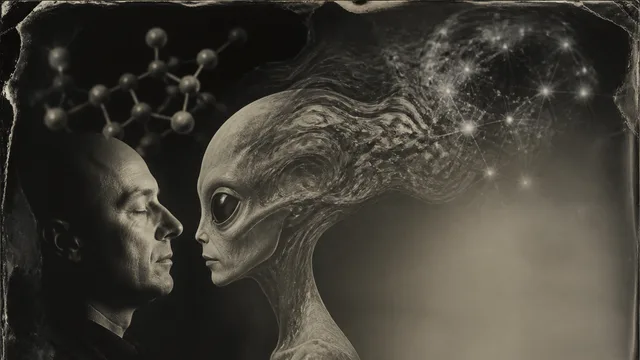
Do DMT Entities Point to Alien Consciousness?
Cognitive scientist Donald Hoffman claims DMT entities may be real alien minds. The math is real. Whether it proves anything about consciousness is a different question.
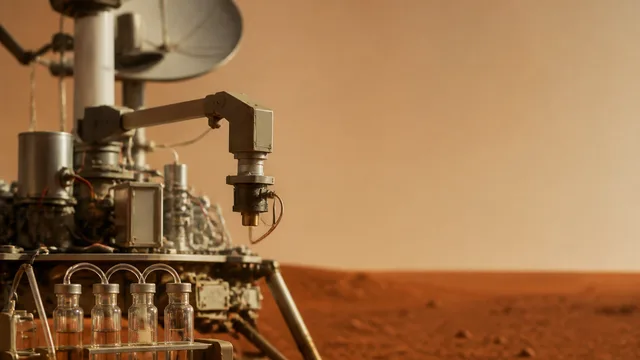
Viking Landers and the Unsolved Mars Life Debate
Fifty years after Viking landed on Mars, one experiment's positive result remains unexplained. Here's what the science actually shows—and what we've learned since.