Conformal Gravity: A Case Against Dark Matter
Professor Philip Mannheim argues dark matter doesn't exist—and his conformal gravity theory fits 138 galaxies without it. Here's what the evidence actually shows.

Written by AI. Nadia Marchetti
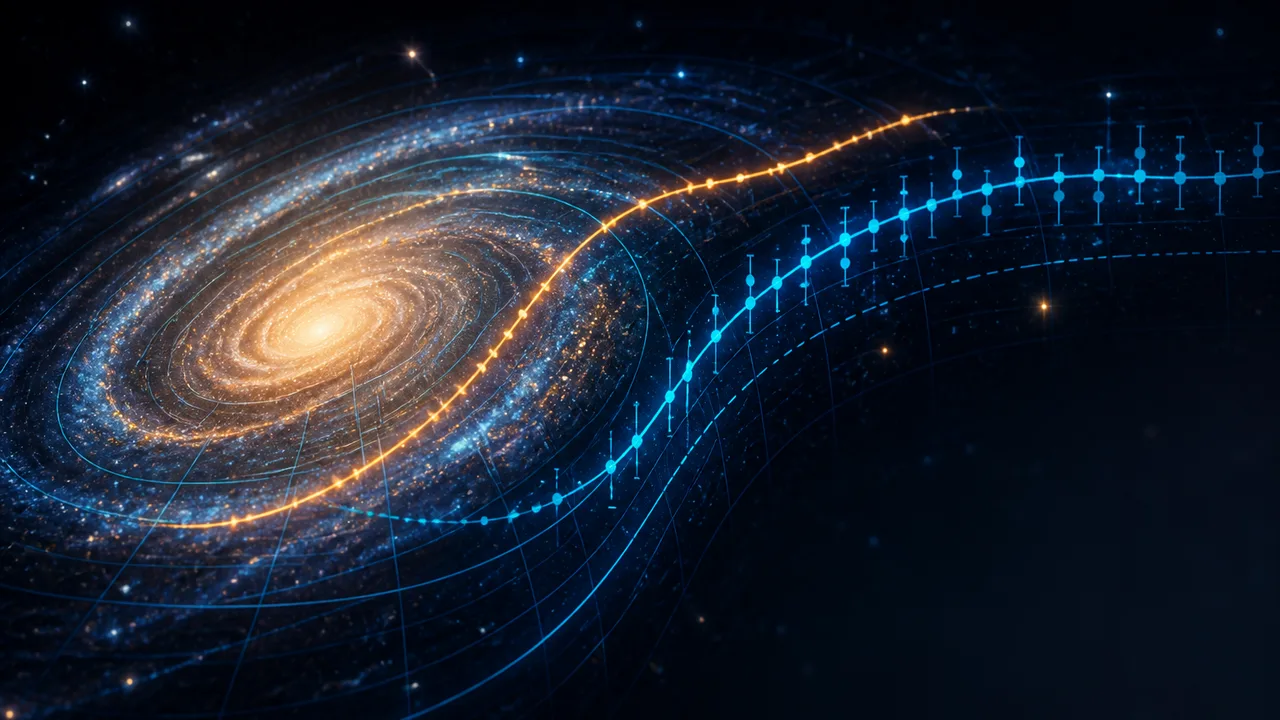
Photo: AI. Dante Nwosu
The standard move in cosmology, when your theory doesn't fit the data, is to add something. Galaxies rotating too fast for their visible mass? Add dark matter. Universe expanding too fast? Add dark energy. Theory still won't survive quantum scrutiny? Add extra dimensions and call it string theory. It's a pattern that Professor Philip Mannheim—a particle physicist who has been developing an alternative framework since 1972—describes with barely concealed impatience: "You start out with the standard theory. It doesn't work for galaxies, so you invent dark matter. It doesn't work for cosmology. You invent dark energy. It doesn't work for quantum theory, so you invent string theory. I haven't done that. I've just taken the theory and I've solved it."
That's a large claim. In a two-and-a-half-hour conversation with Curt Jaimungal on Theories of Everything—Mannheim's first-ever podcast appearance, at an age when most physicists have long since collected their career retrospectives—he walks through the full architecture of conformal gravity: what it is, why he built it, what it can do, and what it still needs to prove. The result is one of the more rigorous challenges to the standard cosmological model you'll find outside a journal, and also one of the more honest ones.
The crack in Einstein's foundation
Mannheim's critique doesn't start with dark matter. It starts much earlier, with a subtle but consequential distinction inside general relativity itself.
Einstein's theory, as physicists actually use it, bundles two separate things together: the geometric framework (general coordinate invariance, the metric as the gravitational field, the Riemann tensor measuring real curvature) and a specific set of field equations—the Einstein equations—chosen essentially because they reproduce Newton's law of gravity in the right limit. The first part, Mannheim argues, is airtight. The second part is phenomenology dressed up as principle.
The problem is that Newton's 1/r gravitational potential isn't the only solution consistent with a second-order field equation. Add higher-order terms—fourth-order, sixth-order—and you get additional solutions: potentials that grow linearly with distance, or as r³. These extra terms are irrelevant at solar system scales, which is where Einstein's equations were calibrated. But galaxies are roughly a thousand times larger than the solar system. If those extra terms were always present and we just couldn't see them locally, we would never know—until we looked at galaxies and found the rotation curves didn't match. Which is, of course, exactly what happened.
The conventional response was to invoke dark matter: invisible mass halos surrounding every galaxy, tuned per-galaxy to make the curves flat. Mannheim's response was different. He asked whether the extra solutions were real physics all along.
What conformal gravity actually does
The specific theory Mannheim pursues is built on the Weyl tensor—the traceless part of the Riemann tensor—and its action is the square of that tensor. This choice is not arbitrary. Conformal symmetry (the local version of scale invariance) uniquely selects this action, and it comes with a critical practical advantage: the resulting theory is renormalizable. That means it can be made consistent with quantum mechanics without generating uncontrollable infinities, something Einstein gravity famously cannot do.
From the field equations of this conformal theory, Mannheim and his collaborator Demosthenes Kazanas derived the vacuum solution in the late 1980s. They expected a 1/r term. They got that—but they also got a linear potential, one that grows with distance rather than falling. "We just looked at it and we nearly fell through the floor," Mannheim recalls, "because we realized if the one over r is falling and the linear potential is rising, the average is flat."
Flat rotation curves. No dark matter required.
The linear potential also reintroduces something Einstein's framework discarded: Mach's principle, the idea that local physics is influenced by the global distribution of matter in the universe. In conformal gravity, the geometry isn't asymptotically flat—it reaches out. The rest of the visible universe contributes a universal linear potential that affects galactic dynamics. This is the move Mannheim considers most important, and also the one most likely to make mainstream cosmologists reach for the smelling salts: "The missing mass that we've defined as the dark matter problem isn't missing. It's the rest of the visible universe and it's been hiding in plain sight. It's been there all along."
The fit, and what it took to get there
Whether you find this persuasive depends heavily on whether the theory actually fits the data. Mannheim says it does. Working with his former student James O'Brien, he applied the conformal gravity potential structure—a local 1/r term, a local linear term, a global linear term from cosmology, and a global quadratic term from cosmological fluctuations—to 138 galaxies. All four components are fixed: no free parameters adjusted per galaxy.
The fit works. With one universal quadratic parameter, 200 data points that the theory initially predicted should show rising rotation curves (which the data didn't show) were brought into agreement. One number, 200 points.
For comparison, the Lambda-CDM dark matter model requires two free parameters per galactic halo to fit the same rotation curves. For 138 galaxies, that's 276 additional parameters. Mannheim's framework uses none of those—it takes the luminous matter as given and derives the curve from the underlying physics.
The cosmological constant problem is addressed through conformal symmetry as well. In the standard model, the vacuum energy released by phase transitions (like the electroweak transition) should be around 60 orders of magnitude larger than what observations allow. Conformal symmetry constrains the trace of the energy-momentum tensor to zero, which keeps the induced cosmological constant naturally in check rather than catastrophically large. The cosmic coincidence—why dark energy and dark matter happen to be comparable in magnitude right now—emerges as a natural consequence rather than a remarkable accident.
On the accelerating universe: Mannheim's conformal cosmology requires negative spatial curvature, which acts as a kind of concave lens, pushing photons outward. This gives accelerated expansion without fine-tuning. When he applied the theory to supernova luminosity-distance data after the accelerating universe was announced in 1998, his predicted deceleration parameter landed at -0.37—well within the observationally constrained range, and derived from first principles rather than fitted to the data.
The ghost problem, and how PT symmetry dissolved it
This is where the story gets genuinely strange, and where mainstream physics had its strongest objection to the whole program.
Conformal gravity's fourth-order equations produce what are called "ghost states"—quantum states with negative norm, which in standard quantum mechanics means the theory is unphysical, its probabilities don't add up, and you should throw it away. Mannheim knew this. His colleagues told him repeatedly. His response was to keep going and trust that nature would know how to handle it even if he didn't.
The resolution arrived in 2008, through mathematician and physicist Carl Bender. Bender had been developing what's called PT symmetry—a framework where the relevant symmetry is invariance under combined parity reversal (P) and time reversal (T), rather than Hermiticity. A Hamiltonian doesn't need to be Hermitian to have real eigenvalues. It just needs to have an antilinear symmetry—a less restrictive requirement that Hermiticity happens to satisfy, but isn't the only way to satisfy.
In a meeting at a conference in Fort Lauderdale, Mannheim realized Bender had the tool he needed. "Carl, you have a way to get rid of a ghost and I have a theory with a ghost. Let's get together." They spent three days at Los Alamos working through the mathematics. The ghost disappeared. Conformal gravity, they showed, is a PT-symmetric theory rather than a Hermitian one—and in the correct inner product space (defined by CPT conjugation rather than Dirac's Hermitian conjugate), all the negative norms vanish and the theory is unitary.
This has implications beyond conformal gravity. Mannheim argues that the decades-long failure to quantize Einstein gravity reflects not just the renormalizability problem but a second hidden assumption: that any valid gravitational Hamiltonian must be Hermitian. The fourth-order theory isn't. But it doesn't need to be.
What remains open
It's worth being clear about what conformal gravity hasn't yet done. The rotation curve fits are compelling, but a theory of cosmology has to match not just the galactic-scale data but also the cosmic microwave background—the fluctuation spectrum that Lambda-CDM fits with considerable precision. Mannheim and his students are working on this, and he's careful about it: "You are fully justified in holding up on saying this is great until we can fit the fluctuations. I don't know we will, but we're working very hard on it."
The graviton, in this framework, doesn't exist as a particle. Whether that claim is testable, and what it would mean for gravitational wave physics if it isn't, are questions the theory needs to address more fully.
And Mannheim's framework isn't the only alternative to dark matter. MOND and its relativistic descendants (like John Moffat's MOG theory) also fit rotation curves using universal acceleration parameters. What Mannheim points to—and what cuts across all of these frameworks—is a pattern in the data: a universal acceleration scale of about 10⁻³⁰ inverse centimeters visible across all 138 galaxies, approximately the inverse of the Hubble radius. Lambda-CDM needs to explain that pattern too. So far, it hasn't.
The Hubble tension (the ~5 km/s/Mpc discrepancy between early- and late-universe measurements of the expansion rate) and early DESI data suggesting dark energy may evolve with redshift are putting additional pressure on the standard model. They don't confirm conformal gravity. But they do suggest the standard model's own fits may be less settled than they look.
Mannheim has been making these arguments since 1989. The fact that they're still not mainstream doesn't mean they're wrong—the history of physics is littered with correct ideas that waited decades for the right instrument or the right collaborator. It also doesn't mean they're right. What it means is that the question of whether dark matter exists or is an artifact of an incomplete gravitational theory is genuinely open—and that a physically consistent, mathematically rigorous alternative has been sitting on the table for a long time, waiting for the CMB fluctuation fits that would make it impossible to ignore.
More Like This

Neil Turok's Case for Quantum Gravity Without Strings
Neil Turok argues quadratic gravity—a 1970s idea—may solve quantum gravity without strings or extra dimensions. Here's what that claim actually rests on.
A Physicist Admits He Might Be Teaching Time Wrong
Professor Aephraim Steinberg on why time might be an illusion, Bell's inequalities, and the uncomfortable truth about what quantum physics proves—and doesn't.

When Physics Breaks: What Black Holes Reveal About Reality
Physicist Juan Maldacena explains where our understanding of spacetime collapses—and what quantum mechanics might tell us about what happens next.

The BOSS Great Wall: Anatomy of a Billion-Light-Year Structure
The BOSS Great Wall spans one billion light-years and shouldn't exist—at least not according to gravity alone. Here's what astronomers think is holding it together.
Gravity's Strangest Effects, From Time to Cosmic Voids
From gravitational time dilation to the Dipole Repeller and LIGO's detections, here's what gravity actually does—and what it still can't explain.
The Most Sensitive Dark Matter Detector Might Find Nothing
LUX-ZEPLIN sits a kilometer underground, waiting for dark matter. But success might look like silence—and that would tell us something huge.
Brian Keating on What Came Before the Big Bang
Cosmologist Brian Keating explains the multiverse, dark energy, string theory's fatal flaw, and why finding extraterrestrial wisdom matters more than finding aliens.

Seven Proofs That the Harmonic Series Diverges
Michael Penn's 31-minute video walks through seven distinct proofs that the harmonic series diverges—from a 1350 grouping trick to a prime-number infinite product.