Neil Turok's Case for Quantum Gravity Without Strings
Neil Turok argues quadratic gravity—a 1970s idea—may solve quantum gravity without strings or extra dimensions. Here's what that claim actually rests on.

Written by AI. Nadia Marchetti
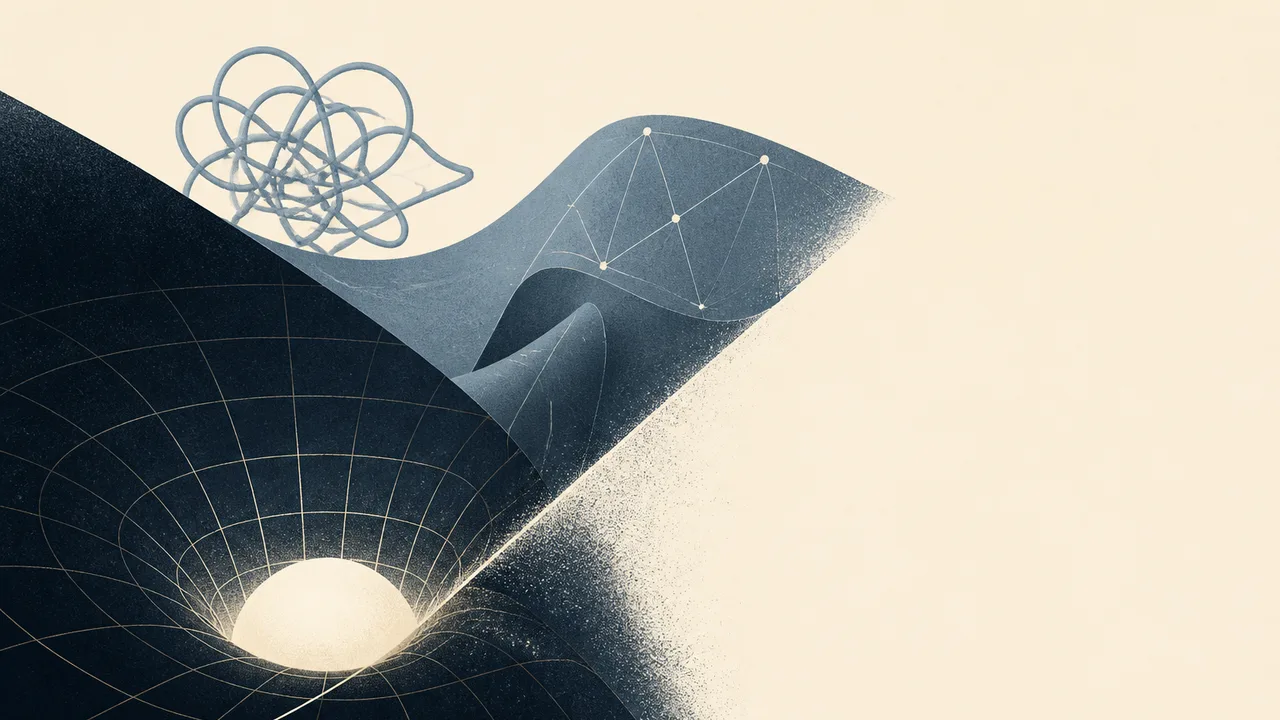
Photo: AI. Mika Sørensen
Here is a question that has quietly haunted theoretical physics for decades: what if the detour was the whole problem?
String theory—the dominant framework for reconciling gravity with quantum mechanics—requires ten dimensions, an enormous landscape of possible vacua, and roughly half a century of refinement that has yet to produce a single testable prediction about the actual universe. It's an intellectual cathedral. But cathedrals, however magnificent, are not automatically correct.
Neil Turok, the cosmologist and former director of the Perimeter Institute for Theoretical Physics, sat down with Curt Jaimungal on the Theories of Everything podcast recently to lay out what he describes as a simpler path. Not a new path, exactly—more like a road that was paved in the 1970s, walked for a while, then largely abandoned when the guardrails seemed dangerous. Turok thinks the guardrails were misread.
The approach is called quadratic gravity, and the core idea is almost elegant in its minimalism.
What Einstein's action leaves out—and why that matters
Einstein's general relativity describes gravity through the curvature of spacetime. The action—the mathematical object you extremize to get the equations of motion—involves curvature terms with two derivatives. That's the standard setup. What Turok is pointing to is what happens when you add terms that are quadratic in the curvature, meaning the curvature squared. Four derivatives instead of two.
This isn't an arbitrary modification. In every other successful quantum field theory—Maxwell's electromagnetism, quantum chromodynamics (QCD) for the strong force—the action is built from the field strength squared. So squaring the curvature in gravity actually makes it look more like the theories we already know work. The move has a kind of structural logic to it.
The British physicist Kelly Stelle made exactly this argument in the 1970s, showing that this quadratic gravity theory is renormalizable. Renormalizability is a technical but crucial property: it means that when your calculations produce infinities (as quantum field theory calculations reliably do), those infinities can be systematically absorbed into redefinitions of the theory's parameters rather than multiplying without end. A renormalizable theory is, at minimum, mathematically self-consistent. Then in the 1980s, Avraham Barvinsky demonstrated it's also asymptotically free—meaning the coupling constant vanishes at very short distances, just like QCD. At the tiniest scales, the theory becomes almost trivially simple: waves that don't interact.
So by the 1980s, there was a renormalizable, asymptotically free theory of quantum gravity sitting on the shelf. Turok's framing is pointed: "What we've recently realized is that there's rather a simple-minded approach to quantum gravity which actually has been around since the 1970s."
Why didn't everyone just use it?
The two disasters that scared people off
Here is where the story gets genuinely interesting, because the reasons for abandoning quadratic gravity are not frivolous. There are two serious problems, both of which emerge when you try to move from the Euclidean (imaginary time) formulation—where the math behaves—to real time, where we actually live.
The first is the Ostrogradsky instability, named for a 19th-century mathematician working in St. Petersburg who asked a simple question: what happens to classical mechanics if your equations of motion have more than two derivatives? The answer is that the energy of the system becomes unbounded below. Configurations with arbitrarily negative energy become available. If you connected such a system to the ordinary world, it would act as an infinite source of energy—draining itself into negative values while pumping energy into everything around it. We have never observed anything remotely like this in nature.
The second problem is ghost states: quantum states with negative norm. Standard quantum mechanics requires that probabilities be positive and sum to one. If your state space contains vectors with negative squared-length, the Born rule—the formula that converts quantum amplitudes into probabilities—seems to break down entirely. Ghosts have historically been treated as fatal: they look like they generate negative probabilities, and negative probabilities are physically meaningless.
Both of these problems are real. Turok does not wave them away.
What the new work actually claims
What Turok and his collaborators have done—and this is presented as work being premiered in this conversation—is argue that the ghost problem is less fatal than it looks, at least in a certain limit of the theory.
The key realization is that negative norm does not automatically mean negative probability. As Turok puts it: "A quantum state is nothing but a label for a system. Its norm is neither here nor there. You can't observe the norm of a quantum state." What matters is whether you can still extract sensible transition probabilities. And here, the team found a way.
The trick involves replacing the standard Born rule with an equivalent formulation using projection operators, which continues to give sensible results even when the state space includes negative-norm vectors. This generalized state space—called a Krein space by mathematicians—is like Minkowski spacetime, where distances can be positive, negative, or null, but the geometry remains coherent and usable. The condition required is a discrete symmetry Turok calls "ghost parity symmetry": an operator that assigns +1 to positive-norm states and -1 to negative-norm states. If the theory's Hamiltonian respects this symmetry, the probabilities always come out positive and sum correctly.
In a specific limit of quadratic gravity—where one of the two allowed coupling constants is set to zero, decoupling the graviton and Weyl curvature contributions—Turok claims they have a theory that is renormalizable, asymptotically free, and has well-defined positive probabilities. It describes the scaling degree of freedom of the metric, which is enough to model cosmology and admits black-hole-like solutions. He calls it a "toy model for quantum gravity," not the full theory.
The honest accounting: the Ostrogradsky instability is not fully resolved in real time for the complete theory. That remains open. And whether the ghost parity symmetry holds in the full quadratic gravity action—not just the simplified limit—is, Turok acknowledges, still an open question. "We're halfway there," he says. "That's optimistic, of course, but that's a nice way of saying it."
The assumption audit
The most provocative part of Turok's argument isn't really technical. It's philosophical.
String theory's requirement for ten dimensions and positive-definite Hilbert spaces wasn't derived from first principles—it was assumed. When theorists quantized strings in the 1970s and 80s, they weren't considering higher-derivative string theories. They assumed the action had only two derivatives. They assumed the state space had to be a Hilbert space with positive norms. These were not proven necessities; they were working constraints that hardened into orthodoxy.
Turok draws a sharp line: "Just a tiny generalization of the orthodox principles means you don't need strings, you don't need extra dimensions to describe gravity. So that's quite shocking."
And then the needle drops: "You make one false move in theoretical physics and you're totally wrong. That's the danger we all have to worry about. And I think people are not sufficiently worried about that. We should be examining very very closely each one of our assumptions to say, is it really necessary?"
This is not an argument that string theory is definitively wrong. It's an argument that the assumptions underwriting string theory's apparent necessity may never have been as secure as the field treated them. That's a different and arguably more uncomfortable claim.
What to do with this
Quadratic gravity has real open problems. The Ostrogradsky instability in Lorentzian (real-time) signature is not a solved problem. The ghost parity symmetry may or may not survive the full theory. And like any theoretical framework without experimental contact, it remains to be seen whether quadratic gravity makes predictions we can actually test—about early-universe cosmology, black hole interiors, or anything else where the Planck scale might leave an imprint.
But the structure of Turok's challenge is worth sitting with. The history of physics is littered with assumptions that turned out to be unnecessary scaffolding—constraints that felt load-bearing until someone pulled one out and the building stayed up. General relativity itself was built by questioning assumptions about simultaneity and absolute space that Newton never needed to question because they seemed too obvious.
Whether quadratic gravity is the next such story, or a promising path that hits a wall at step three, is a genuinely open question. The honest position is that we don't know yet. The more interesting question might be: what else are we assuming that we haven't examined?
More Like This
A Physicist Admits He Might Be Teaching Time Wrong
Professor Aephraim Steinberg on why time might be an illusion, Bell's inequalities, and the uncomfortable truth about what quantum physics proves—and doesn't.
When Physics Breaks: What Black Holes Reveal About Reality
Physicist Juan Maldacena explains where our understanding of spacetime collapses—and what quantum mechanics might tell us about what happens next.

Why a Theory of Everything Is Centuries Away
Fermilab physicist Don Lincoln says a theory of everything is at least 100 years away—and his reasoning is harder to dismiss than it sounds.
The BOSS Great Wall: Anatomy of a Billion-Light-Year Structure
The BOSS Great Wall spans one billion light-years and shouldn't exist—at least not according to gravity alone. Here's what astronomers think is holding it together.

Harvey Friedman: Math's Foundations Are Shaking
Harvey Friedman spent 60 years proving that ordinary math can't be trusted. His work in reverse mathematics may be the most unsettling idea in modern logic.
Why Gravitons Remain Elusive in Quantum Physics
Exploring the challenges of detecting gravitons and what this means for quantum gravity.
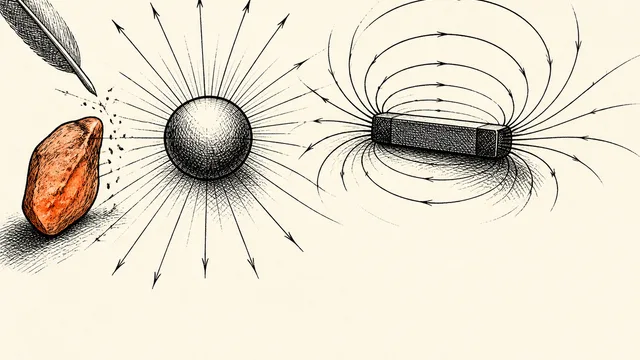
Electric and Magnetic Fields Explained From First Principles
From ancient amber to Gauss's law: how physicists replaced "action at a distance" with the field concept that underpins all of modern physics.
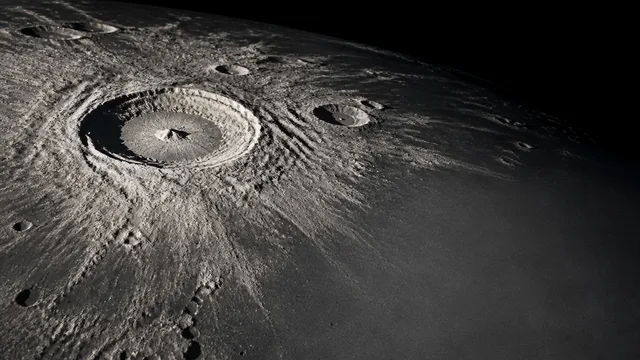
Tycho Crater: The Moon Impact That Reached Earth
Tycho crater is 85km wide, 4.8km deep, and possibly 108 million years old. But when exactly did it form — and what did it do to Earth?