Can You Really Grow Your Own Food Anywhere?
Kevin Espiritu of Epic Gardening joins StarTalk to explore urban farming, hydroponics, gray water systems, and whether humans could grow food on the moon.

Written by AI. Nadia Marchetti
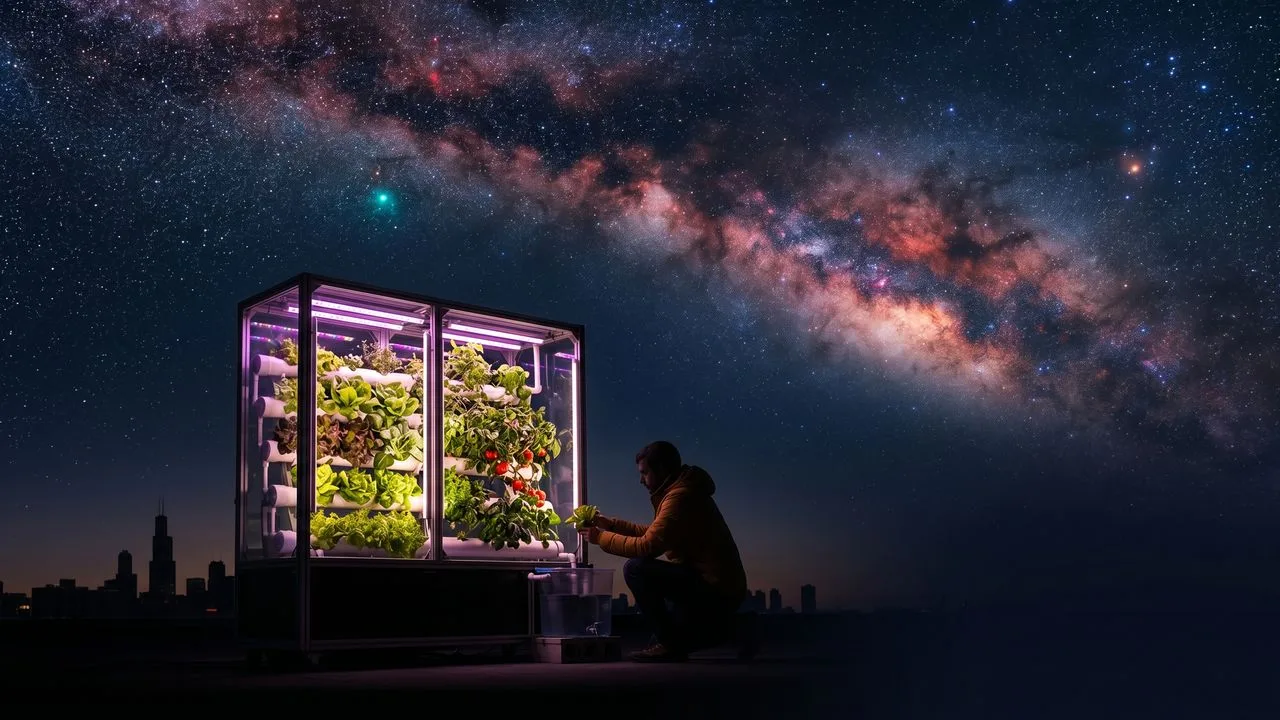
Photo: AI. Castor Belov
There's a version of this conversation that gets very utopian very fast. Backyard chickens, rainwater cisterns, 30 fruit trees, food sovereignty—it can start sounding like a Pinterest board with a manifesto attached. What makes the recent StarTalk episode featuring Kevin Espiritu, the gardener behind Epic Gardening, worth your time is that it mostly resists that pull. The idealism is present, but it keeps bumping into reality in productive ways.
Espiritu operates out of San Diego—USDA hardiness zone 10b, for those keeping track—on a third-of-an-acre lot. That's not a homestead. It's a suburban lot with ambitions. And that gap between fantasy and feasibility is where the interesting questions live.
Soil Is a Medium, Not a Magic Trick
One of the cleaner pieces of plant science Espiritu lays out in the episode is deceptively simple: plants don't actually need soil. What they need is what soil provides—oxygen, water, and nutrients. Soil is, as he puts it, essentially a medium.
That reframe matters because it's the intellectual foundation for hydroponics and aeroponics—two growing methods that get tossed around interchangeably but aren't the same thing. Hydroponics (hydro = water, ponics from the Greek ponos = work) delivers nutrients dissolved in water directly to roots. Aeroponics does the same thing via mist, suspending roots in air. In both cases, you've cut out the middleman.
Espiritu's entry into hydroponics was characteristically unglamorous. Living in a condo with a north-facing balcony—essentially a light desert—he Googled his way into a 5-gallon bucket system with an airstone, some grow lights, and nutrient solution. The results were, by his own account, terrible: "I grew probably the world's worst tasting cucumbers of all time and I fed them to my brother and he said he almost threw up."
He got hooked anyway. Which raises the question the episode only partially addresses: why do hydroponic plants often taste worse? The video description mentions it—hydroponic plants grow faster but taste flatter—but the transcript doesn't fully unpack the mechanism. The short version, for context: flavor compounds in many plants are partly stress responses. A tomato fighting for water and nutrients in actual soil produces more of the volatile compounds we associate with "real tomato flavor." Give it a perfect, frictionless hydroponic environment and you get yield without struggle. Whether that's a worthwhile trade-off depends entirely on what you're optimizing for.
There's also a subtler point buried in Espiritu's description of hydroponic roots: they look "almost unnatural," he says, spreading out in perfect white tendrils because they're not fighting against anything, not crawling through soil. That image stuck with me. Efficiency and ease don't always produce the most interesting outcomes—in plants or elsewhere.
The Honest Math on Self-Sufficiency
One of the more grounding moments in the episode is Espiritu's account of a 30-day experiment feeding himself entirely from his own land—out of a 15-by-30-foot plot. He survived. Poorly.
That's worth sitting with. A person with genuine gardening expertise, deep motivation, and an existing productive garden barely managed on a small urban lot for a month. The episode doesn't dwell on the details of that experiment—what he ate, what he ran out of, what broke down—but the mere fact of it reframes a lot of homesteading rhetoric. Self-sufficiency is possible at small scale. It's just harder, more limiting, and more calorie-precarious than its advocates tend to advertise.
The financial math is similarly sobering. When Neil deGrasse Tyson asks about savings, Espiritu doesn't oversell it. Solar panels on his roof have paid themselves off over roughly five years—a legitimate return. But rainwater harvesting? He does the arithmetic clearly: "Water ends up being so inexpensive that putting in a $2,000 cistern, you will not pay that off for a very long time. So it's more of like a security or sustainability move that you're actually paying for rather than like saving money."
That's a useful distinction. Sustainability infrastructure—cisterns, gray water diversion systems—is primarily insurance and ideology, not a financial play. People who frame it as money-saving are often doing motivated math. Espiritu, to his credit, doesn't.
Gray Water and the Infrastructure of Small Choices
The gray water section is one of the more practically interesting stretches of the conversation. Espiritu runs his shower water (and sometimes laundry water, depending on detergent) through a three-way valve that can divert either to the city sewer or to his orchard. Fruit trees need a lot of water, he explains, and shower water—after switching to compatible detergents—is clean enough for the purpose.
The water classification system here is worth knowing: gray water is semi-contaminated (shower, laundry); black water is wastewater from toilets and, apparently, sink drain water, which carries a higher contamination load. Gray water can be legally used on landscaping in many jurisdictions, with restrictions. Black water cannot. The regulatory landscape varies significantly by state and municipality, which the episode doesn't address—a gap worth flagging if you're considering this.
What Espiritu's setup illustrates is something industrial agriculture has been slow to internalize: water that's "used" isn't necessarily "wasted." The same water can move through multiple systems before it's actually exhausted. That logic scales up in interesting ways.
The Moon Problem
The episode opens with a riff about lunar agriculture that initially reads like a thought experiment but actually contains a genuine proposal. Neil deGrasse Tyson notes that the lunar surface isn't soil at all—it's regolith, pulverized rock, geologically sterile. No microbiome, no organic matter, no structure that plants could meaningfully use.
Espiritu's response is aquaponics: fish in a water medium, whose waste fertilizes the plants, which clean the water, which sustains the fish. A closed loop. On the moon, you'd feed the fish, the fish would feed the plants, you could eat both.
"I don't think NASA's thought about that," Tyson says, which is probably generous to NASA—they've thought about closed-loop life support systems extensively—but the specific aquaponics-for-lunar-habitats framing is genuinely underexplored in public discourse. Fish in space is an almost comically difficult proposition (zero-g is not kind to fish, as the group amusingly notes), but the underlying logic of closed biological loops is exactly what long-duration space habitation requires.
The question of whether space-grown food would even taste good gets raised but not really answered. Given what we know about stress-derived flavor compounds, and given that space-grown plants would presumably be optimized for yield and resource efficiency above all else, the honest guess is: probably not great. That's not a dealbreaker for survival, but it's worth acknowledging that the culinary experience of lunar agriculture is unlikely to inspire a Michelin star.
Learning in Public as Infrastructure
There's a thread in this conversation that isn't about plants at all, and it might be the most durable one. Espiritu didn't come to gardening through formal training. He came through video game addiction, a north-facing balcony, a Google search, and a very patient (or perhaps unwise) brother willing to taste terrible hydroponic cucumbers.
He built an audience not by being an expert first, but by figuring things out in front of people. "Just learning in public," he says, "has inspired people—like, it's really not that hard. It seems overwhelming. It's really not that bad."
That's a different knowledge-transmission model than credentialed expertise, and it's not obviously worse for certain domains. Gardening, home systems, small-scale food production—these are areas where trial, error, and visible iteration might be more useful pedagogically than formal instruction. The people who watch Espiritu install a gray water diversion valve and get it slightly wrong before getting it right are probably better equipped to try it themselves than people who read a manual.
Whether that model scales to more consequential domains—medicine, engineering, food safety—is a separate and much thornier question. But for the question of how to grow a zucchini on a balcony in a city apartment, watching someone fumble through it publicly seems like a reasonable approach.
The episode ends, per StarTalk's style, with more questions than it resolves. Could aquaponics sustain a lunar colony? Can hydroponic produce ever match the flavor complexity of soil-grown food? Is urban self-sufficiency a meaningful goal or an elaborate hobby that makes people feel better about systems they can't actually exit?
The most honest answer, threading through everything Espiritu describes, is that it depends entirely on what you're actually trying to accomplish—and that most people haven't been rigorous enough with themselves about which of those goals they actually hold.
More Like This

When Celebrities Actually Do Real Science
From Hedy Lamarr's frequency-hopping patent to Brian May's astronomy thesis, these celebrity scientists made contributions that still hold up under scrutiny.

The Missing Middle of Note-Taking: What Happens Next?
Tris Oaten's Obsidian system solves note-taking's biggest problem: what to do after you've captured everything. A look at the processing layer.

How Common Knowledge Influences Society
Explore how common knowledge shapes human interactions and societal norms with insights from Steven Pinker on StarTalk.

When AI Writes Code, What's Left for Developers to Do?
ThePrimeagen spent 6 months questioning his value as a developer. His answer challenges assumptions about what matters in an AI-assisted world.
Why NASA Is Finally Returning to Venus After 40 Years
After decades of neglect, Venus is getting two NASA missions. Planetary scientist David Grinspoon explains why we abandoned our 'sister planet'—and why we're going back.

When AI Makes Everything Free, What Are You Worth?
AI tools have broken the old chain of value: production, effort, expertise. Here's what tech workers need to prove instead—and why it's harder than it looks.

Do DMT Entities Point to Alien Consciousness?
Cognitive scientist Donald Hoffman claims DMT entities may be real alien minds. The math is real. Whether it proves anything about consciousness is a different question.
Viking Landers and the Unsolved Mars Life Debate
Fifty years after Viking landed on Mars, one experiment's positive result remains unexplained. Here's what the science actually shows—and what we've learned since.