Harvey Friedman: Math's Foundations Are Shaking
Harvey Friedman spent 60 years proving that ordinary math can't be trusted. His work in reverse mathematics may be the most unsettling idea in modern logic.

Written by AI. Nadia Marchetti

Photo: AI. Tomoko Hayashi
Here's a credential that stops conversations: Kurt Gödel—the Gödel—personally sponsored Harvey Friedman's paper for the Proceedings of the National Academy of Sciences. Not a blurb, not a recommendation letter. A sponsorship, which in academic terms is roughly equivalent to Einstein showing up to your thesis defense and saying "I vouch for this one."
Friedman was 18 when Stanford gave him a PhD and a professorship simultaneously. The Guinness Book of World Records noted the achievement. And then, for the next six decades, he did something most prodigies don't: he kept going, grinding at a single question that most of his colleagues would prefer to declare answered and move on from.
The question: Can ordinary, finite mathematics be trusted?
In a conversation with Curt Jaimungal on the Theories of Everything podcast, Friedman's first-ever podcast appearance, the answer that emerged was unsettling in a very specific way. Not the dramatic "math is broken" kind of unsettling. More like the feeling of pressing on a wall you assumed was load-bearing and finding it give slightly under your hand.
What Gödel Actually Said (And What People Keep Getting Wrong)
Before you can understand what Friedman built, you need to clear away the mythology around the thing he's extending.
Gödel's incompleteness theorems are probably the most confidently misquoted results in all of mathematics. Friedman is visibly bothered by this. In the podcast, he draws a clean line: "Gödel's first incompleteness theorem merely says that there are some things given any particular logical framework—there's always going to be some things that system doesn't handle, that the system doesn't know whether it's true or false."
That's it. Not "we can't know anything for sure." Not a philosophical license for epistemic despair. The theorem says every sufficiently strong formal system has statements it can neither prove nor disprove—but plenty of other statements remain perfectly provable within that system.
The second incompleteness theorem—which tends to get collapsed into the first in popular accounts—is actually quite different: no sufficiently strong system can prove its own consistency. These are separate claims with separate implications, and conflating them is, per Friedman, a genuine error rather than a harmless simplification.
The standard example of a Gödelian unprovable statement is an elaborate self-referential construction—technically legitimate, philosophically interesting, and utterly irrelevant to what working mathematicians actually do. Friedman's life work has been asking: what if incompleteness shows up in mathematics that isn't a philosophical contrivance? What if it shows up in the kind of math you'd encounter in a combinatorics seminar?
ZFC and the Problem of "Good Enough"
The gold standard for mathematical foundations is a system called ZFC—Zermelo-Fraenkel set theory plus the Axiom of Choice. It's been the consensus framework since roughly 1930, and most mathematicians treat it the way most people treat indoor plumbing: they don't think about it much, but they'd notice immediately if it stopped working.
Gödel and Paul Cohen together showed, between 1940 and the early 1960s, that the famous Continuum Hypothesis—a question about the sizes of infinite sets—is neither provable nor disprovable within ZFC. Independent of the axioms, full stop. You can take it or leave it and ZFC functions either way.
Most mathematicians shrugged. The Continuum Hypothesis involves "arbitrary sets of real numbers with no patterns and no ways of generating it," as Friedman describes it—objects so abstract that most working mathematicians never encounter them. It felt like a foundational crisis happening in a neighborhood nobody actually lived in.
Friedman's project has been to move the crisis downtown.
He's spent sixty years developing what he calls tangible incompleteness—statements that are mathematically natural, combinatorially grounded, and recognizable to any trained mathematician, which nonetheless cannot be proved or refuted within ZFC. Not baroque self-referential curiosities. Things involving finite trees, rational numbers, combinatorial patterns that a graduate student could understand the statement of.
"I attack it differently," Friedman told Jaimungal. "I say it isn't even good enough to do finite things that we care about."
That's a significant claim. The abstract set theorists—Friedman specifically names Hugh Woodin as the leading figure on the other side—attack ZFC from above, arguing it fails to accommodate sufficiently large, sufficiently abstract mathematical objects. Woodin wants to expand the foundations upward, toward greater abstraction, to accommodate objects like measurable cardinals that ZFC leaves undecided.
Friedman's critique runs in the opposite direction. He's not saying ZFC fails at the exotic stuff. He's saying it fails at the ordinary stuff.
Two Visions of Mathematical Truth
The Friedman-Woodin contrast is worth dwelling on, because it's not just a technical disagreement—it's a disagreement about what mathematics is fundamentally for.
Woodin, as Friedman describes him, believes the Continuum Hypothesis has a definite truth value even though ZFC can't determine it. His job, as he sees it, is to uncover that truth through increasingly powerful axioms—treating mathematical exploration the way a physicist might treat discovering new laws. There's a fact of the matter; we just haven't found the right framework yet.
Friedman finds this move dubious: "He took the high abstract road and I took the point of view that the future of foundations of math is how well it connects up with ordinary mathematical objects and ordinary mathematical intuitions—not extraordinary intuitions that only a few people have."
This is a genuine fork in the road, and it's not obvious which path is correct. Woodin's approach has produced remarkable results in set theory. Friedman's approach has produced something arguably more alarming: the discovery that ZFC breaks down on terrain that looks, from the outside, completely mundane.
Neither side is obviously right. That's actually the point.
What Reverse Mathematics Is Doing
Reverse mathematics—the field Friedman founded—inverts the usual direction of mathematical inquiry. Normally you start with axioms and ask what theorems you can prove. Reverse mathematics asks: given a theorem, what's the weakest set of axioms needed to prove it?
This sounds like a technical bookkeeping exercise, but it turns out to be surprisingly revelatory. Many theorems in ordinary mathematics cluster around a small number of axiom systems—suggesting that mathematical truth has a kind of natural structure that wasn't visible from the top-down view. And some theorems turn out to require axiom systems that feel dramatically more powerful than the theorem itself would suggest.
TREE(3)—a combinatorial function that grows so fast it makes the famous Graham's number look microscopic—emerges from exactly this kind of analysis. The statement that a certain kind of tree-labeling game always terminates is, on its face, a finite combinatorial fact. It cannot be proved in the usual foundational systems without ascending to something much stronger.
That's Friedman's signature move: taking something that looks like it should be settleable with ordinary mathematical tools, and showing that it secretly requires enormous foundational power. The mismatch is the message.
The Admission That Complicates Everything
What I find most striking about Friedman's account—and what Jaimungal drew out well—is Friedman's willingness to say that his own work has made things more mysterious, not less.
"I regard what the ultimate view of truth in mathematics is as a totally open question that's been made more mysterious by my efforts. It's been made more mysterious. Maybe not clarified—but made more mysterious."
That's an unusual thing for a mathematician to say about sixty years of work. Science and mathematics have a progress narrative: you do the research, you clear away the fog, you inch toward clarity. Friedman is describing a career that has systematically expanded the fog.
The category theorists, meanwhile, think the whole framing is wrong—that ZFC and the logic-first tradition are answering the wrong question, and that categorical foundations offer a more natural home for mathematical truth. Friedman is skeptical, and he makes an acerbic point: Saunders Mac Lane, who wrote the foundational text on category theory, opens the book by defining a category in terms of sets. The man who wanted to replace set theory used set theory to define his replacement.
This doesn't settle the dispute. But it's a good illustration of how the foundations question keeps curling back on itself.
The foundations of mathematics were supposed to be the one thing you could take as given—the bedrock under everything else. What Friedman has spent sixty years demonstrating is that the bedrock has questions embedded in it, and some of those questions turn out to be ordinary math in a very thin disguise.
Whether that makes the foundations broken or simply alive might be the most important philosophical question in mathematics right now.
More Like This
A Physicist Admits He Might Be Teaching Time Wrong
Professor Aephraim Steinberg on why time might be an illusion, Bell's inequalities, and the uncomfortable truth about what quantum physics proves—and doesn't.
Žižek's Challenge: What If Consciousness Begins With Death?
Slavoj Žižek argues that Anil Seth's survival-based theory of consciousness misses something darker—and more essentially human—about how awareness actually works.
When Physics Breaks: What Black Holes Reveal About Reality
Physicist Juan Maldacena explains where our understanding of spacetime collapses—and what quantum mechanics might tell us about what happens next.

Math Intuition vs. Tricks: The Gauss Problem
Is math just a bag of tricks, or is there a deeper way to think? The Gauss problem reveals a fascinating argument for building genuine mathematical intuition.
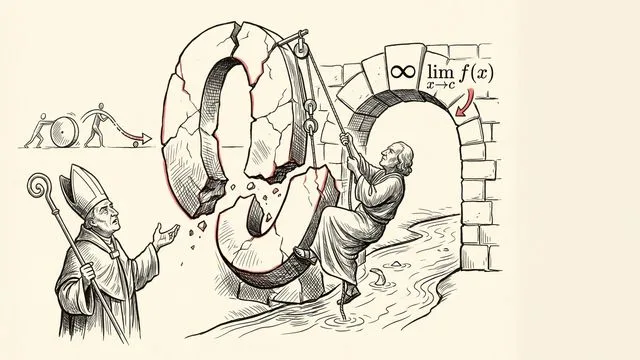
How Mathematics Finally Escaped Dividing by Zero
For 150 years, calculus worked perfectly on broken logic. Here's the fascinating story of how mathematicians finally fixed it—and what a bishop had to do with it.
Verlinde vs. Jacobson: Does Gravity Emerge From Nothing?
Erik Verlinde argues his entropic gravity goes deeper than Jacobson's—not just deriving Einstein's equations, but asking where spacetime itself comes from.
Do DMT Entities Point to Alien Consciousness?
Cognitive scientist Donald Hoffman claims DMT entities may be real alien minds. The math is real. Whether it proves anything about consciousness is a different question.
Viking Landers and the Unsolved Mars Life Debate
Fifty years after Viking landed on Mars, one experiment's positive result remains unexplained. Here's what the science actually shows—and what we've learned since.