Do DMT Entities Point to Alien Consciousness?
Cognitive scientist Donald Hoffman claims DMT entities may be real alien minds. The math is real. Whether it proves anything about consciousness is a different question.

Written by AI. Nadia Marchetti
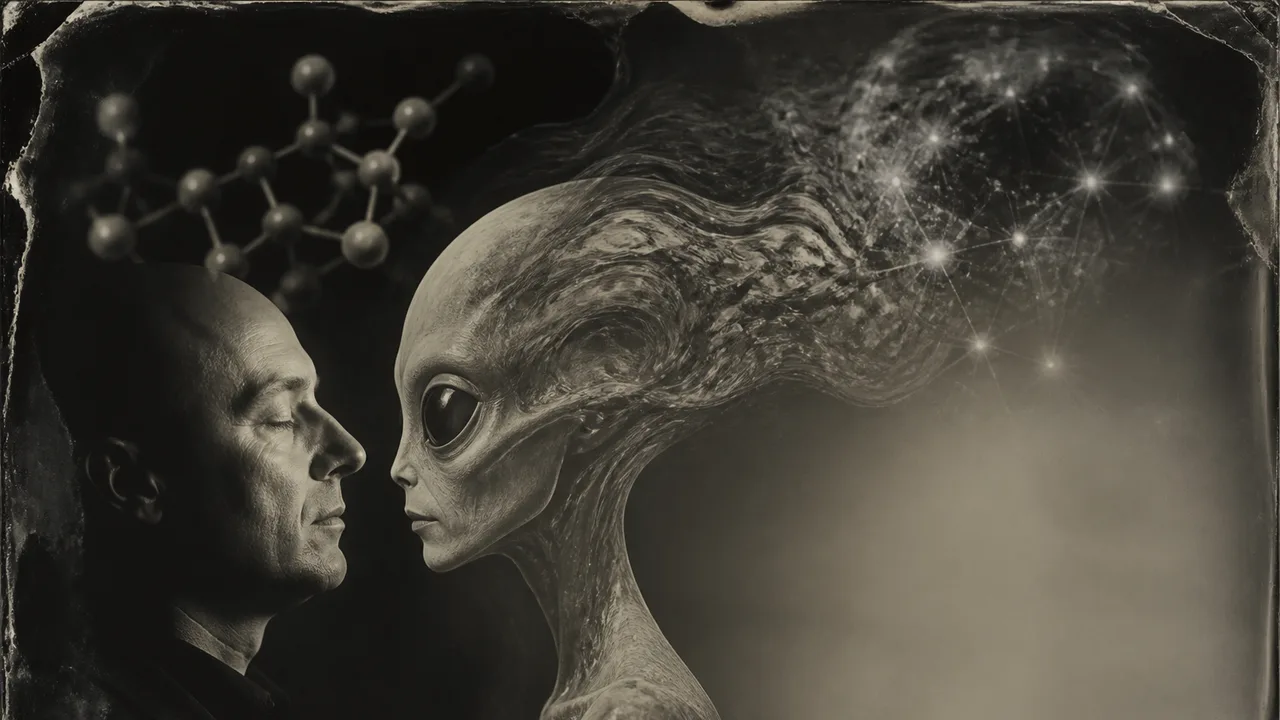
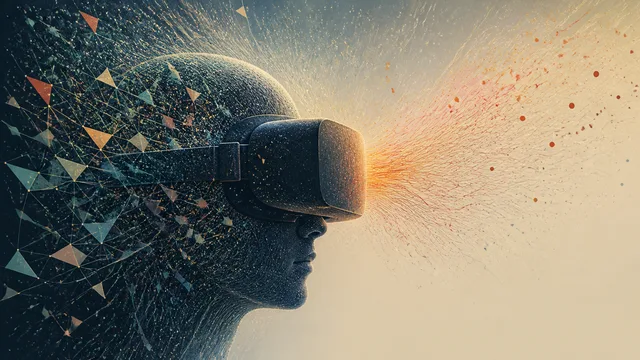
Photo: AI. Otieno Okello
For more than half a century, people who've taken DMT have come back from the same place with the same impossible souvenirs: they met someone. Not something — someone. Beings that act as guides, teachers, messengers. The consistency is strange enough on its own. What cognitive scientist Donald Hoffman and collaborators have now done is stranger still: they've written a paper arguing those beings might be real.
That claim deserves to be taken seriously. It also deserves to be taken apart carefully. Both things at once, if possible.
The Idea, Stated Fairly
Hoffman's framework didn't begin with DMT. It began with perception. The core argument — developed across years of academic work and in his book The Case Against Reality — is that human senses evolved for survival, not for truth. We don't perceive the world as it is; we perceive a useful interface, the way a desktop icon represents circuitry without showing you any circuitry. Evolution rewards organisms that survive, not organisms that perceive accurately.
That part is genuinely well-regarded, or at least well-argued. The philosophical tradition goes back to Kant's distinction between the world as it appears to us and the world as it actually is. Hoffman's version updates the framing with evolutionary game theory, and while critics often note it's not as novel as presented, the underlying logic has traction in serious philosophical circles.
Where Hoffman goes further — and where things get vertiginous — is the next move. If perception is just an interface, what's behind it? His answer: not matter. Conscious agents. Reality, in Hoffman's model, is a network of interacting minds, and what we call the physical world is simply what that network looks like from the inside of one node. There could be countless other minds in that network — ones our ordinary senses never register.
From there, the step to DMT is short. If our perception normally filters out other conscious agents, then a drug that radically reconfigures perception might, conceivably, let some of those agents bleed through. As his paper argues, some of the beings people encounter during DMT experiences "might correspond to traces of conscious agents that are normally imperceptible."
That's the claim. State it without mockery, and it has a certain internal coherence.
Where the Argument Earns Its Trouble
Hoffman's paper formalizes "mind" using a mathematical object called a Markov kernel — a probabilistic map that takes one state and outputs probabilities for the next. It's well-established mathematics, used in weather modeling, economics, machine learning. There's nothing wrong with the math itself.
The problem is what the math is doing — or rather, what it isn't doing. A Markov kernel describes state transitions. It doesn't encode anything about what it's like to be something, about subjective experience, about the felt quality of encountering another mind. Labeling the kernel "consciousness" is definitional, not derivational. You're not discovering that the math describes consciousness; you're deciding to call it that, then treating the label as if it were a discovery.
Compare this to Integrated Information Theory, the other major mathematical framework for consciousness. IIT is controversial — arguably deeply flawed — but it at least attempts to derive a consciousness measure from the structural properties of a system. There's something to argue about. With Markov kernels relabeled as minds, there's no purchase for the argument to grab. If your framework can describe a stock portfolio just as well as it describes a mind, then "mind" isn't doing any explanatory work.
The proposed experiments don't rescue this. The paper suggests that a person on a DMT trip might perceive something in a separate room, or that two independent users might encounter the same entity. These are testable in principle. The trouble is the exit ramp built into the framework: if no effect appears, the entity "didn't feel like cooperating," or operates under different spatial assumptions, or the conditions weren't right. A hypothesis that can absorb any null result isn't a hypothesis in any scientifically useful sense. It's a story.
The Genuinely Strange Part
Here's what I keep coming back to, though: the consistent phenomenology of DMT experiences is actually a legitimate scientific puzzle, and it gets lost in the noise around Hoffman's mathematical overreach.
Dreams recycle the familiar. Psychosis recycles the familiar — faces you've seen, rooms you've been in, voices you've heard. DMT doesn't do this. It serves up a remarkably specific cast: entities described as alien, often with a recurring character profile — the helpful guide, the trickster, the assessor. This cross-cultural consistency across decades of reports is not nothing. It points toward something structural in human neurology, or human narrative psychology, or both. The explanation might be entirely neurological. It might involve something we don't yet have good models for. What it almost certainly isn't is solved by applying standard probabilistic mathematics and calling the result a new science of consciousness.
The genuine inquiry here — why does the brain, under DMT, generate this specific kind of experience rather than any of infinite alternatives? — is worth pursuing rigorously. What Hoffman's paper offers instead is a framework that makes the question feel answered while leaving it completely untouched.
What This Is, and What It Isn't
There's a version of this debate that's easy to dismiss: fringe scientist takes psychedelics seriously, mainstream physicist rolls eyes, everyone performs their assigned role. That's not the interesting version.
The interesting version is about what it means to mathematize something. Mathematics has extraordinary explanatory power when the formalism connects meaningfully to the phenomenon — when the equations track something real about how the system behaves. General relativity works because the curvature tensors describe something that actually curves. Markov kernels describe state-transition probabilities. If you want to use them to describe minds, you need a principled argument for why state-transition probabilities capture what minds are. Hoffman doesn't provide that argument. He provides a label.
That's the methodological crack at the center of this project. And it matters because the underlying questions — about consciousness, perception, and why DMT experiences take the shape they do — deserve better tools than this. The phenomenon Hoffman is gesturing at is real and genuinely understudied. The framework he's built to explain it doesn't yet hold water.
Which leaves the DMT entities exactly where they've always been: encountered, reported, consistent, and unexplained. Serious researchers in consciousness studies and psychedelic science are actively working this terrain. The question of what these experiences mean — neurologically, philosophically, and in terms of what they might be pointing at about the structure of mind — remains fully open.
Whether the math to answer it exists yet is another question entirely.
More Like This

Does AI Understand Things, or Just Predict Words?
The "AI just predicts tokens" argument is technically true—but is it the whole story? A murder mystery with fake physics might hold the answer.

Danny Goler's Laser Experiment and the Code of Reality
Danny Goler turned a cheap red laser and DMT into a years-long experiment on the nature of reality. Here's what he found—and what remains genuinely unresolved.
Physicists Just Caught Virtual Particles Becoming Real
New experiment at Brookhaven Lab allegedly proves virtual particles exist—challenging how we understand empty space and quantum reality itself.
Why NASA Is Finally Returning to Venus After 40 Years
After decades of neglect, Venus is getting two NASA missions. Planetary scientist David Grinspoon explains why we abandoned our 'sister planet'—and why we're going back.
One Mathematical Operation to Rule Them All: The EML Paradox
A Polish mathematician claims all math operations can collapse into one function. It's elegant, it's correct, and it reveals something strange about simplicity.
Donald Hoffman: Evolution Hid Reality From Us
Cognitive scientist Donald Hoffman argues on StarTalk that evolution gave us a VR headset, not a window—and the math behind Darwin backs him up.

What the Dinosaur Asteroid Actually Did to Earth
New research reframes the Chicxulub impact—not just as a mass extinction event, but as a creative force that may have built the Amazon rainforest.

SpaceX Hits 600 Falcon 9 Booster Reuses
SpaceX reached 600 flight-proven Falcon 9 booster launches on July 13-14, 2026. Here's what that number actually means for spaceflight economics.