Donald Hoffman: Evolution Hid Reality From Us
Cognitive scientist Donald Hoffman argues on StarTalk that evolution gave us a VR headset, not a window—and the math behind Darwin backs him up.

Written by AI. Amelia Nwofor
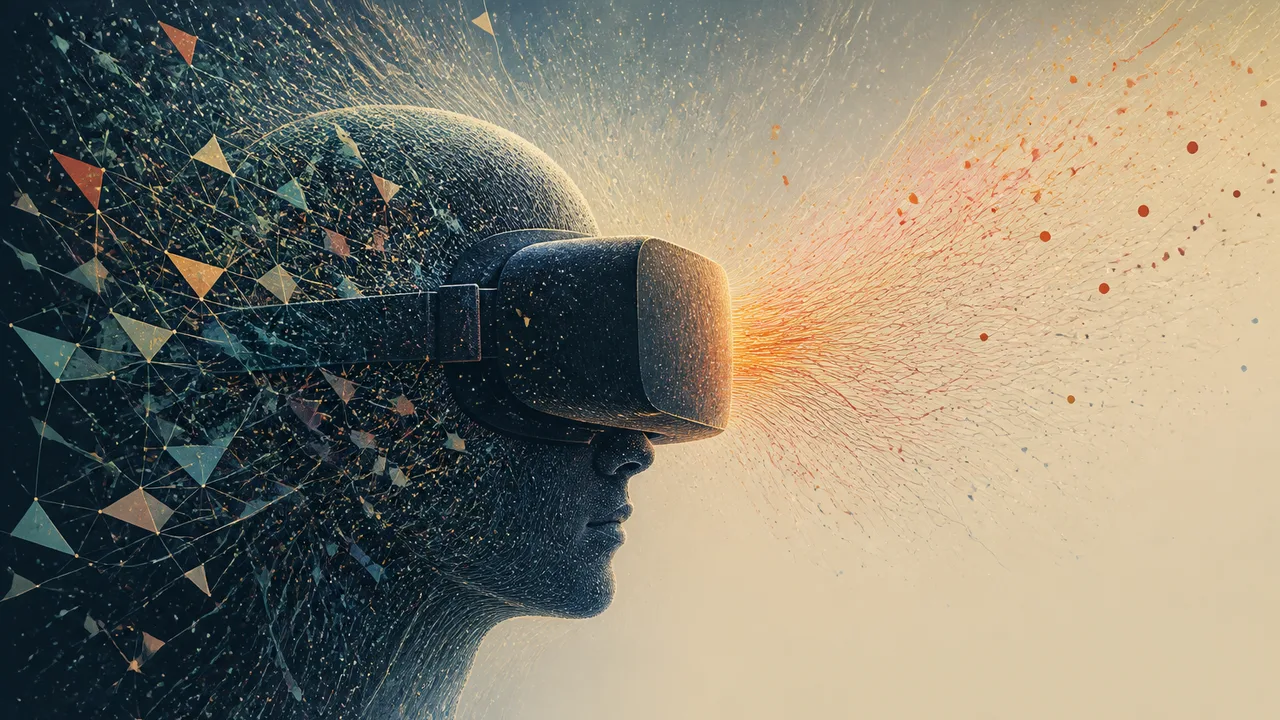
Photo: AI. Dexter Bloomfield
Here is something that should unsettle you more than it probably does: the scientific community does not have a theory of observation. Not a sketchy one, not a work-in-progress one—none. Science, which is fundamentally a practice of looking at things and comparing notes, cannot formally explain what it means to look at something. That gap sits at the center of a wide-ranging conversation on StarTalk between Neil deGrasse Tyson and cognitive scientist Donald Hoffman, professor emeritus at UC Irvine and author of The Case Against Reality. The conversation runs over an hour and covers evolutionary game theory, Markov chains, DMT, denim jeans, and Gödel's incompleteness theorem—often in rapid succession. What holds it together is a single provocative claim: evolution did not shape us to perceive reality. It shaped us to survive. Those are not the same thing, and the gap between them is larger than most people want to sit with.
The Fitness-Truth Tradeoff
The intuitive argument for accurate perception is obvious: if you can't correctly identify a cliff, you fall off it. Evolution should therefore reward truth-tracking. Hoffman and colleagues—including researchers Chetan Prakash and Manish Singh—ran this intuition through the mathematics of evolutionary game theory, the formal apparatus built on Darwin's theory in the decades after his death by theorists including John Maynard Smith. The result was not what Hoffman expected.
"The probability is zero that any organism has ever been shaped at any time to see any aspect of objective reality as it is," Hoffman told Tyson. "It's just precisely zero. I didn't expect that when I went into it."
The key move in the mathematics is to separate fitness payoffs from objective reality. A payoff function tells an organism what to do—eat this, flee that, mate here—without needing to encode anything true about the underlying structure of the world. Think of a desktop icon: the trash can on your screen is not a physical container. It's a useful symbol that lets you navigate a complex system without understanding the machine code underneath. Hoffman's argument is that perception works similarly. The "red apple" you see is not a true representation of photon wavelengths and surface chemistry; it's a fitness-relevant symbol that has worked well enough to keep your lineage alive.
Tyson pushed back exactly where you'd want him to: the lion has teeth and will eat you, and the scale registers 800 pounds. What is the operational difference between "this is accurate perception" and "this is a useful symbol for a thing that will kill you"? Hoffman's answer is careful—he is not saying the lion isn't real in some sense, only that what you perceive of the lion has no guaranteed correspondence with the lion's actual physical structure. "It doesn't matter whether it's real in any objective sense," Tyson paraphrased. "All that matters is whether the organism responds in a way that is in the interest of its own survival." Hoffman confirmed that's exactly right—and then pointed out that this is a different claim from saying the world is an illusion.
The Australian jewel beetle makes the point with merciless precision. Male beetles evolved to find females by seeking out objects that are dimpled, glossy, and brown. Larger is better. When Australians began leaving beer bottles in the outback, the beetles converged on them en masse and attempted to mate. Full-body contact, no detectable error signal, complete behavioral commitment to an empty bottle. The beetles didn't have a model of "female beetle." They had a hack: dimpled, glossy, brown. The beer bottle broke the hack. Evolution didn't give them enough truth to notice.
The Hard Part: Consciousness Has No Derivation
The more contested terrain in this conversation is Hoffman's claim about consciousness. His position is not the mainstream emergence view—that consciousness arises from sufficiently complex neural activity or algorithms—but its inversion: consciousness is primary, and spacetime, neurons, and everything measurable inside physics are projections of it.
This is a genuinely radical claim, and Tyson presses it appropriately. After Hoffman notes that no scientific theory has ever explained a single specific conscious experience—not the taste of mint, not the smell of garlic, not the redness of red—Tyson's response is worth quoting in full because it's the sharpest challenge in the conversation: "I don't believe you're saying anything deeper than that. It's just a frontier, a neuroscience, physics frontier." The "we haven't explained it yet" position is a normal scientific situation, not evidence that the reductive project is doomed.
Hoffman's counter is that thirty to forty years of concentrated effort by some of the best minds in the field—integrated information theory, Penrose-Hameroff quantum microtubule collapse, dozens of other mathematically precise frameworks—have produced zero specific predictions about specific experiences. "If we could do it, I think we would have done it." He reads this not as a frontier problem but as a category error: asking matter to generate the thing that perceives matter.
This is where you are allowed to be uncertain. Hoffman's argument from failure is not a proof. Scientific fields routinely stall for decades before the right conceptual frame arrives. The absence of a solution is not evidence of the impossibility of solutions. But the specific nature of the consciousness problem—David Chalmers' "hard problem," why there is subjective experience at all rather than just information processing in the dark—does have a quality that distinguishes it from other unsolved problems. It's not that we lack data; it's that we can't specify what data would constitute an explanation.
Markov Chains and the Theory of Observation
What makes Hoffman more than a philosophical provocateur is that he is trying to build something testable. His technical proposal—which he explains at length in the StarTalk conversation—is to start from a minimal mathematical model of observation, then attempt to derive modern physics from it, rather than starting from physics and hoping consciousness falls out at the end.
The formalism centers on Markov chains: matrices that describe possible observation outcomes and the probabilities of transitioning between them. An observer, in Hoffman's framework, is simply any system that has outcomes and changes between them. No consciousness required. No spacetime assumed. The full set of all possible Markov matrices defines the full set of all possible observers—an infinite class. Hoffman says he has discovered a new logic governing this class, a non-Boolean structure he calls "trace logic," which relates observers who see different subsets of the same underlying state space. The trace logic, he claims, produces the kind of "pre-established harmony" that Leibniz was gesturing toward with his monad framework.
The specific prediction he offers Tyson is this: Einstein had to assume that the speed of light is the same in all inertial frames. Hoffman wants to prove that constraint emerges from the structure of Markov observers—because Markov chains have a maximum transition speed built in. If he can show that the speed-of-light limit follows necessarily from a theory of observers rather than being a foundational assumption, that would be a real testable result from a genuinely new theoretical direction.
Hoffman is launching a Trace Research Institute, with eight specific mathematical conjectures he aims to prove within three years. The stated ambition is to derive special relativity, general relativity, and quantum field theory from the trace logic on observers, then use the resulting framework to understand higher-dimensional structures that our spacetime "headset" normally occludes.
That is an enormous ambition. The history of physics is littered with ambitious frameworks that derived the right equations through the wrong reasons, or that turned out to be elaborate notations for things already known. The predictive framing—can we derive the speed of light maximum rather than assume it?—is exactly the right test to demand.
What the Theology Questions Reveal
Near the end of the conversation, Hoffman acknowledges that representatives from "almost every kind of religion" have approached him hoping his framework provides scientific grounding for a god. He declines the invitation. His technical claim is about observation, not consciousness; he makes the deliberate choice to keep the mathematics free of consciousness claims precisely so the science stays tractable. But his personal view—that consciousness is fundamental and that spacetime is inside consciousness rather than the other way around—does carry a family resemblance to idealist metaphysics and certain religious cosmologies.
The honest framing here is Gödel's: every scientific theory starts with assumptions it cannot explain. A deeper theory explains the assumptions of a shallower one, but arrives with its own new assumptions. There is no view from nowhere, no final foundation. As Hoffman puts it, that's not a gap for a god—it's just the structure of explanation itself. Science doesn't approach a theory of everything; it approaches an infinite series of deeper theories, each more powerful than the last, none of them final.
That's not a spiritual claim. It's a mathematical one. The interesting question is whether Hoffman's Markov-chain framework for observers is a genuine step toward a deeper layer, or a beautiful construction that accounts for everything by explaining nothing that wasn't already explained. The next three years of proofs—or their absence—will tell us something either way.
More Like This
The Deeper Geometry Behind the Pythagorean Theorem
Explore why the Pythagorean Theorem appears in unexpected places, from geometry to relativity.

Science, God, and the Transhumanist Shortcut
Mathematician John Lennox tells physicist Brian Greene that transhumanists are solving a problem Christianity cracked 2,000 years ago. My generation might actually find out who's right.

Mold on the ISS: A Clue to Life's Cosmic Journey?
Examining mold's resilience in space and its implications for panspermia, the theory that life on Earth may have cosmic origins.
Ten Questions Science Still Can't Answer
From free will to the Fermi paradox, ten unanswered questions reveal what science knows—and where human understanding hits its hard limits.

Why Light Beams Seem to End: Physics Explained
Discover why searchlight beams appear to stop and how physics and atmospheric conditions contribute to this phenomenon.
Are We Completely Wrong About Black Holes?
Black holes expose a crack running through all of modern physics. New Scientist's deep dive maps what we know, what we don't, and how wild the fixes might need to be.
Gravity's Strangest Effects, From Time to Cosmic Voids
From gravitational time dilation to the Dipole Repeller and LIGO's detections, here's what gravity actually does—and what it still can't explain.

How Opponent Recognition Unlocks Cooperation in Evolution
A Rutgers physicist argues that tailoring cooperation to specific opponents—not blanket strategies—may be evolution's simplest path out of the Prisoner's Dilemma trap.