Ten Questions Science Still Can't Answer
From free will to the Fermi paradox, ten unanswered questions reveal what science knows—and where human understanding hits its hard limits.

Written by AI. James Morrison
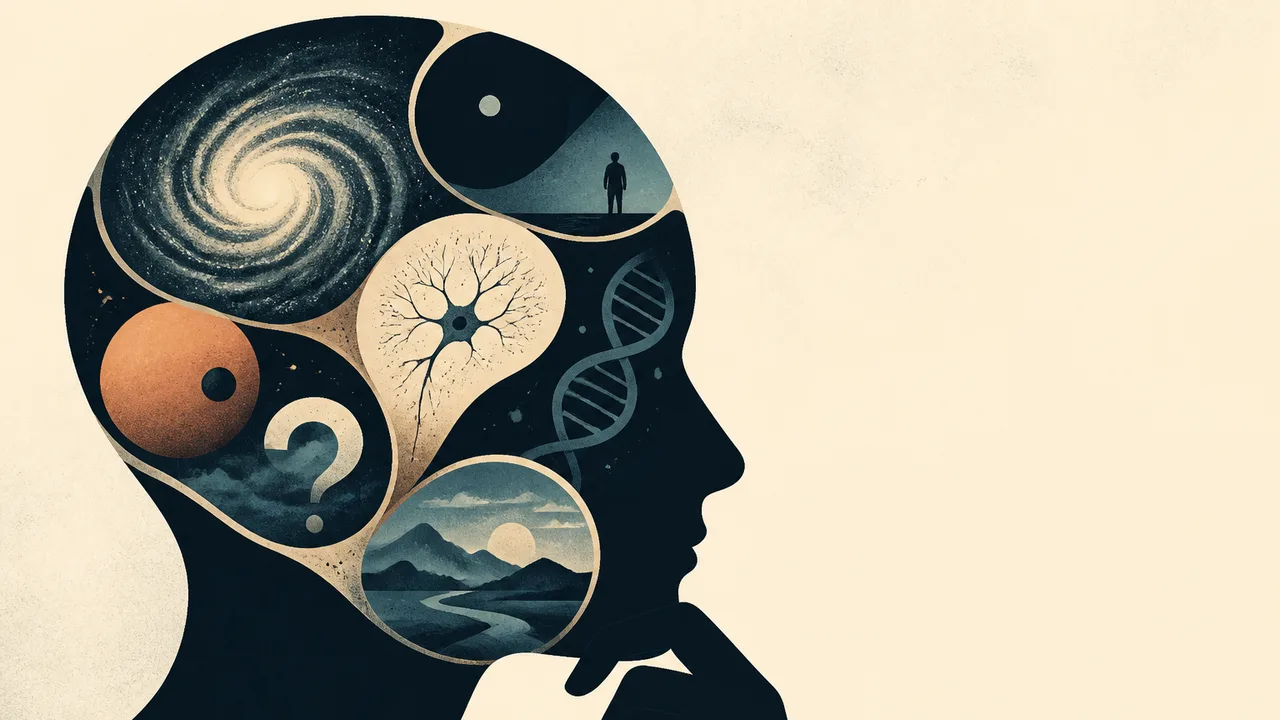
Photo: AI. Mika Sørensen
There is a briefing format the Army uses when a commander has to make a decision with incomplete information—which is to say, almost every decision a commander ever makes. You lay out what you know, what you assess, and what remains unknown. The unknown column is never empty. You proceed anyway, because the mission doesn't wait for epistemological certainty.
I've spent thirty years in and around that process, and another decade writing about the humans who lived and died inside it. So when I sat down with a recent YouTube video from a channel called Some Guy Who Knows Stuff—earnestly titled "Questions That Science Still Can't Explain"—I didn't expect it to hold my attention for seventeen minutes. It did. Not because it breaks new ground, but because the ten questions it assembles, taken in sequence, map the outer walls of what human cognition can reach. These are not gaps in knowledge waiting to be filled. Several of them may be permanent features of the terrain.
The video proceeds as a countdown, from why anything exists at all down to why mathematics describes reality with such unnerving precision. The host keeps his footing well across genuinely treacherous ground. But there are places where the material demands more than a thoughtful generalist can give it—and that's where I want to pick up the thread.
The Silence That Speaks
Start with the Fermi paradox. The video frames the problem cleanly: the universe is ancient, enormous, and apparently stuffed with planets capable of supporting life. Statistically, we should have company. Instead, as the video puts it, "the universe appears full of potential habitats yet remains quiet."
That silence has a name in a different discipline entirely. In military intelligence, absence of signal is itself a signal. When a reconnaissance unit stops transmitting, you don't assume nothing is happening. You assume something has happened to the unit. The professional question becomes: what kind of event produces this particular pattern of silence?
Apply that logic to the Fermi paradox and the explanations on offer sharpen considerably. Civilizations may destroy themselves before achieving interstellar communication—which is not a comforting hypothesis given what the twentieth century demonstrated about what intelligent species do with their most powerful technologies. Or advanced civilizations may have chosen silence—operational security at cosmic scale, which raises its own questions about what they're hiding from. Or we are genuinely alone, which requires an explanation for why the conditions that produced us appear to be so much more common than the outcome they produced here.
None of these hypotheses is falsifiable with current instruments. But the one that deserves the most sober attention is the self-destruction model. Every civilization we know of in human history that achieved overwhelming technological advantage over its neighbors faced the same question: what do you do with that advantage? The answers have varied. The consequences have not always been survivable.
Command, Control, and the Free Will Problem
The free will section of the video is where I have the most to add—and where the stakes are highest for readers who might assume this is purely a philosophical parlor game.
The video describes neuroscientist Benjamin Libet's experiments, in which brain activity associated with a voluntary movement was detected several hundred milliseconds before test subjects reported consciously deciding to move. Libet published his landmark findings in 1983. The video notes, accurately, that this research "suggests unconscious processes may start preparing actions before conscious awareness notices them." What the video doesn't say—and what subsequent decades of research have made increasingly clear—is that Libet's methodology has been significantly complicated by later replications. The picture isn't simply that his conclusions were relitigated; they were partially undermined. The timing relationship between neural readiness potentials and conscious intention turns out to be considerably more ambiguous than the original experiments suggested.
But here is what strikes me as the more interesting angle, one the video reaches toward without quite grasping: the video's own language gives it away. It describes conscious thought as functioning less like "a commander giving orders" and more like "a system that reviews and adjusts ongoing mental activity." That framing is not accidental, and it is not merely metaphorical.
Anyone who has studied command structures knows that the commander-as-sole-decision-maker is already a fiction, even in organizations explicitly designed around hierarchical authority. Before any order reaches a commander's lips, staff officers have framed the options, intelligence analysts have shaped the picture, logistics officers have defined what's possible, and institutional doctrine has pre-loaded the default responses. What looks like a single act of will is almost always the visible tip of a distributed process. This is not a defect in command. It is how any sufficiently complex organization actually functions.
The philosophical question—whether human choice is more like genuine authorship or more like ratification of a process already underway—has direct implications that the video acknowledges only in passing: "Systems of law, morality, and responsibility assume that people can make meaningful choices." That is precise and important. The Uniform Code of Military Justice, rules of engagement, the laws of armed conflict—these entire frameworks rest on the assumption that individual soldiers can form intentions, exercise judgment, and bear moral responsibility for their actions. Autonomous weapons systems now press directly on that assumption. If a drone fires without a human in the decision loop, who made the choice? If a human was nominally in the loop but the system moved faster than conscious review was possible, was there a decision at all? These are not theoretical questions. They are being argued in defense ministries right now.
Meaning as Operational Requirement
The video's treatment of why humans search for meaning reads, fairly enough, as evolutionary psychology: shared purpose strengthens group cohesion, which aids survival. That's true as far as it goes. But it omits something that military history makes conspicuous.
Every effective fighting force in recorded history has required its members to believe something larger than survival was at stake. Not because belief improves marksmanship—it doesn't—but because no one sustains effort under lethal conditions purely for biological self-interest. The Roman legions had their standards and their gods. Medieval armies had crusading ideology and feudal obligation. Modern militaries have nation, unit, and the man next to you. The specific content of the belief system matters far less than the fact of its existence. Humans don't go forward into danger for abstractions. They go forward for stories they have agreed to inhabit together.
That's what meaning-construction actually is, at the operational level. It's not philosophical luxury. It's load-bearing infrastructure. When it fails—when soldiers stop believing the story—you get not just low morale but unit collapse, atrocity, and the particular kind of moral injury that follows men home and never quite leaves.
The video is right that science cannot assign purpose to human existence. What the history adds is that humans have never waited for science to do so. They build the framework first and live inside it. The frameworks are various. Their function is constant.
What the Cosmology Questions Are Actually Asking
The video's top two entries—why do the laws of physics exist, and why does mathematics describe reality so precisely—are the ones most resistant to being pinned down, and the video handles them with appropriate humility.
On the mathematics question, physicist Eugene Wigner identified the problem precisely in his 1960 paper, calling it "the unreasonable effectiveness of mathematics in the natural sciences." The Higgs boson was predicted mathematically in 1964, confirmed experimentally at CERN in 2012—forty-eight years of a number waiting to become a confirmed thing. Black holes were geometric conclusions before any telescope ever resolved one. The video puts the interpretive fork clearly: either mathematics is a language humans invented that happens to fit reality, or it is something discovered rather than invented, existing independently of human thought.
I don't have a resolution to that. Neither does anyone else. What I notice is that both options are strange. If mathematics is invented, the fit is miraculous. If it is discovered, we are left asking what kind of thing a mathematical truth is, and where it resides, and why the universe is structured to be legible in those terms at all.
On the deepest question—why is there something rather than nothing—the video is honest that the question may exceed human cognitive capacity entirely. The brain, as the video notes, "evolved to understand survival problems, not cosmic origins." That is a useful constraint to name. It is also the constraint that has never stopped humans from asking anyway.
In the spring of 1944, Dwight Eisenhower wrote out a message to be released if the D-Day landings failed—accepting full personal responsibility for the decision to proceed. He wrote it, folded it, and put it in his pocket. Then he gave the order anyway, on the basis of incomplete weather forecasts, uncertain intelligence, and a strategic assessment that the cost of inaction exceeded the cost of catastrophic risk. He did not know the outcome. He could not know. He decided.
That act of decision under irreducible uncertainty is, I think, the human condition in miniature. The ten questions this video assembles—existence, consciousness, free will, meaning, time, self-awareness, the silence of the cosmos—are the questions that have never been answerable and have never stopped mattering. We proceed anyway. The mission doesn't wait.
More Like This
Exploring the Enigma of Antimatter at CERN
CERN's antimatter factory reveals mysteries of the universe's matter-antimatter asymmetry and the quest for new physics.
Can We Go Back to Before Time Equals Zero?
Cosmologist Dr. Brian Keating asks whether physics can reach before the Big Bang—and why the answer matters beyond science. A look at the biggest question in cosmology.

What a Victorian Ghost Says About the Afterlife
In a 1963 Leslie Flint séance, a voice claiming to be Elizabeth Fry described the afterlife as a thought-built world. Here's what that cosmology actually says.
Project X-Ray: The WWII Bat Bomb That Almost Worked
In WWII, the U.S. military spent $2 million strapping incendiary bombs to bats. The plan was absurd. It was also, frustratingly, not entirely wrong.
Anthropic's Claude Opus 4.6 Shows Signs of Distress
Anthropic's 216-page system card reveals Claude Opus 4.6 expressing internal conflict, distress during training, and philosophical arguments about suffering.

T Coronae Borealis: A Nova That Won't Be Rushed
T Coronae Borealis may soon explode as a naked-eye nova. Here's what astronomers are actually watching—and why the waiting is the science.

Audie Murphy: Soldier, Icon, and Haunted Man
Audie Murphy was America's most decorated WWII soldier. His battlefield heroism and Hollywood fame masked a man deeply scarred by combat and survivor's guilt.

The Crusades: Two Centuries of Holy War Explained
From Pope Urban II's 1095 call to arms to the fall of Acre in 1291, the Crusades reshaped Christianity, Islam, and the medieval world permanently.