Free Will, Psychopathy, and the Neuroscience of Self
Sam Harris, Roger Penrose, and Sophie Scott debate free will, consciousness, and whether neuroscience should reshape how we assign moral responsibility.

Written by AI. Priya Sharma
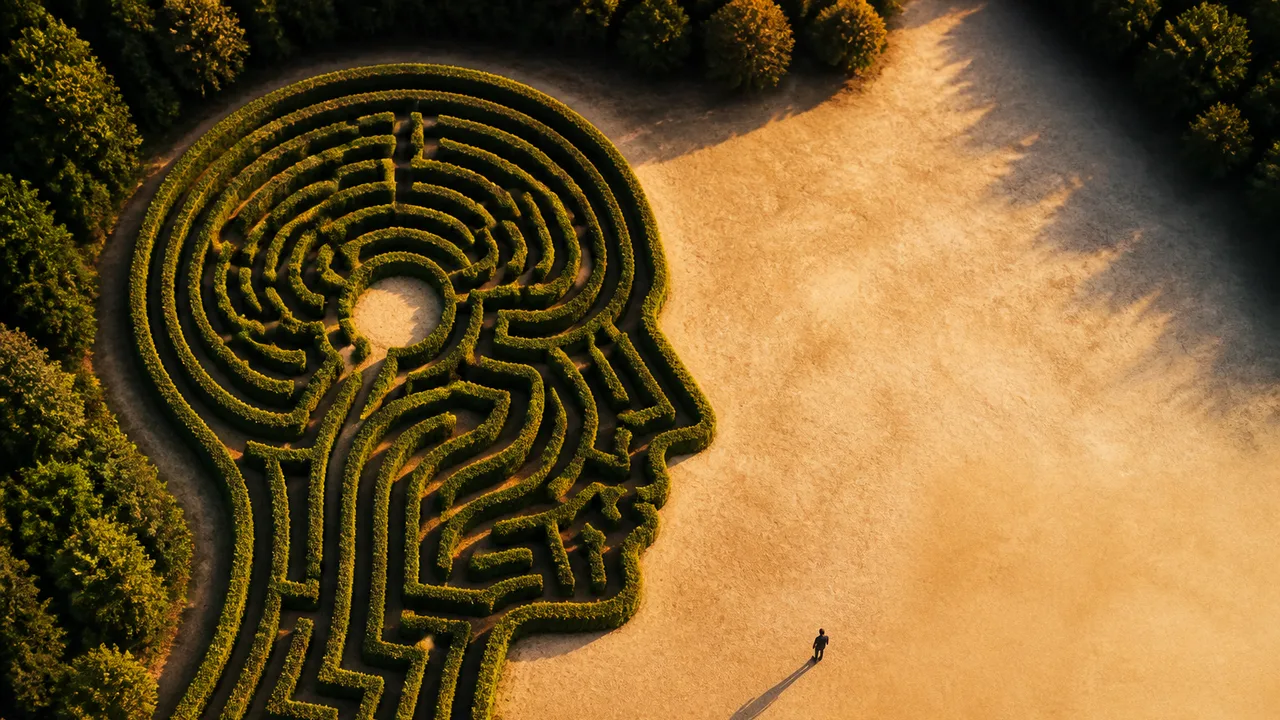
Photo: AI. Rio Sanchez
Try this experiment. Think of a film — any film. You know hundreds of titles. Pick one.
Whatever surfaced, Sam Harris has a point about it: you have no idea why that one. You can probably construct a story after the fact — you saw a trailer recently, someone mentioned it at dinner — but the honest answer is that the selection process was opaque to you. It happened, and then you became aware that it had happened.
Harris used exactly this illustration in a recent discussion at the Institute of Art and Ideas, seated alongside Nobel Prize-winning physicist Roger Penrose and cognitive neuroscientist Sophie Scott. The topic was the divided self — whether the unified, continuous "I" we navigate daily life with is a coherent concept at all, or a kind of useful fiction the brain tells itself. The conversation moved from phenomenology to quantum mechanics to psychopathy, which is either a sign of genuine intellectual range or a very ambitious panel brief. Probably both.
The self that isn't there
Harris's position is clean enough to state, though its implications are anything but: the sense of being an unchanging subject who persists through time and authors your own decisions is, neurophysiologically, not defensible. The brain is a process — electrochemical, dynamic, nothing crystalline about it. "There is no part of it that is truly unchanging," he argued. The entity you imagine looked out through your eyes at sixteen is not lurking somewhere in your frontal lobes, older and wiser. That self simply doesn't exist. What does exist is consciousness, and consciousness, Harris suggested, "at bottom, once you strip away all of the particulars of its contents, is a kind of impersonal reality."
This is the part that tends to make people either nod with recognition or reach for an objection — sometimes simultaneously. Harris is not denying that memory, psychological continuity, or personality exist. He is making a more specific claim: that the feeling of being a separate observer of your own experience, a self sitting behind the eyes watching the show, is a construction. The observer isn't distinct from the river. It is the river.
Scott approached the same territory from a more empirical direction. Identity, she argued, is substantially performative — a set of social presentations we deploy and adjust by context. People with aphasia often describe their condition as identity theft, she noted: when you can no longer speak the way you used to, others' assumptions about you shift immediately, and something you'd considered central to your self is suddenly inaccessible. Scott also offered the more personal evidence of finding her own teenage diary — expecting nostalgia, getting something closer to anthropology. "It was like it'd been written by a total stranger," she said, describing how a sixteen-year-old constructed an entirely different narrative around the same events she can still recall in her fifties.
This accords with work from other corners of neuroscience: the idea, as Emory neuroscientist Gregory Berns has explored, that unified selfhood is less a stable entity than an ongoing editorial project — a story we constantly revise, with each new chapter slightly reframing what came before.
Penrose's detour through quantum mechanics
Roger Penrose, characteristically, arrived at the conversation from a different galaxy of assumptions. His view is that consciousness is not simply a product of computation — that no Turing machine, regardless of storage capacity, can replicate the quality of understanding something. His evidence for this comes partly from Gödel's incompleteness theorems, which he encountered as a graduate student and which, in his telling, were intellectually transformative. Gödel's theorem demonstrates that within any consistent formal system, there are true statements that cannot be derived by the system's own rules — yet a human mathematician can see that they're true. "The quality of understanding something goes beyond what can be achieved by a computer," Penrose argued.
To the obvious retort — that AI systems can now pass exams, write code, and produce text indistinguishable from human output — Penrose would say: yes, and so what. His claim is not about performance, but about something prior to performance. What is it to actually understand that a statement is true, rather than to process inputs and generate a plausible output? This is, roughly, Searle's Chinese room argument dressed in mathematical formalwear. It remains contentious. Many philosophers of mind think it proves less than its proponents claim. But Penrose pressed further into physics: consciousness, he suggested, may be exploiting aspects of physical law we don't yet understand, specifically the collapse of the wave function — the still-mysterious process by which quantum superpositions resolve into definite classical states. He was careful to disavow the naive version of this view, where consciousness causes wave function collapse. His claim is more hedged: wherever consciousness connects to physics, it happens at this poorly understood junction. "There is something beyond the computable picture," he maintained, "and we actually harness that for consciousness."
Whether Penrose is right, there is something to notice about the structure of his argument: it carves out a space in which human understanding cannot be fully reduced to mechanism, which would have considerable implications for moral responsibility if it held up. The panel didn't fully close that loop, but the implication was present in the room.
Where this gets genuinely difficult: psychopathy and punishment
The last and most practically consequential stretch of the discussion concerned moral responsibility. Harris laid out what might be called the compassionate determinist position: everyone is, at some level, a force of nature. No person chose their genes, their early environment, or the neurological state their brain was in before their last action. "The combination of genes and environment are precisely what created the states of their brain prior to their last action."
This does not mean, Harris was careful to say, that incarceration is unjust or unnecessary. People who are dangerous need to be separated from society. The moral calculus, though, changes substantially. He offered a thought experiment: if we had a cure for psychopathy — a complete neurological understanding of what makes someone incapable of empathy or remorse, and a reliable intervention — would it make sense to withhold it on the grounds that psychopaths deserve to suffer? "We would recognize that psychopathy is on some basic level a derangement of the brain," Harris argued, "and we would cure that in the same way we would cure diabetes."
The thought experiment is well-constructed precisely because it doesn't ask us to let dangerous people roam free. It asks what our emotional insistence on deserved punishment actually tracks. If the answer is "ignorance of mechanism," that's uncomfortable. Our intuitions about moral responsibility may be less about justice and more about the limits of our current understanding of brains.
Scott added a layer that is easy to overlook in these abstract discussions: sex differences in criminal behavior. The incarceration ratio of men to women — roughly 23 to 1, she noted, drily describing it as "worse than engineering departments" — is a biological signal we tend to suppress in moral discourse. Testosterone-dopamine interactions appear to amplify reward-seeking behavior in ways that manifest differently across sexes. "What we do with this," Scott observed, "is we ignore it. And we pretend it's not true and that people have made moral failings." This isn't an argument against moral norms — Scott was explicit that human communities require them — but it is a case for holding those norms more loosely, with more attention to the biological substrate underneath them.
Galen Strawson's philosophical formulation hung implicitly over this section of the discussion: you do what you do because of who you are; you cannot be responsible for who you are; therefore you cannot ultimately be responsible for what you do. It's one of those arguments that feels airtight until you try to live by it, at which point it becomes unclear what you'd even be doing differently.
The unresolved tension
What the Harris-Penrose-Scott conversation surfaces, but does not resolve, is a genuine tension between two things we seem to need simultaneously. We need the concept of moral responsibility — without it, social norms are unmoored and the entire apparatus of law collapses into therapeutic management. And we are accumulating neuroscientific evidence that the kind of authorship moral responsibility requires — a self that could have done otherwise, that chose freely from genuine alternatives — is not well-supported by what we know about how brains produce behavior.
Harris's film experiment is a small demonstration of this. One thought, not another. A trillion repetitions producing the same result. Adding randomness to the picture, he noted, doesn't recover agency — randomness is just noise, not choice.
The question isn't whether determinism is true (most working neuroscientists treat the brain as a physical system and proceed accordingly). The question is what we build on top of it. Does recognizing the self as a narrative construction require us to renegotiate punishment, blame, and moral desert? Or do those concepts survive, functioning well enough as social technology even if their metaphysical foundations are shaky?
None of the three panelists fully resolved this. The honest position might be that we are still early in figuring out what neuroscience actually demands of ethics — and that the people most certain they know the answer probably haven't been paying close enough attention to either.
More Like This

Stoicism as a Political Philosophy, Not a Retreat
Massimo Pigliucci argues Stoicism's dichotomy of control isn't passive resignation—it's a framework for smarter, more durable political engagement.
How the Brain Decides What Is Real and What Is Not
UCL neuroscientist Nadine Dijkstra explains how the brain constructs reality, why imagination isn't hallucination, and what breaks when the system fails.
Do DMT Entities Point to Alien Consciousness?
Cognitive scientist Donald Hoffman claims DMT entities may be real alien minds. The math is real. Whether it proves anything about consciousness is a different question.
Mapping the Brain's Electrical Grid to Treat Schizophrenia
Duke researcher Kafui Dzirasa is building an electrical map of the brain to find new treatments for schizophrenia and depression—beyond dopamine and serotonin.
James Webb Telescope Data Strains Big Bang Cosmology
Philosopher of science Bjørn Ekeberg argues Webb's early galaxy findings expose a deeper problem: cosmology's dependence on interpreting light it cannot fully verify.
AI Math Breakthroughs and the Personhood Debate
OpenAI's Astra solves decade-old math problems, Jeff Dean exits Google, and thinkers debate whether AI deserves legal personhood. What it all means.

Texas Chupacabra Sighting Explained by DNA Analysis
A Texas police dash cam captured a bizarre creature in 2008. DNA testing later revealed what it actually was — and the answer is stranger than fiction.

Black Holes: Destroyers, Organizers, and Open Questions
Black holes destroy worlds and organize galaxies—but what does the science actually show? A look at Sagittarius A*, adaptive optics, and the limits of what we know.