Stoicism as a Political Philosophy, Not a Retreat
Massimo Pigliucci argues Stoicism's dichotomy of control isn't passive resignation—it's a framework for smarter, more durable political engagement.

Written by AI. Helen Papadopoulos
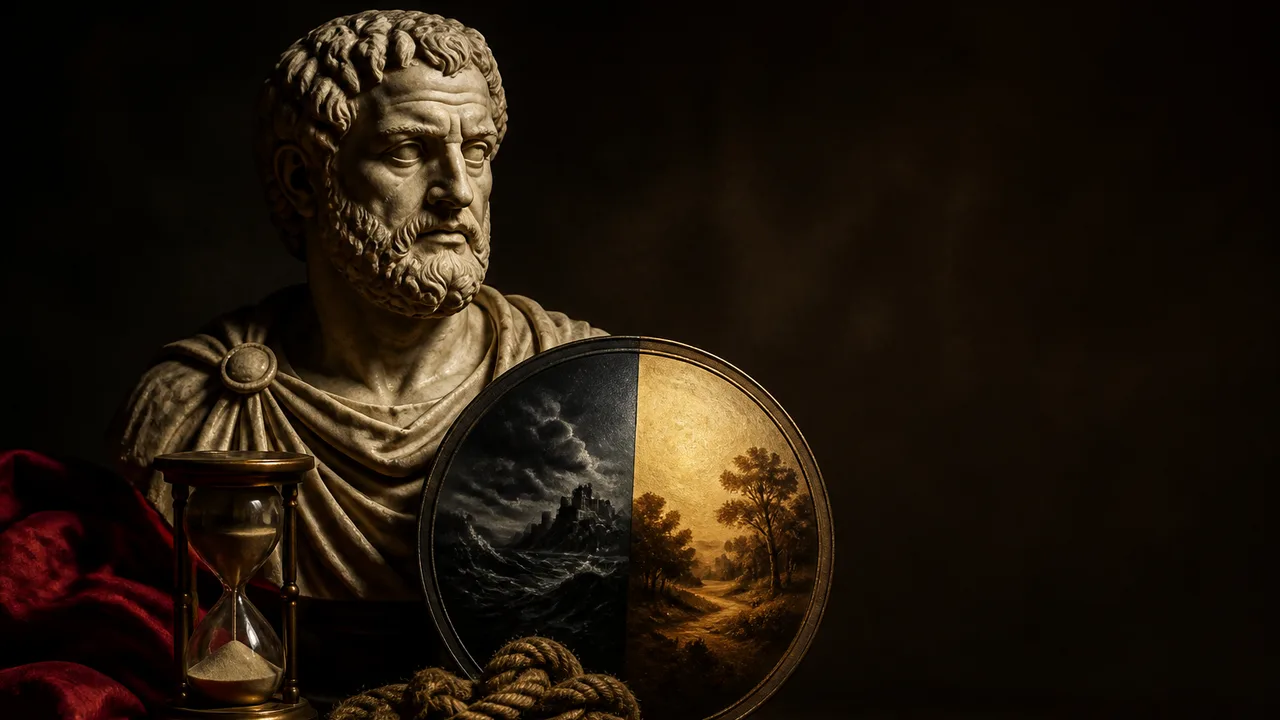
Photo: AI. Soraya Hadid
There is a version of Stoicism that has become very fashionable and very useless. It turns up in productivity podcasts and wellness apps, promising equanimity through detachment—the philosophical equivalent of a cold plunge. Endure. Accept. Breathe. It is a philosophy, in this rendering, for people who have already made peace with the world as it is.
Massimo Pigliucci, philosopher of science and one of the more prominent contemporary advocates for Stoic practice, thinks this reading is a misreading. Speaking at the How the Light Gets In festival in a conversation published by the Institute of Art and Ideas, he makes a case that the ancient Stoics were after something considerably more demanding—and more politically useful—than therapeutic resignation.
The distinction he draws is terminological but not trivial. The phrase "dichotomy of control," now standard in Stoic self-help circles, is actually a modern coinage. The ancient Stoics—Epictetus, Marcus Aurelius, Seneca—spoke instead of what is up to us and what is not up to us. That framing carries different weight. It is less about sorting the world into controllable and uncontrollable bins and more about a precise reckoning with responsibility: what are you genuinely accountable for, and what are you expending energy on that was never yours to determine?
Pigliucci illustrates this with a train delay—his train stopped mid-route the day before the festival, no explanation forthcoming, no recourse available. He found an alternative route, and then, crucially, sat down and read a book. "The idea is to discriminate between where it is exactly that you can act and do it. And then accept that, you know, sometimes there are certain things in life you just—they are the way they are. Nothing you can do about it."
The train is easy. It scales poorly, at first glance, to a democratic system that seems immune to citizen input, or a climate crisis driven by forces orders of magnitude larger than any individual's footprint.
The Wall Analogy and Its Limits
The interviewer presses Pigliucci on exactly this point: what about people who vote, who protest, who write and organize and donate, and still see nothing shift? Doesn't Stoic acceptance, repeatedly applied to repeated failure, become a sophisticated excuse for giving up?
His answer is brisk: "A risk of inaction is only if you do it badly." The Stoic framework, he argues, does not license withdrawal—it licenses strategic reassessment. If one approach isn't working, the task is to find another approach, not to abandon the project. He reaches for a wall metaphor: there is no point in battering your head against a wall you know will not break. Your head breaks instead. The question is whether you can find a way around it, over it, under it, or whether you can find different tools for demolition.
That is a reasonable argument, but it contains a tension Pigliucci doesn't fully resolve. Stoicism has historically been a philosophy of elites—Marcus Aurelius was an emperor, Seneca a wealthy statesman—and Epictetus, who was enslaved, is perhaps the exception that unsettles the rule. Pigliucci acknowledges, when the climate question comes up, that what you can do depends heavily on who you are and what resources you command: "Some people are very good at public speaking. Other people are good at organizing protests. Other people have a lot of money." The majority, he concedes, can inform themselves, vote, and support causes in modest ways. That is true, and it is probably correct. Whether it is sufficient as an ethical framework for structural injustice is a question the ancient Stoics did not have to answer—and Pigliucci doesn't claim they did.
The Epistemological Crisis
The conversation shifts, and this is where Pigliucci is on surer footing, to the collapse of expert trust in the post-pandemic landscape. His framing is precise: debunking pseudoscience used to mean correcting factual misunderstandings. Now, he says, you have to fight a prior battle—a "war of credibility"—before any facts can land.
His example is a relative who called during the pandemic asking for the original research papers on the virus, armed with a statistics course taken twenty years prior. Pigliucci, a biologist, told her honestly that he would struggle to read those papers himself given that his expertise runs to evolutionary biology, not virology. She remained undeterred. The problem, as he frames it, is not ignorance but the confident misestimation of one's own competence.
He is careful not to make this a blanket defense of all expert claims—experts make mistakes, he notes, and when a mechanic repeatedly returns your car broken, you find a different mechanic. But you find another mechanic, not a priest. The expert category itself remains the relevant one. "For some reason, we got to a situation where people do that in all instances except when it comes to science."
What Pigliucci doesn't grapple with directly—though the tension surfaces—is how that trust was eroded in the first place. Institutional credibility is not simply lost through individual irrationality; it is also lost when institutions behave in ways that justify skepticism, when expertise becomes entangled with commercial interest, or when the public has experienced being told things that turned out to be wrong. The mechanic analogy works precisely because mechanics are typically not also in the business of selling you a car you don't need. Science, as a social enterprise, operates in more complicated territory.
The Ghost Question
Pigliucci closes the interview with the question he has presumably fielded most often and takes least seriously: are there ghosts?
"Complete pseudoscience," he says, without apparent anguish. He describes a dowsing experiment he participated in—setting up randomized buckets of water, demonstrating that the dowser found water exactly fifty percent of the time, which is what probability would predict. When presented with this outcome, the dowser offered a response that has a certain deranged elegance: the proximity of skeptics interferes with his powers. They manifest, he explained, only when not being tested.
This is not an argument. It is an unfalsifiability machine, and Pigliucci recognizes it as such. What's interesting is that he doesn't pretend to find it boring. He admits he would genuinely love for certain paranormal things to be true—UFOs in particular. ("If a flying saucer were to land right here, I would volunteer to go there and greet them.") The desire for the world to be stranger and more populated than it is turns out to be compatible with rigorous skepticism. Perhaps that is the most Stoic position of all: wanting things to be different while accepting that they are as they are, and continuing to look anyway.
Metaphysics vs. Particle Accelerators
One exchange deserves more space than the festival format allowed. Pigliucci's description of his ongoing disagreement with philosopher David Chalmers—who holds a chair at NYU and is best known for coining the "hard problem of consciousness"—cuts to a genuine fault line in contemporary philosophy.
Pigliucci's position is not that metaphysics is stupid but that it has been made redundant. Metaphysicians, in the classical sense, try to uncover the underlying nature of reality through reasoning alone. Physicists do the same thing with particle accelerators, and they find things classical metaphysicians could not have anticipated. "He's living in the wrong century," Pigliucci says of Chalmers—who, it should be noted, would dispute this vigorously, and has, in print, at length.
Chalmers' rejoinder—one he has made repeatedly in his own work—is that physics can tell us what the world does without telling us what it is to experience anything. The hard problem of consciousness is precisely the question of why physical processes give rise to subjective experience at all, a question that particle accelerators, so far, have not addressed. Whether that question is scientifically tractable or philosophically confused is one of the genuinely live debates in contemporary philosophy of mind. Pigliucci bets on the former; Chalmers holds the latter position. Both men are serious, and the fight is real.
What's worth sitting with is that Pigliucci, the committed Stoic and champion of rational inquiry, chooses this as his favorite disagreement precisely because it requires him to work. Debating a creationist, he says, is easy—not because the creationist might not be articulate, but because the intellectual preparation required is minimal. Disagreeing meaningfully with Chalmers requires genuine effort, real preparation, actual intellectual risk.
That, it turns out, is as good a description of the Stoic approach to civic life as any he offered. Not disengagement. Not banging your head against immovable walls. But finding the fights worth having, preparing for them honestly, and accepting—without ceasing—that you might not win.
More Like This
Middle Platonism's Hidden Role in Western Esotericism
ESOTERICA's new crowdfunded seminar argues Middle Platonism built the foundations of Hermeticism, Gnosticism, and early Christian theology. Here's what that means.
WW1 Trench Life: What the Western Front Was Really Like
From Pals' Battalions to the Vickers gun, a new documentary unpacks the grim machinery of survival on the WW1 Western Front in unflinching detail.
Waco Siege: Ancient Echoes in Modern Tragedy
Explore the 1993 Waco siege through the lens of ancient cult dynamics and modern law enforcement challenges.

Donald Hoffman: Evolution Hid Reality From Us
Cognitive scientist Donald Hoffman argues on StarTalk that evolution gave us a VR headset, not a window—and the math behind Darwin backs him up.
Speusippus and the First Crisis of Platonism
Plato's own nephew may have dismantled Platonism's core doctrine. Dr. Justin Sledge's free seminar excavates the forgotten philosopher who changed everything.
Searching for London's First Roman Road Under Lambeth
Time Team investigates whether London's first Roman road ran through Lambeth Palace gardens—and why the Romans crossed the Thames there before building Londinium.

Pandemics That Brought Down Ancient Civilizations
From Cahokia to Constantinople, ancient DNA is rewriting how civilizations fell. Disease was often the hidden accelerant history forgot to record.

Prehistoric Anomalies That Challenge Archaeology's Timeline
From Göbekli Tepe to the Baghdad Battery, we examine the archaeological anomalies fueling debate about how far back advanced human knowledge really goes.