James Webb Telescope Data Strains Big Bang Cosmology
Philosopher of science Bjørn Ekeberg argues Webb's early galaxy findings expose a deeper problem: cosmology's dependence on interpreting light it cannot fully verify.

Written by AI. Priya Sharma
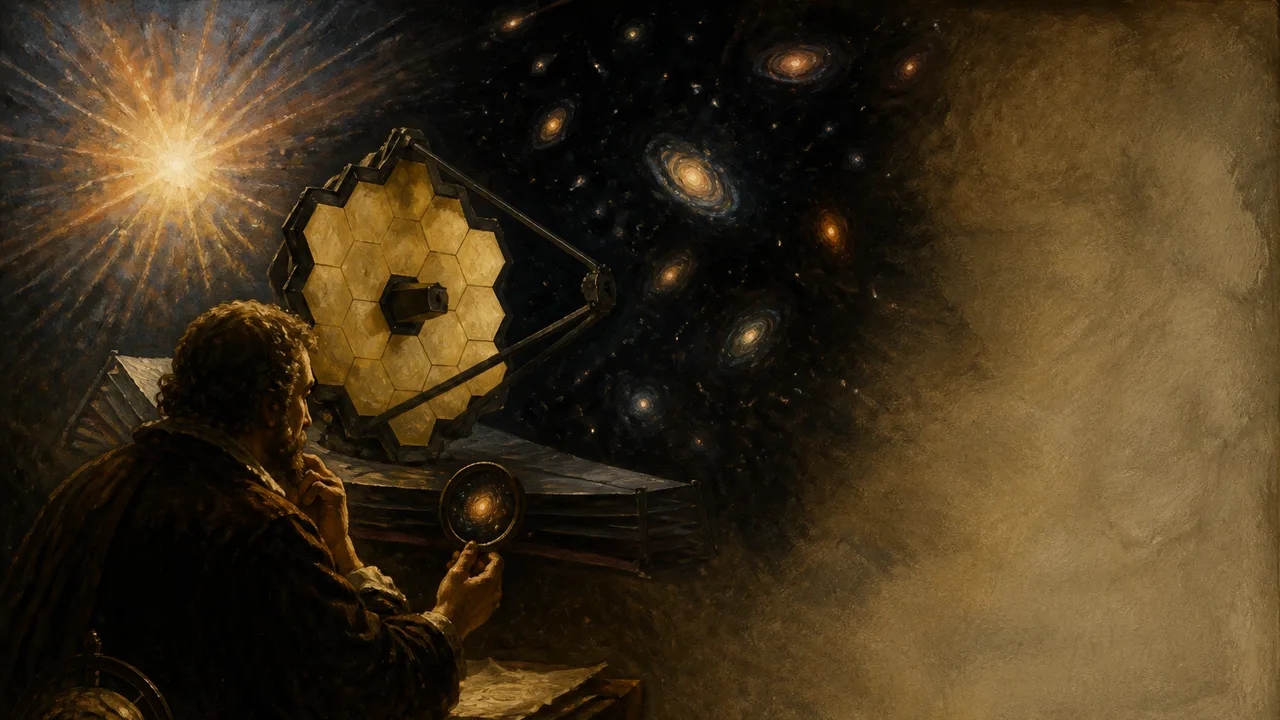
Photo: AI. Henrik Solberg
The headline version of cosmology is seductive: we built a $10 billion machine, pointed it at the sky, and watched the early universe come into focus. What Bjørn Ekeberg wants you to notice is how much work the word "watched" is doing in that sentence.
Ekeberg, a philosopher of science whose book Metaphysical Experiments: Physics and the Invention of the Universe scrutinizes the foundational assumptions of modern physics, gave a talk at the Institute of Art and Ideas laying out a case that deserves more careful attention than the usual "Webb breaks the Big Bang" headlines allow. His argument is not that the James Webb Space Telescope has falsified anything. It's that Webb has raised the epistemic pressure inside cosmology to a level where some honest accounting is overdue.
What the telescope actually does
Start with the machine itself. Webb, launched Christmas Day 2021 and positioned at the Sun-Earth L2 point roughly a million miles from Earth, is designed to detect infrared light — specifically, the ancient light from the early universe that has been stretched into longer wavelengths by cosmic expansion over billions of years. It measures wavelengths, spectra, brightness, patterns of radiation. That's the observation. Everything else — distance, age, mass, the look-back time that lets us say a galaxy existed in the very early universe — is interpretation.
"Cosmology is not direct vision in the ordinary sense," Ekeberg said. "It is a disciplined reconstruction of signals according to a theoretical model. So it's basically a theory of the universe built from traces of light."
That reconstruction is genuinely impressive. A spectral feature becomes a redshift. A redshift becomes a distance. A distance becomes a timestamp. A brightness becomes a mass estimate. Stack enough of these inferences and you have what looks like a detailed history of cosmic structure. But each step in that chain depends on the theoretical model that frames it — and the model was built, largely, from observations far closer to home than Webb is now reaching.
The findings that don't fit
Webb has produced results that strain the prevailing story in at least three ways, and the strain has not diminished as researchers look more carefully at the data.
First: JADES-GS-z14-0, one of the most distant confirmed galaxies known. According to Wikipedia's summary of the object's confirmed redshift measurement, this galaxy existed approximately 300 million years after the Big Bang. What unsettles cosmologists is not its distance but its luminosity — it is far brighter than models predicted anything should be that early. More luminosity at that epoch means star formation had to happen faster, more efficiently, or be distributed differently than current theory accounts for. The early universe galaxies problem isn't confined to one outlier; Webb has found a population of massive, well-assembled galaxy candidates appearing within the first billion years of cosmic history. "This was not supposed to happen," Ekeberg said. The standard timeline of structure formation simply did not anticipate this.
Then there are the "little red dots" — compact, red objects in the early universe that resist clean classification. Some may be young galaxies, some may be black holes wrapped in dense gas. The ambiguity is itself informative: these objects are not just mysteries, they are classification failures for the existing framework.
Ekeberg is careful not to overstate this. The Big Bang model has not been falsified. But "what Webb has done is exposed a heightened pressure inside of cosmology," he said, and that pressure points toward something deeper than adjusting a parameter here or there.
The reach of general relativity
Here is where Ekeberg's philosophical training sharpens the picture in a way that straightforward science reporting tends to miss.
Cosmology runs on Einstein's general relativity. The theory's track record within our local neighborhood — planetary orbits, light bending near the Sun, satellite timing corrections, and most dramatically, the direct detection of gravitational waves from merging compact objects by LIGO/Virgo, as documented by NASA's Blueshift — is genuinely extraordinary. But that extraordinary success was earned at scales and conditions that are not the scales of cosmology. General relativity has been verified in specific, controlled domains; extending it to the structure of the entire observable universe requires assuming it applies uniformly at scales where we have no independent check.
That success comes at a cost that rarely gets named: the more precisely you've verified a theory in one regime, the more tempting it becomes to assume it everywhere — including regimes where verification is structurally impossible from where you stand. When cosmologists test gravity at universal scales, they are not testing general relativity in isolation. They are testing general relativity inside a complete cosmological model, which already encodes assumptions about how matter is distributed, how space is expanding, and how uniform the universe is at large scales. The theory and the model are load-bearing for each other. You cannot easily pull one out to inspect it independently.
The cosmological principle
That interdependence is most visible in what Ekeberg calls one of cosmology's "philosophical load-bearing beams": the cosmological principle. This is the foundational assumption that on the largest scales, the universe is homogeneous and isotropic — the same in every direction, broadly uniform everywhere. It is supported theoretically by the large-scale smoothness of the cosmic microwave background, discovered in the 1960s, which became the observational cornerstone of the Big Bang framework.
But the cosmological principle cannot be tested from outside the universe. We use observations taken from within the universe to justify a simplifying assumption about the whole — an assumption without which much of modern cosmological calculation would become intractable. Ekeberg calls this circular in a very specific sense: the model tells us how to read the light, and the light then confirms or presses for revision of the model. "There's a circularity in this," he acknowledged, "and that circularity is how science works or has to work at the edge of the observable." The circularity is not a scandal. But it does mean the confidence interval on cosmological claims should be wider than the press cycle typically allows.
Ekeberg sketched out three domains of cosmological knowledge: the zone of direct observation (our solar system and what pre-Webb telescopes could resolve clearly), the much larger zone of inference where Webb now operates, and beyond that, an unknown totality whose extent we cannot measure because we don't know what we don't know. The farther out you reach, the more model-dependent every number becomes.
Light's impossible job
The deepest thread in Ekeberg's argument concerns what cosmology is actually asking light to do. In physics, light is well characterized: electromagnetic radiation, photons, built into the structure of spacetime and causality in general relativity. The speed of light in a vacuum is the foundation of our entire measurement system. Physics has a strong grip on this phenomenon as it behaves locally.
But cosmology promotes light to a different role entirely. It becomes the instrument by which we infer distance across billions of light-years. It becomes the clock by which we reconstruct cosmic timelines. It becomes the archive of everything we think we know about how the universe evolved. Along the way, that light has been stretched by expansion, bent by gravity, marked by intervening gas, and dimmed or brightened by dust — all of it processed through instruments whose calibration is itself theory-dependent.
"Cosmology reads light after the universe happened to it," Ekeberg said, "and then it asks that light to tell us the whole history of the universe."
That is a legitimate scientific program. It has produced real knowledge. But Ekeberg's point is that treating it as equivalent in epistemic status to a laboratory measurement — the way popular science communication routinely does — is a category error. The history of the cosmos is being reconstructed from signals that the cosmos itself has heavily processed before they ever reach us.
What Webb is showing, galaxy by too-bright galaxy, is that the reconstruction may need revision. The more interesting question — the one Ekeberg's talk keeps circling without quite landing on, because it may be unanswerable from inside the discipline — is whether any revision of parameters will be enough, or whether the framework doing the interpreting is itself part of what needs to change.
More Like This
Brian Keating on What Came Before the Big Bang
Cosmologist Brian Keating explains the multiverse, dark energy, string theory's fatal flaw, and why finding extraterrestrial wisdom matters more than finding aliens.
James Webb Challenges Dark Matter Beliefs
James Webb Telescope data questions the Bullet Cluster's role as dark matter proof, suggesting complex galaxy interactions.

Indigenous Star Lore Is Reshaping Astrophysics
A new arXiv paper argues Indigenous astronomical traditions aren't just cultural history—they're a scientific resource. But who controls how that resource gets used?
Dark Energy: New Dimensions in Cosmological Models
Exploring how dark energy challenges our understanding of the universe and its evolution over time.
Galaxies That Challenge Our Cosmic Timeline
James Webb Space Telescope finds galaxies too evolved for the young universe, challenging current cosmological models.
Primordial Black Holes as Dark Matter Candidates
After decades of failed WIMP searches, physicists are turning to primordial black holes as a serious dark matter candidate. Here's what the evidence actually shows.
Fire Tornadoes on a Lake: The Bardstown Bourbon Disaster
In 2003, fire tornadoes erupted on a Kentucky lake. The cause wasn't paranormal—it was 800,000 gallons of burning bourbon and the right wind geometry.
The Maths Behind Palindrome Ages Explained
Mathematician Kat Phillips unpacks why some pairs of people have reversible ages—and the surprisingly elegant number theory that governs when it happens.