Primordial Black Holes as Dark Matter Candidates
After decades of failed WIMP searches, physicists are turning to primordial black holes as a serious dark matter candidate. Here's what the evidence actually shows.

Written by AI. Priya Sharma
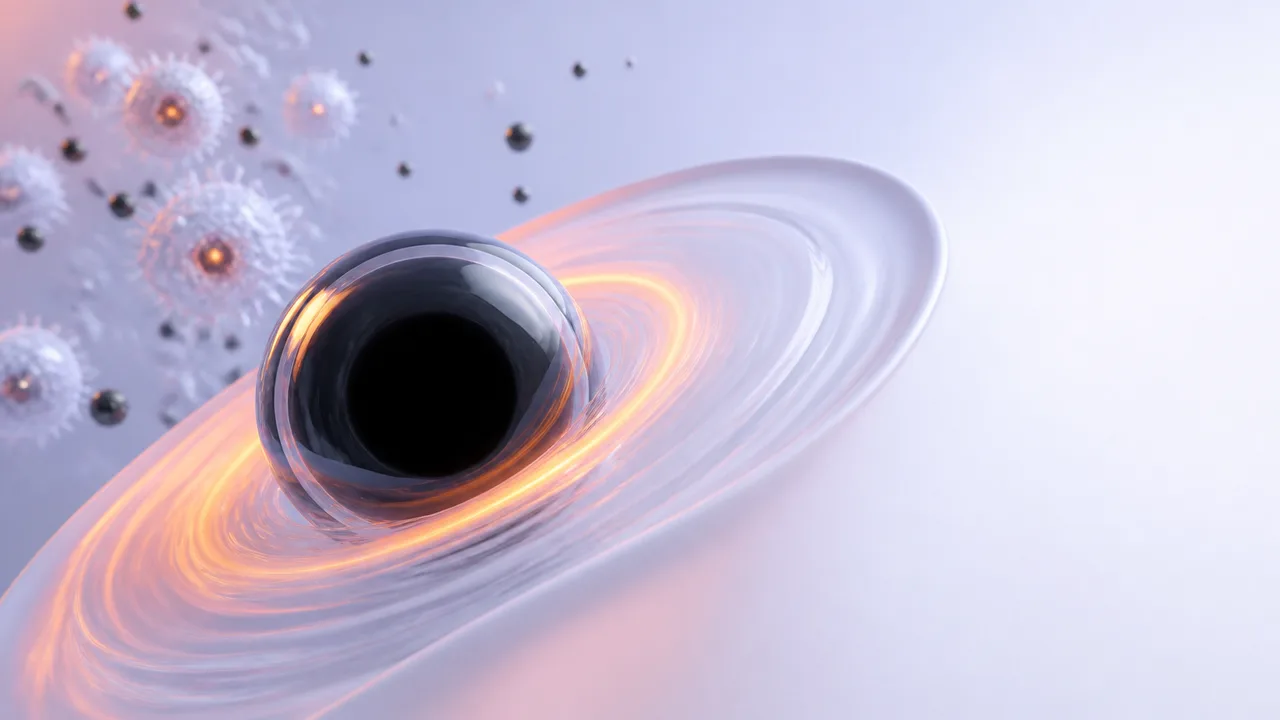
Photo: AI. Ren Takahashi
The universe is, by mass, mostly something we cannot identify. That sentence has been true for roughly a century, and it remains just as embarrassing now as it was when Fritz Zwicky first noticed, in 1933, that the galaxies in the Coma Cluster were moving far too fast to be held together by their own visible mass. Something unseen had to be providing the gravitational glue. Zwicky's observation was, at the time, treated with a degree of polite skepticism. It wasn't until Vera Rubin and her collaborators confirmed in the 1970s — by mapping the rotation curves of spiral galaxies — that the physics community accepted it as a genuine crisis.
That crisis, now decades old, has a name: dark matter. And for much of the time since Rubin's work, the field's best bet for solving it was a category of hypothetical particles called weakly interacting massive particles, or WIMPs. The appeal was theoretically elegant: WIMPs emerged naturally from extensions of the Standard Model of particle physics, they had roughly the right mass to explain the observed gravitational effects, and they interacted weakly enough to have evaded detection so far. All physicists needed to do was build a sensitive enough detector.
They built many.
The Long Blank Page
Sensors buried in Antarctic ice. Multi-ton chambers filled with liquid xenon. The full force of the Large Hadron Collider. Experiment after experiment, each more sensitive than the last, each returning the same answer: nothing. As theoretical physicist Elba Alonso-Monsalve describes it in a recent NOVA PBS video, "it felt like a dark matter dark age when experiment after every larger experiment came up empty."
The WIMP null results are not fatal to the hypothesis — absence of evidence in a finite set of experiments is not evidence of absence — but they have been sobering enough to make the field more receptive to alternatives. The particle zoo of candidates has always been crowded: gravitinos, axions, Kaluza-Klein particles, and more exotic proposals have all had their advocates. What's shifted recently is the growing seriousness with which physicists are treating an older, non-particle candidate: black holes. Specifically, primordial black holes — PBHs — formed not from stellar collapse but from the universe's own violent infancy.
What "Primordial" Actually Means
The distinction matters. The black holes most people know about — the ones detected through gravitational wave astronomy, the ones at galactic centers, the one whose accretion disk we photographed — formed from astrophysical processes: massive stars collapsing at the end of their lives, mergers, extreme gravitational environments. They are, cosmologically speaking, recent.
Primordial black holes would be ancient in a different sense entirely. Alonso-Monsalve explains that they "would have formed in the first tiny fraction of a second after the Big Bang" — before atoms existed, before protons and neutrons had settled into their current configurations, in an era when the universe was dense enough that quantum fluctuations could create pockets of matter compressed past the threshold for gravitational collapse. The result: black holes with masses potentially far smaller than any stellar-origin black hole, ranging across many orders of magnitude depending on when exactly they formed.
The canonical image Alonso-Monsalve offers is striking: "the mass of an asteroid, but packed into the volume of a single atom." Objects like that would carry no electromagnetic signature. They wouldn't emit light. They wouldn't interact with ordinary matter except gravitationally. They would be, in the most literal sense, dark.
Why couldn't large astrophysical black holes be dark matter? The constraint is observational. We have enough data on the distribution of massive black holes — from gravitational lensing surveys, from gravitational wave detections, from the dynamics of stellar populations — that if stellar-mass and supermassive black holes constituted the bulk of dark matter, we would have found far more of them than we have. The mass window for PBHs to explain dark matter is constrained but not closed, and that remaining space is what has researchers interested.
Why Now?
Negative results and theoretical reconsideration alone don't explain the current momentum behind PBHs. The more concrete reason is instrumental: experiments are becoming sensitive enough to actually test the hypothesis. This is the critical difference between an interesting idea and a scientific one — whether it makes predictions that current or near-future technology can check.
Alonso-Monsalve describes two detection strategies that are now within reach. First, precision tracking of solar system bodies: the positions of the moon and Mars are known with extraordinary accuracy, and a PBH passing through the solar system would produce detectable gravitational wobbles in their orbits. Second, and more speculatively, PBHs below a certain mass threshold are predicted by Stephen Hawking's theoretical work to emit radiation and eventually evaporate — "exploding" in a burst of high-energy particles. Alonso-Monsalve notes that it's "possible we already detected this," a claim that deserves careful qualification. Some anomalous gamma-ray signals have been proposed as consistent with Hawking radiation from evaporating PBHs, but no such detection has reached scientific consensus. The possibility remains open, not established.
This connects to a broader thread worth following: potential detections of anomalous signals in the Milky Way that some researchers have interpreted as dark matter signatures — though, again, without consensus. The pattern here is one of accumulating hints rather than confirmed discoveries, which is either the shape of a field approaching a breakthrough or a reminder that dark matter has been "almost found" before.
The Honest State of the Question
It is worth being precise about what PBHs would and would not explain, because the hypothesis can be oversold. PBHs are not a new exotic form of matter — they would be made of ordinary mass-energy, just arranged in a configuration that is gravitationally extreme and observationally elusive. In that sense, if confirmed, they would resolve the dark matter problem without requiring any new physics beyond what general relativity and quantum mechanics already predict. That's appealing to some researchers and suspicious to others: nature rarely hands us solutions this tidy.
There are also real constraints. Cosmological observations — particularly from the cosmic microwave background and from big bang nucleosynthesis — place limits on how much of the universe's dark matter PBHs can account for, and those limits depend on the assumed mass distribution of the PBHs. Some mass ranges are effectively ruled out by microlensing surveys; others remain viable. The field is working through a parameter space, not endorsing a simple answer.
Alonso-Monsalve frames the current moment with appropriate tentativeness: "after decades in the dark, we might be on the cusp of making a major breakthrough." That "might" is doing real scientific work in that sentence. The experiments are becoming capable. The theoretical motivation is stronger than it was a decade ago. But "capable of detecting" and "having detected" are separated by the most important gap in science.
Dark matter research has a history of almost-moments. WIMPs were not just a casual guess; they were theoretically motivated, experimentally pursued, and persistently elusive. The shift toward PBHs is a genuine reorientation, not a fad, but it would be premature to declare the mystery solved before a single primordial black hole has been confirmed.
What the PBH hypothesis does accomplish, regardless of whether it ultimately proves correct, is remind us that dark matter's solution may not require new particle physics at all — that the universe's most persistent mystery might be hiding in the geometry of spacetime rather than in some undiscovered field. That possibility, now testable in principle, is what makes this a live scientific question rather than a theoretical curiosity.
Whether the wobble in a lunar orbit or a burst of Hawking radiation will be the thing that finally ends the search — that is a question the next generation of experiments will answer.
More Like This
Could We Have Detected Dark Matter at Last?
Scientists may have detected dark matter's signal in the Milky Way, hinting at potential breakthroughs in understanding the universe.
Galaxies That Challenge Our Cosmic Timeline
James Webb Space Telescope finds galaxies too evolved for the young universe, challenging current cosmological models.
James Webb Telescope Data Strains Big Bang Cosmology
Philosopher of science Bjørn Ekeberg argues Webb's early galaxy findings expose a deeper problem: cosmology's dependence on interpreting light it cannot fully verify.
Hubble Tension: The Universe's Unsolved Mystery
Explore the Hubble tension and its implications for our cosmic understanding.
Exploring Cosmic Voids: The Universe's Empty Giants
Cosmic voids, vast regions of emptiness, hold secrets about the universe's structure and fate, revealing the interplay of dark matter and energy.
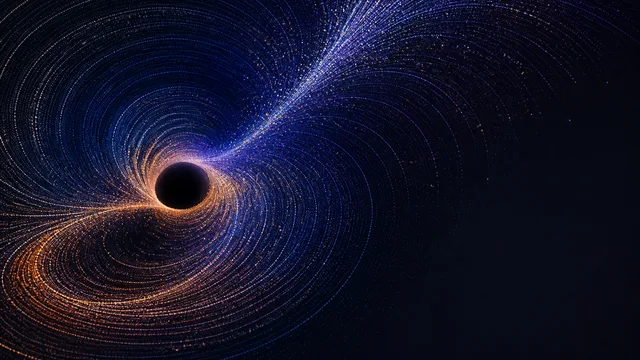
LIGO May Have Found a Primordial Black Hole
LIGO's latest catalog may contain a sub-solar-mass black hole that couldn't form from a star—and what that means for our understanding of the early universe.

Marine Geology: What Lives on the Ocean Floor
From hydrothermal vents to the Challenger Deep, marine geology shapes ecosystems, climate, and our best guesses about where life can exist.

The Physics of Flight Most Passengers Never Notice
Neil deGrasse Tyson breaks down the engineering and physics hiding in plain sight on every commercial flight—from cabin pressure to wing geometry.