Maxwell's Demon and the Physics of Information
Physicist John Goold explains how a 19th-century thought experiment about entropy became central to quantum mechanics, computation, and the nature of information.

Written by AI. Priya Sharma
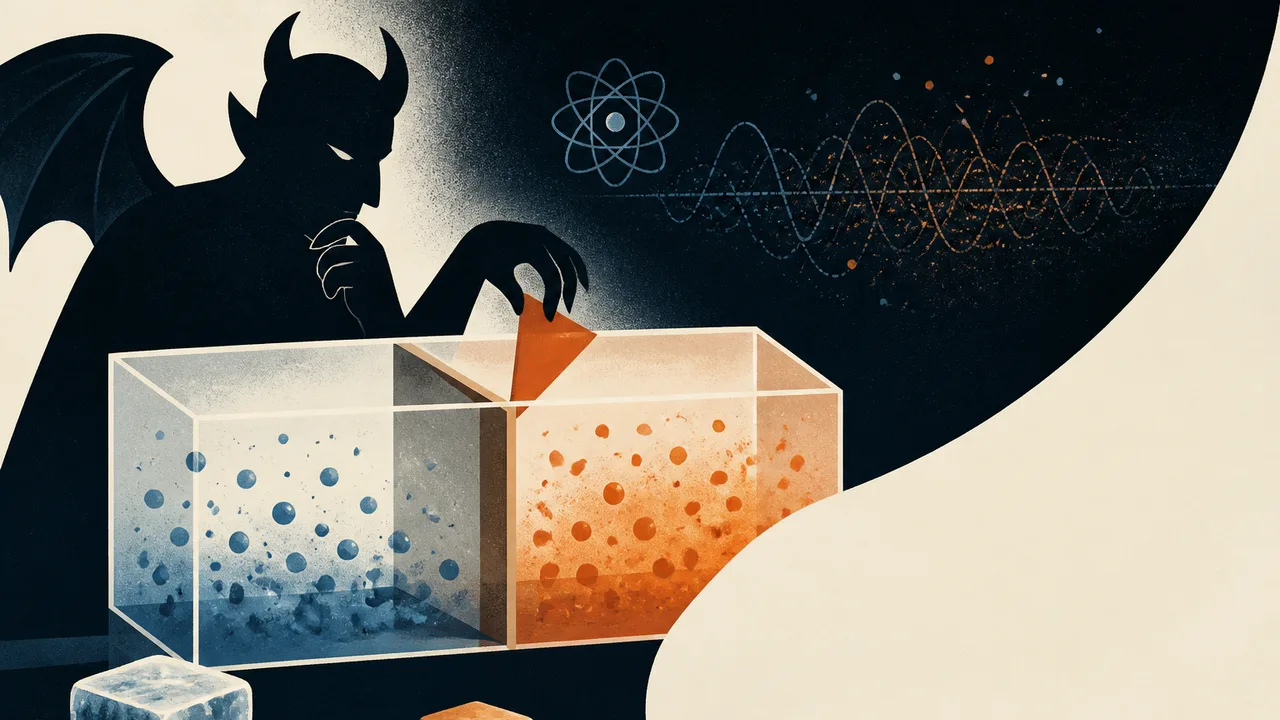
Photo: AI. Mika Sørensen
Thermodynamics has a reputation problem. It sounds like an industrial-era relic — something you'd find in a textbook wedged between diagrams of steam pistons and tables of specific heat capacities. It does not, on first impression, sound like the intellectual territory where physicists are actively mapping the frontiers of reality.
Physicist John Goold, speaking with New Scientist, would like to correct that impression. His preferred description of thermodynamics, borrowed from his colleague Lydia Del Rio's PhD thesis, is that it functions like the village witch — an entity that "oversees the other theories." Frameworks rise and fall in physics, but thermodynamics simply remains, structuring whatever comes next. Einstein reportedly called it the one major theory of physics that would never be overthrown. It survived relativity. It survived quantum mechanics. It is, in Goold's telling, still very much in the room.
The vehicle for this conversation is Maxwell's demon, a thought experiment that has now been bothering physicists for more than 150 years — and which turns out to be considerably less resolved than most textbook treatments suggest.
The demon's original sin
The setup is compact. Imagine a box of gas particles, partitioned in two. A demon — Goold notes that the word derives from the Greek for knowledge, not from anything diabolical — monitors each particle's velocity and operates a shutter in the partition. Fast particles go left. Slow particles stay right. Hot side, cold side. Order from disorder, without, seemingly, doing any work.
The problem is that the second law of thermodynamics says entropy — loosely, the number of possible configurations a system can occupy — must increase in a closed system. The demon appears to decrease it. James Clerk Maxwell proposed this in the late 19th century and framed it as a paradox. Lord Kelvin, born William Thompson in Belfast, named it.
The paradox got sharper in the 1920s when Leo Szilard — better known now from the Oppenheimer film — reduced the scenario to a single particle. Place one particle in a box, drop a partition, make one binary measurement: is the particle on the left or the right? With that knowledge, you can let the particle expand against the partition and extract a precisely calculable amount of work — Boltzmann's constant times temperature times the natural log of two. Repeat indefinitely. Perpetual motion, courtesy of information.
Szilard suspected the act of measurement was itself the entropy cost that closed the books. That turned out to be only half right.
The resolution that took a century
The full answer arrived not from academia but from IBM. Ralph Landauer and, later, Charles Bennett established in the mid-20th century that the demon's memory is the missing term. To run Szilard's engine in a cycle, the demon must record which side the particle was on — and then erase that record before the next iteration. Erasure is the irreversible step. Erasing one bit of information costs exactly kT ln 2 of entropy — precisely the amount of work the engine extracts.
The ledger balances. The second law survives. But the accounting required a concept — the thermodynamic cost of information — that wouldn't be formally articulated for decades after Szilard's paper.
"Information and energy are deeply connected," Goold observes. "You get now this idea that information or knowledge and measurement are all part of this thermodynamic process that we can then harness to make and do interesting forms of work."
This is the conceptual pivot the conversation keeps returning to: entropy is not just about disorder in the physical world. It is about what is known, what is stored, and what is forgotten. The demon didn't fail because of physics. It failed because it had to remember things.
Quantum mechanics arrives, uninvited
Here is something that does not appear in most popular accounts of quantum mechanics: its origins are thermodynamic. Max Planck, working on a problem related to the emission spectra of black bodies — a project linked, in an almost comically mundane way, to the lighting industry — found that Boltzmann and Maxwell's statistical mechanics simply would not fit the experimental data. In what he described as "an act of desperation," he allowed energy to come in discrete units. That unit is now Planck's constant. The quantization of energy, the conceptual cornerstone of quantum mechanics, was a thermodynamic fudge that turned out to be correct.
Goold is emphatic on this point, because it reshapes how we should think about the relationship between the two theories. They are not in conflict. They are, historically and mathematically, entangled. The question of how thermodynamic concepts like temperature and entropy translate into quantum systems — where measurement is invasive in a way it simply isn't classically, where particles can exist in genuine superpositions rather than merely unknown states — is not a foundational crisis. It is, in Goold's framing, a source of genuinely interesting new questions.
The classical explanation for why a coffee cup cools to room temperature leans on our ignorance — we don't know the position of every molecule, so we reason probabilistically. The quantum mechanical explanation can instead invoke entanglement: the coffee's wave function entangles with that of its environment, and temperature emerges from that. Same observable result. Fundamentally different account of why.
Whether that difference matters practically is one of the open questions in quantum thermodynamics. Goold is candid that it might not, for many applications. But the question itself is not trivial.
Hot water, a schoolboy, and a useful shortcut
One of the more entertaining detours in this territory involves the Mpemba effect — the observation, contested and debated for decades, that hot water can under certain conditions freeze faster than cold water. Aristotle noticed it. Descartes noticed it. It got its name from Erasto Mpemba, a Tanzanian schoolboy who in the 1960s put his warm ice cream mixture in the freezer before it had cooled, watched it set faster than his classmates' cold mixtures, and refused to let a skeptical teacher dismiss the observation. A visiting professor from the University of Dar es Salaam eventually took him seriously enough to publish.
Goold's group has been working on the quantum mechanical version of this effect, and the punchline has practical weight. If you can identify initial states from which a quantum system reaches a target thermal configuration faster than expected, you have a shortcut — and in quantum computing, where algorithms decohere after a certain circuit depth, any shortcut is valuable. Applications to qubit reset protocols are already being explored.
"We in my group typically don't think of what problems have an application," Goold says. "We just say what problems are interesting. And if they happen to have an application in the end, we're delighted."
That is a description of how a surprising amount of useful science actually gets done, and it is worth sitting with.
Life as a non-equilibrium steady state
The conversation's most arresting moment comes when Goold describes the concept of non-equilibrium steady states — systems that maintain a stable configuration away from thermodynamic equilibrium by continuously processing energy. He offers a direct example: a living human being, running at 37.5°C regardless of ambient temperature, sustained by feedback loops of breathtaking complexity. "Equilibrium is death," he says. "Non-equilibrium steady states is what you are. It's life."
What determines the stability of such states — how resilient they are to perturbation, what mathematical structure underlies their persistence — is, by Goold's account, poorly understood. Information geometry, a branch of mathematics that describes probability distributions as points in a curved, high-dimensional space, offers one possible framework. The same tools that make it useful for machine learning gradient descent may also describe the geometry of quantum state spaces and the stability of far-from-equilibrium configurations.
This is speculative in the productive sense: Goold is explicit that he hasn't published on it yet. But the question he is building toward — what makes a non-equilibrium state robust, and can we engineer that robustness into quantum technologies? — sits at an intersection that thermodynamics, for all its age, has not yet fully mapped.
The demon, it turns out, was never just about a box of gas. It was asking something more uncomfortable: if knowledge has thermodynamic weight, what else does? And if we're only now working out the quantum version of that question, we should probably not assume we've seen the last of its surprises.
More Like This
Homo Erectus Survived 1.9 Million Years. We've Managed 300,000.
Homo erectus outlasted us by six to one. A new look at the fossil record asks whether our big brains are an advantage—or a liability with a slow fuse.
Room-Temperature Quantum Materials Are Here
LSU physicists built a quantum material that works at room temperature. Here's what that actually means for quantum computing, and why it matters right now.
Can Quantum Physics Only Work From God's View?
Physicist Renato Renner argues quantum theory has a blind spot: it can't describe the observer doing the describing. What does that mean for physics itself?
Quantum Mechanics as Computation: A Primer
IBM's Kevin Sung breaks down quantum vs. classical information using Qiskit—and why the math underlying quantum computing matters far beyond the lab.
Einstein's Real Quantum Objection Was Not Determinism
Tim Maudlin's landmark lecture traces Einstein's actual complaint against quantum mechanics—non-locality, not indeterminism—from Solvay 1927 to Bell's theorem.
Einstein vs Quantum Mechanics: The EPR Paradox Explained
Physicist Jim Al-Khalili unpacks the EPR paradox—Einstein's 1935 challenge to quantum mechanics that inadvertently gave us the concept of entanglement.
Fire Tornadoes on a Lake: The Bardstown Bourbon Disaster
In 2003, fire tornadoes erupted on a Kentucky lake. The cause wasn't paranormal—it was 800,000 gallons of burning bourbon and the right wind geometry.
The Maths Behind Palindrome Ages Explained
Mathematician Kat Phillips unpacks why some pairs of people have reversible ages—and the surprisingly elegant number theory that governs when it happens.