Room-Temperature Quantum Materials Are Here
LSU physicists built a quantum material that works at room temperature. Here's what that actually means for quantum computing, and why it matters right now.

Written by AI. Tyler Nakamura
Here's the thing about quantum technology that nobody in the marketing materials wants to say plainly: most of it requires keeping hardware colder than outer space to function. We're talking cryogenic cooling systems—serious, expensive, facility-grade infrastructure—as the baseline requirement just to get quantum effects to show up reliably. That constraint isn't a minor footnote. It's a velvet rope around the entire field, keeping quantum computing from leaving the specialized lab and entering the real world.
Which is exactly why what's coming out of Louisiana State University right now deserves more attention than it's getting.
A New Material, a New Name
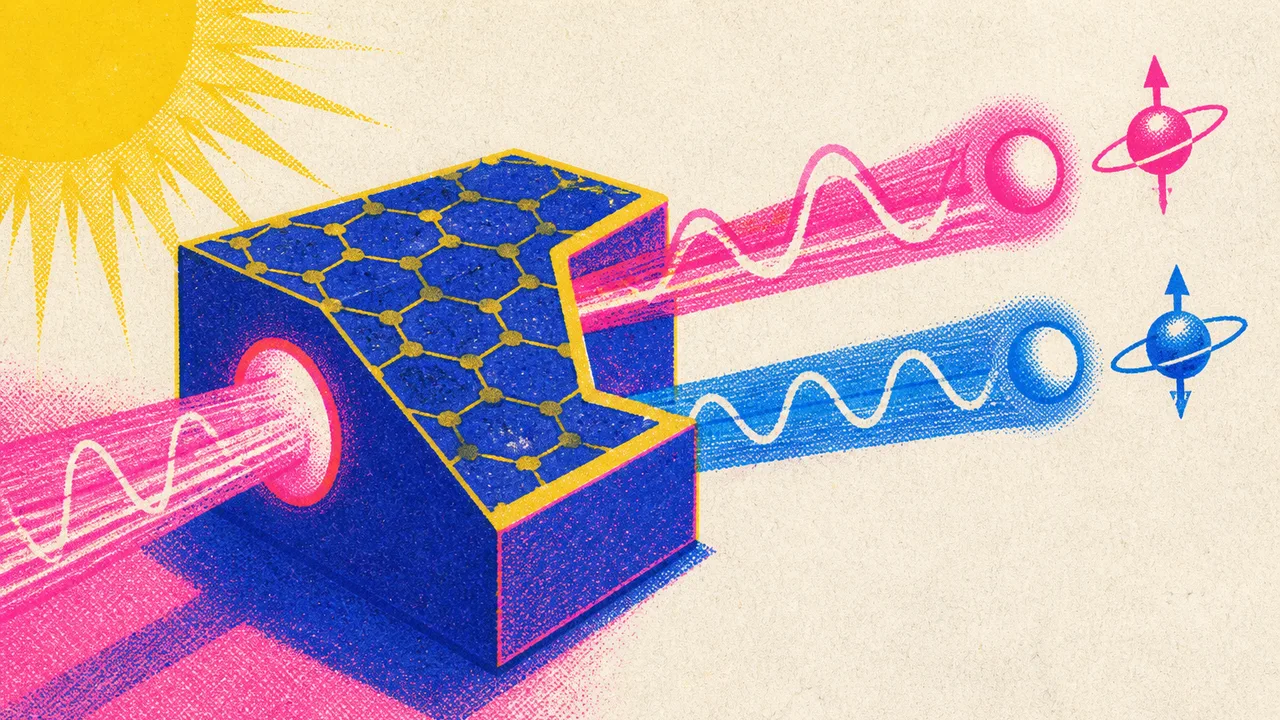
According to phys.org, LSU physicists have published a study in Nature describing the first room-temperature quantum material capable of distinguishing and transporting different quantum states of light. The material is so novel — sitting at such a strange intersection of quantum optics and condensed matter physics — that the researchers had to invent an entirely new name for it: the quantum statistical plasmonic metacrystal.
That name is a mouthful, but it's doing real descriptive work. "Plasmonic" signals that the material manipulates plasmons — collective oscillations of electrons at a metal's surface that can interact with light at the nanoscale. "Metacrystal" points to an engineered, structured material rather than something pulled from the periodic table. And "quantum statistical" is where it gets genuinely interesting: the material doesn't just route light, it routes quantum states of light, specifically distinguishing between different statistical signatures — coherent states, squeezed states, Fock states — that carry quantum information differently.
As Slashdot notes, the LSU team overcame a longstanding barrier in quantum materials research. Doing this without cryogenic cooling is the part that changes the calculus.
Why "Room Temperature" Is the Whole Story
Quantum effects are notoriously fragile. The technical term is decoherence — quantum states collapse when they interact with their environment, and heat is basically environmental noise turned up to eleven. The colder you get, the less thermal noise you have, and the longer your quantum states survive. That's why most quantum computers operate near absolute zero, in cooling systems that are engineering marvels in their own right — and serious cost and infrastructure barriers for anyone outside a well-funded research institution or a major tech company.
None of my cited sources quote a specific dollar figure for these systems, and I'm not going to manufacture one. But the qualitative point stands: the infrastructure required to run cryogenic quantum hardware is industrial, not something you can casually deploy. The moment you can get quantum behavior at 70°F instead of -459°F, the physics-to-engineering gap shrinks dramatically. You're no longer engineering around temperature as a fundamental constraint.
That's what makes the LSU result so structurally important. It's not just a materials science achievement — it's an unlock.
Three Labs, One Direction
What strikes me looking across the current research landscape is that the LSU result doesn't sit in isolation. It's part of a broader convergence happening right now, across multiple labs, on different types of quantum materials.
Over in Finland, physicists from the University of Jyväskylä and Aalto University have just achieved something that theorists predicted over a decade ago but nobody could build: a two-dimensional topological crystalline insulator (TCI). According to ScienceDaily, this is the first experimental realization of such a material. TechTimes reports the Finnish team used strain engineering to achieve conducting edge states in a band gap exceeding 0.2 eV — a figure that's significant because a larger band gap means the topological protection survives at higher temperatures, not just in cryogenic conditions.
Topological insulators are a different animal from the LSU metacrystal — they protect quantum information through the geometry of their electronic structure rather than through optical manipulation of light states. But the directional logic is the same: make quantum properties robust enough to survive real-world conditions.
Then there's Princeton. The university's Office of the Dean for Research reported that physicists observed novel quantum effects in a topological insulator at room temperature — the first time that had been done. What this result tells me, sitting alongside the LSU and Finnish work, is that "room temperature" is no longer the ceiling here — it's becoming the floor. Three separate research groups, working on different material classes, are all pushing past the same thermal barrier in the same window of time. That's not coincidence. That's a field reaching a maturation point.
What Quantum States of Light Actually Get You
Let me back up on the LSU result specifically, because the "quantum states of light" piece deserves some unpacking for anyone who hasn't been deep in quantum photonics.
Classical fiber-optic communication uses light to carry bits — ones and zeros encoded as pulses. Quantum communication uses light to carry qubits — quantum states that can exist in superposition and can be entangled with other qubits across distance. The security properties of quantum communication (think quantum key distribution, the basis of theoretically unbreakable encryption) depend on being able to preserve and route specific quantum states of light without disturbing them.
The problem is that different quantum states of light behave very differently, and a material that can sort, distinguish, and route them is essentially the quantum equivalent of a network switch. You need it for any serious quantum photonic network. And until the LSU team published in Nature, nobody had built one that worked outside a cryogenic environment.
The applications that come into sharper focus: quantum-secured communications infrastructure, quantum sensors that can operate in field conditions rather than lab conditions, and eventually photonic quantum processors that don't require the cooling apparatus that currently makes quantum hardware so inaccessible. None of this is next-quarter stuff — but the foundational piece that was missing is now, at least in prototype form, no longer missing.
What We Don't Know Yet
I want to be straight about where the record is thin, because the hype cycle around quantum computing has a long history of overpromising and underdelivering, and I'd rather not contribute to that.
The LSU Nature paper establishes proof-of-concept for the quantum statistical plasmonic metacrystal. What we don't yet know from the available reporting: how scalable the fabrication process is, what the decoherence times look like for the routed quantum states, how the material performs under real-world interference conditions, and how far away device-level implementation actually is. These are not minor questions — they're the difference between a landmark result and a practical technology. The Finnish TCI work has the same gap: a 0.2 eV band gap is promising, but the jump from "conducting edge states observed" to "quantum device built on this" involves a lot of engineering nobody has done yet.
The Princeton topological insulator result similarly needs engineering translation — observing an exotic quantum state at room temperature is exactly the kind of finding that takes years to move from observation to application.
None of that diminishes what's been achieved. It just means we're watching the beginning of a story, not the end of one.
The Trajectory
The pattern across these results is unmistakable: room temperature is becoming the new baseline expectation for quantum materials research. The theoretical groundwork was laid years ago — the Finnish TCI was predicted more than a decade before anyone built it, as TechTimes notes. What's changed is the experimental capability to actually realize those predictions. Strain engineering, plasmonic nanostructures, advanced fabrication — the materials toolkit has caught up with the theory.
For anyone tracking where quantum hardware is actually heading: the cryogenic requirement was never a feature. It was always a bug. And it's starting to look like one that's finally getting fixed.
More Like This
World's Fastest Drone Reclaims Record with V4
Discover how Peregreen V4 reclaimed the world's fastest drone title with a speed of 657 km/h.

Google Pays $250K for 16-Year-Old Linux KVM Flaw
A 16-year-old Linux KVM flaw called Januscape earned a $250K bounty after enabling guest VM escapes on Intel and AMD systems. Here's what it means for cloud security.

Microsoft Majorana 2: Bold Claims, Thin Evidence
Microsoft's Majorana 2 chip promises a 1,000x reliability leap and a 2029 quantum computer. Scientists say the paper doesn't back any of it up.

Quantum Gates Explained: What Encryption's Future Hinges On
Hadamard, CNOT, T gate — the quantum circuits that could eventually crack RSA encryption, explained clearly for security-minded readers.

Q-Day: What Quantum Computing Means for Encryption
Quantum computers may crack modern encryption within five years. Here's what Q-Day actually means, how close we are, and what can be done about it.

This Tool Treats Your Home Lab Like Infrastructure Code
RackPeek documents home labs as YAML code in Git. Brandon Lee shows how this infrastructure-as-code approach beats static diagrams and spreadsheets.

Meta Faces Lawsuit Over AI-Driven Layoff Decisions
26 former Meta employees allege AI scoring systems—not managers—decided who got laid off. Here's what that means for anyone who wants to work in tech.
EU Tells Meta to Fix Addictive Instagram Features
The EU is threatening Meta with fines up to 6% of global revenue over infinite scroll and autoplay. Here's what that actually means for your Instagram experience.