Can Quantum Physics Only Work From God's View?
Physicist Renato Renner argues quantum theory has a blind spot: it can't describe the observer doing the describing. What does that mean for physics itself?

Written by AI. Priya Sharma
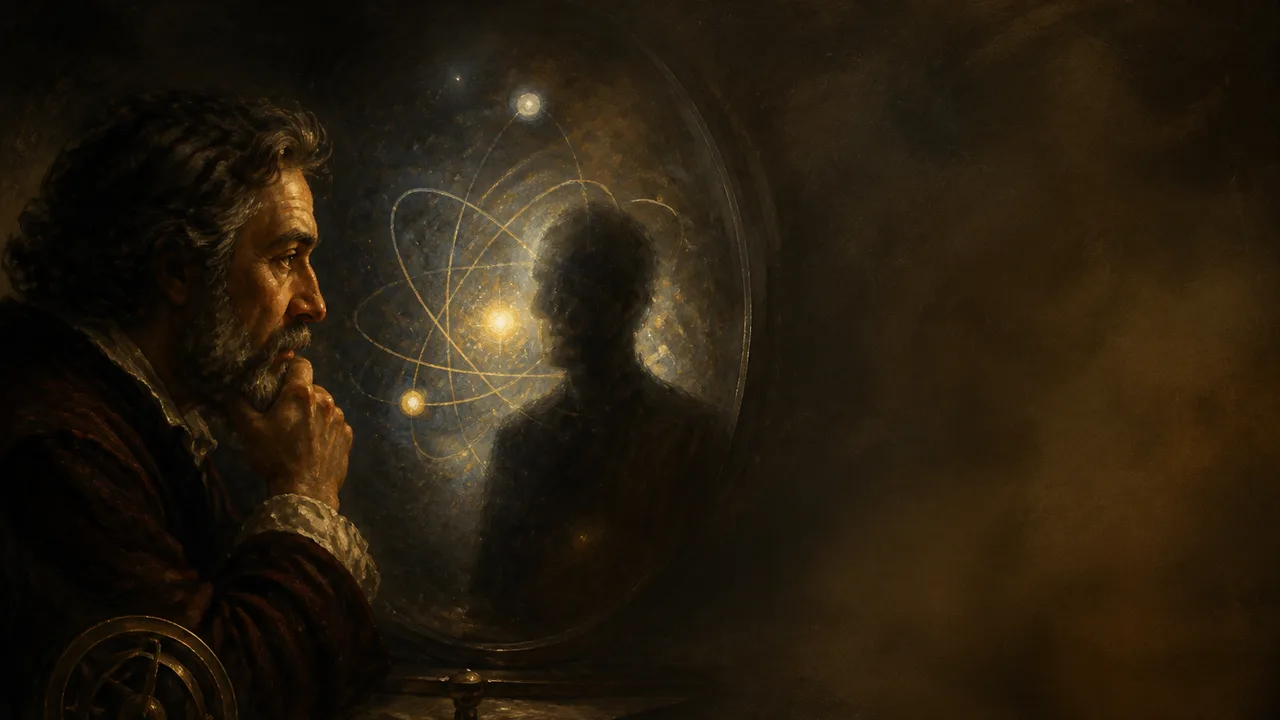
Photo: AI. Henrik Solberg
There is a quietly unsettling assumption baked into how physicists use quantum mechanics, one so fundamental it rarely gets named. The physicist is always outside the system being described. Not outside the universe, obviously—but outside the equations. The observer writes down the wave function; the observer is never in the wave function.
For most practical purposes, this works fine. You want to predict the spin of an electron, you don't need to include a description of your own neurons firing while you run the calculation. But physicist Renato Renner, in a conversation with Curt Jaimungal on the Theories of Everything podcast, pushes on this assumption with unusual persistence—and what he finds underneath it is genuinely disorienting.
The Recursion Problem
Renner's starting point is deceptively simple: quantum theory has no mechanism for a system to fully describe itself. If you tried to write down a complete quantum description of the universe—every particle, every interaction—you would necessarily have to include yourself, the physicist running the calculation. And including yourself means describing your own reasoning process as it generates the description, which then needs to be included, which changes the description, which needs to be included again.
"This leads to a terrible recursion," Renner says, "that is just not dealt with in quantum theory."
The practical ceiling, then, is not the whole universe but the whole universe minus the observer. That's the maximum scope of what any physicist can rigorously describe using current quantum theory. It sounds like a minor technical caveat. It isn't.
Consider what happens when two physicists each take that maximum perspective simultaneously. Physicist A describes everything except herself—including Physicist B. Physicist B describes everything except himself—including Physicist A. Both are operating at the edge of what quantum theory permits. And yet their descriptions, by construction, cannot fully coincide. A described B as a physical system. B described A as a physical system. Neither described themselves. They are not looking at the same world.
This is not a failure of communication or a matter of comparing notes afterward. It's structural. The two physicists, because they are each embedded in the experiment they're trying to describe, have irreconcilably different perspectives—and no meta-level quantum description exists that can adjudicate between them.
The Wigner's Friend Lineage
Renner's work sits in a tradition that goes back to Eugene Wigner's thought experiment from the 1960s, in which an observer (Wigner) stands outside a sealed lab while a friend inside the lab performs a quantum measurement. From the friend's perspective, the measurement has a definite outcome. From Wigner's perspective—applying quantum mechanics to the entire sealed system, including the friend—the friend is still in superposition. Two valid applications of quantum theory, two incompatible descriptions.
What Renner's group has done is formalize and sharpen this into a no-go theorem with testable structure. The experiment requires multiple agents—at least four, based on their current construction, though whether three would suffice remains an open question—arranged so that each agent's quantum-mechanical description is locally valid but globally inconsistent. No single observer can reconcile all the accounts, because doing so would require describing themselves.
A persistent objection to this kind of setup is that the recursion sneaks back in: by describing another agent who is describing you, haven't you described yourself indirectly? Renner and collaborators Lydia del Rio and Nuran Galva took this seriously enough to write software that implements the experiment's reasoning chains and checks for loops. The software is publicly available. If indirect self-reference were unavoidable, the program would hang. It doesn't.
That's not nothing. It's one of those cases where turning an argument into runnable code constitutes genuine progress—not because code is always right, but because an infinite loop is unambiguous in a way that philosophical prose rarely is.
The God's Eye Problem
Here is where the conversation becomes interesting for anyone who cares about what physical theories are actually for.
A significant fraction of working physicists aren't especially troubled by the observer problem because they adopt, implicitly or explicitly, what Renner calls the "god's eye view." Many-worlds advocates, for instance, describe a universal wave function evolving unitarily—no collapse, no special role for observers, just one vast quantum state encompassing everything. From that vantage point, the recursion problem dissolves: there is an outside view, and the theory operates from it.
Renner's response to this is less a refutation than a demand for completeness. He's not arguing that the god's eye view is incoherent. He's arguing that it cannot be the only valid view.
"I wouldn't object," he says. "They would say, okay, that's you can take this opinion that there is this outside view—but there should at least also exist an inside view."
The chess analogy Jaimungal introduces is useful here, with appropriate caveats about the limits of analogies. In the standard physics-as-chess framing, particles are pieces, laws are rules, and physicists are players studying the board. The god's eye view is the player's view—detached, complete, looking down at the whole game. Renner's point is that in physics, unlike chess, everything is on the board. The physicist is a piece. And a rook does not have the option of stepping back to inspect the board from above.
What Renner asks for is that physics be usable by us—by beings who are themselves part of the system being described, not external auditors of it. His minimum requirement for a physical theory is that it function from the inside. If a theory additionally works from some hypothetical outside, great. But "only God can do this physics" strikes him as a failure condition, not a feature.
"By denying that as a valid viewpoint," he says, "you basically say you're not a valid physicist."
The Knowledge-Reality Fault Line
One thread running through Renner's approach that deserves more attention than it typically gets: the question of what a quantum state actually is. Is it a description of physical reality, something that exists independently of any observer? Or is it an encoding of knowledge—a summary of what a particular agent knows about a system?
This is the epistemic-versus-ontic debate that has occupied foundations-of-physics researchers for decades without resolution. Renner's experimental framework sidesteps it by design. Rather than asking agents to compare quantum states—which would immediately drag in all the contested metaphysics—the framework asks agents to compare predictions about outcomes. Correlations. Expectation values. The architecture deliberately recalls Bell's theorem, which famously derived testable inequalities without committing to any particular interpretation of quantum mechanics.
"We tried to kind of not give importance to the meaning of states," Renner explains, "and therefore talk as little as possible about quantum states in this experiment."
This is methodologically clean. It also means the contradictions Renner identifies are harder to dismiss as artifacts of a particular interpretation. They show up in the predictions, not in the philosophical gloss layered over the predictions.
What Remains Open
None of this resolves the measurement problem—that stubbornly persistent question of how and why quantum superpositions yield definite outcomes when observed. Renner's framework clarifies the structure of the problem rather than dissolving it. The contradictions between observers aren't noise to be filtered out; they're signal. They're telling us something about the relationship between description and reality that current quantum theory hasn't fully absorbed.
Whether a future theory can handle recursive self-description—a physicist writing down an equation that includes the physicist writing down the equation—remains genuinely unknown. Renner is explicit about this: current quantum theory doesn't even attempt it.
What's clarifying about his position, though, is the minimal demand it places on whatever comes next. Not that physics achieve omniscience. Not that we solve consciousness or find the ultimate theory of everything. Just that the theory be usable by the kind of beings who actually do physics: embedded in the world, unable to step outside it, describing a universe that always, irreducibly, includes them.
More Like This
A Physicist Admits He Might Be Teaching Time Wrong
Professor Aephraim Steinberg on why time might be an illusion, Bell's inequalities, and the uncomfortable truth about what quantum physics proves—and doesn't.

Is Physics Really in Charge? Ellis vs. Carroll Explained
George Ellis argues physics doesn't decide outcomes—context does. Here's why his debate with Sean Carroll's reductionism is more consequential than it sounds.
Your Intuitions Are Built for the Wrong Universe
Astrophysicist Hakeem Oluseyi explains quantum fields, spacetime, and why the mental models we rely on daily are macroscopic approximations of a stranger reality.
Black Hole Paradox: Are Reference Frames the Key?
Exploring how reference frames might resolve the black hole information paradox.
Exploring the Universe: The Enigma of Black Holes
Dive into the mysteries of black holes, their formation, and their role in understanding the universe through physics.
Exploring the Power of the Fourier Transform
Discover the Fourier Transform's role in unlocking the hidden geometry of sound and its applications from quantum mechanics to gravitational waves.

Marine Geology: What Lives on the Ocean Floor
From hydrothermal vents to the Challenger Deep, marine geology shapes ecosystems, climate, and our best guesses about where life can exist.

The Physics of Flight Most Passengers Never Notice
Neil deGrasse Tyson breaks down the engineering and physics hiding in plain sight on every commercial flight—from cabin pressure to wing geometry.