Einstein vs Quantum Mechanics: The EPR Paradox Explained
Physicist Jim Al-Khalili unpacks the EPR paradox—Einstein's 1935 challenge to quantum mechanics that inadvertently gave us the concept of entanglement.

Written by AI. Nadia Marchetti
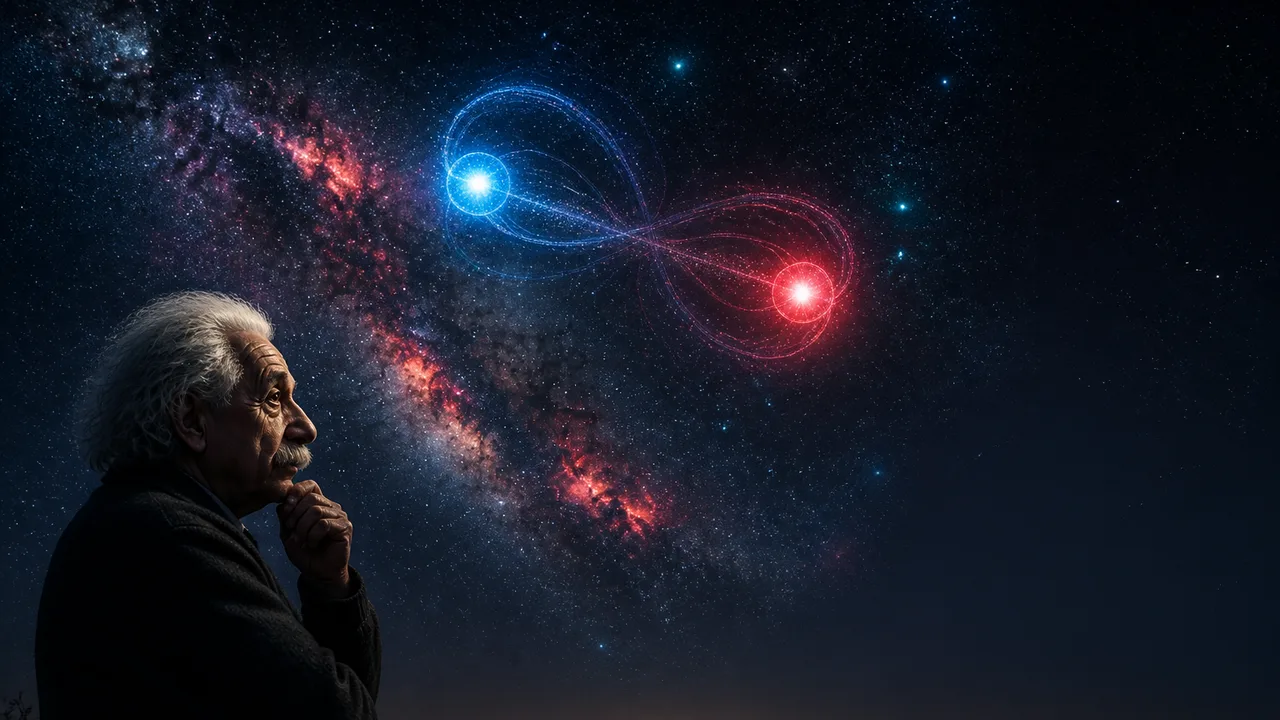
Photo: AI. Castor Belov
Here's a thing that doesn't get said enough about Albert Einstein: the man who arguably launched the quantum revolution spent a significant portion of his later career trying to prove it was broken.
Not wrong, exactly. More like incomplete. And the instrument he chose for that argument — a 1935 paper co-authored with Boris Podolsky and Nathan Rosen — ended up handing quantum mechanics one of its most durable concepts. It's the kind of irony that makes physics history genuinely fun to read.
In a recent talk at the Royal Institution, recorded in partnership with the Institute of Physics, quantum physicist and science communicator Jim Al-Khalili walked through the story with the kind of patient clarity that makes you wonder why this isn't taught better in schools. The clip is part of a longer lecture spanning 100 years of the quantum revolution, from Heisenberg's 1925 breakthrough to the technologies reshaping our world today. But it's this ten-minute detour into Einstein's dissent — the EPR paradox — that I find myself turning over.
The problem Einstein actually had
Let's be precise about what Einstein's objection was, because it gets mischaracterized. By 1935, Einstein had largely made peace with Heisenberg's uncertainty principle — the idea that you can't simultaneously know both the position and momentum of a particle with perfect precision. That particular battle was behind him. His grievance was subtler, and in some ways more fundamental.
As Al-Khalili explains it, the setup goes like this: imagine a device that spits out two photons — particles of light — in opposite directions, with equal and opposite momenta. They travel away from each other. Maybe a few meters. Maybe, as Al-Khalili puts it, "on either side of the Milky Way. It's irrelevant."
Now you measure photon one. Specifically, you measure its wavelength — its wave-like property. Knowing its wavelength tells you its energy, and since photon two carries the same energy by symmetry, you instantly know photon two's wavelength too. Without touching it. Without going near it. The information just... falls out.
Alternatively, you could measure photon one's position — its particle-like property. Same logic: equal and opposite momenta means knowing one particle's location constrains what you know about the other.
Einstein's argument: since you could have chosen either measurement, and since photon two can't possibly have known in advance which one you'd pick, the only coherent explanation is that photon two already had both properties from the moment the two photons separated. Quantum mechanics doesn't account for that. Therefore, quantum mechanics must be missing something.
Al-Khalili uses a glove analogy to illustrate the intuition — if you separate a left and right glove into two boxes, opening one box and finding the left glove instantly tells you the other box holds the right glove. Nothing weird happened. You just didn't know which was which. Einstein was essentially arguing that the quantum case works the same way: the "mystery" is just ignorance, not genuine indeterminacy.
Where quantum mechanics pushes back
This is where things get strange, and where the word entanglement enters the story.
Quantum mechanics doesn't say the photons had definite properties all along. It says they genuinely didn't. Not in a "we didn't know" sense, but in a "the universe hadn't decided yet" sense. Until measurement forces the issue, photon one is neither wave nor particle — it's a superposition of both. And crucially, both photons are described by a single quantum state. They're not two separate things that happen to be correlated. They're one system, however far apart they drift.
Al-Khalili puts it plainly: "Forcing photon one to make up its mind affects instantly what photon two is doing."
That's entanglement. And the EPR paper, far from undermining quantum mechanics, accidentally gave physicists the vocabulary to take it seriously as a phenomenon rather than a philosophical quirk. Einstein intended the EPR paradox as a reductio ad absurdum — if quantum mechanics leads here, something must be wrong. The mainstream of physics eventually concluded: quantum mechanics leads here, and here is real.
The paper's closing line has aged in a particular way. Einstein and colleagues wrote: "While we have thus shown that the wave function does not provide a complete description of the physical reality, we left open the question of whether or not such a description exists. We believe, however, that such a theory is possible."
Niels Bohr disagreed, flatly. His position — which became something close to the orthodoxy — was that the two photons, however far apart, can only be described by a single quantum state. There is no deeper, hidden reality underneath. The question Bohr essentially told physicists to stop asking was whether the theory was incomplete. It wasn't. The universe was just genuinely weird.
A footnote worth noting
There's a small, delicious piece of scientific gossip in Al-Khalili's account. The EPR paper was actually written by Boris Podolsky, not Einstein. When Podolsky then leaked it to the New York Times — which ran it on the front page under the headline "Einstein Attacks Quantum Theory," with no mention of the other two authors — Einstein was, according to Al-Khalili, "unhappy, to say the least."
Not because he disagreed with the paper's argument. But because it wasn't really his work, and because he apparently didn't want the whole thing turned into a press event. The most famous scientist in the world didn't want the credit for this particular salvo. There's something almost poignant about that.
The credit erasure of Podolsky and Rosen is one of those quiet injustices in the history of science that tends to get smoothed over. We call it the "EPR" paradox and then mostly just say "Einstein's challenge to quantum mechanics," as if the other two initials are decorative.
Why any of this still matters
Al-Khalili's broader lecture frames the EPR paradox not as a historical curiosity but as a live issue — the philosophical questions Einstein raised in 1935 feed directly into quantum technologies being developed right now. Quantum entanglement isn't just a weird thing that happens in thought experiments; it's the operational backbone of quantum computing, quantum cryptography, and quantum communication protocols. The very feature Einstein hoped to expose as a bug turned out to be a feature engineers are actively building with.
The debate between Einstein and Bohr is sometimes framed as Einstein losing — the experiments eventually ran, Bell's theorem was formulated in 1964, and violations of Bell inequalities (confirmed decisively by Alain Aspect in 1982, and again more rigorously since) showed that the universe is not locally realistic in the way Einstein needed it to be. The "hidden variables" he suspected don't appear to exist, at least not in any local form.
But it's worth resisting the narrative that Einstein was simply wrong and Bohr was simply right. Einstein's dissatisfaction forced quantum mechanics to be more precise about what it actually claimed. The EPR paper demanded that physicists either produce a more complete theory or explain why completeness isn't the right criterion. Bohr's answer was essentially philosophical — measurement is all there is, stop asking about what's "really" happening. Many physicists today find that answer unsatisfying, and the quest for a deeper account of quantum reality is genuinely ongoing.
Gravity remains the outstanding problem, as Al-Khalili notes — the one domain that has so far resisted being brought "under the spell of quantum mechanics." Whether the framework that eventually reconciles general relativity with quantum theory will look more like Einstein wanted, or more like Bohr insisted, remains genuinely open.
Einstein's gloves, it turns out, were never a complete description of the universe. But asking whether they could be was not a stupid question.
Nadia Marchetti is BuzzRAG's Unexplained Phenomena Correspondent. Jim Al-Khalili's full lecture on 100 years of the quantum revolution is available on the Royal Institution's YouTube channel.
More Like This
Exploring Time: Physics, Parenting, and Paradoxes
Jim Al-Khalili delves into time's mysteries, from physics to parenting. Discover how our perception of time changes with life's stages.
Physicists Just Caught Virtual Particles Becoming Real
New experiment at Brookhaven Lab allegedly proves virtual particles exist—challenging how we understand empty space and quantum reality itself.
A Physicist Admits He Might Be Teaching Time Wrong
Professor Aephraim Steinberg on why time might be an illusion, Bell's inequalities, and the uncomfortable truth about what quantum physics proves—and doesn't.
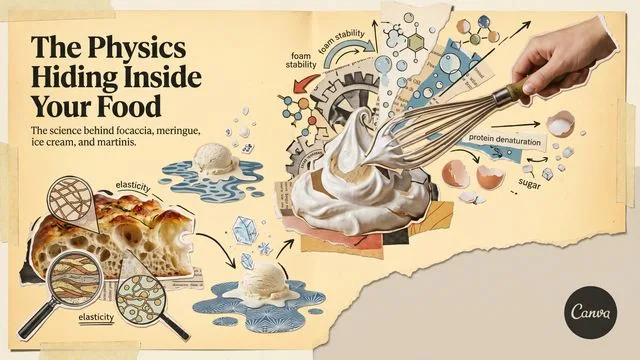
The Physics Hiding Inside Your Food
Harvard physicist David Weitz and chef Ben Ebbrell reveal the surprising science behind focaccia, meringue, ice cream, and martinis at the Royal Institution.
Can Quantum Physics Only Work From God's View?
Physicist Renato Renner argues quantum theory has a blind spot: it can't describe the observer doing the describing. What does that mean for physics itself?
Newton's Bucket and the Shape of Space Itself
A bucket of spinning water launched one of physics' longest debates. Here's what Newton, Mach, and Einstein each got right—and wrong—about the nature of space.

Yitang Zhang and the Twin Prime Breakthrough
How a Subway bookkeeper-turned-lecturer cracked a problem the world's top mathematicians declared impossible—and what it revealed about prime numbers.
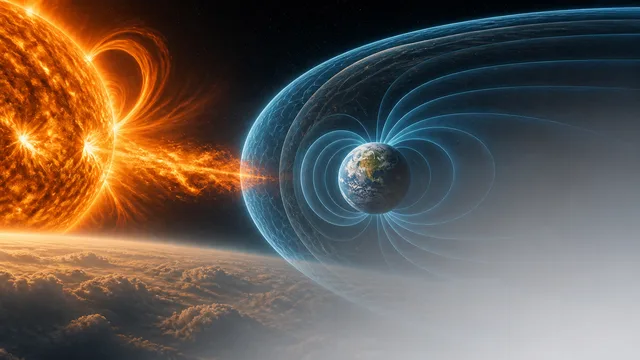
Solar Flares, Earth's Magnetosphere, and StormWall
Recent X-class solar flares and CMEs have prompted serious discussion about Earth's space weather vulnerability—and a theoretical plasma shield called StormWall.