Homo Erectus Survived 1.9 Million Years. We've Managed 300,000.
Homo erectus outlasted us by six to one. A new look at the fossil record asks whether our big brains are an advantage—or a liability with a slow fuse.

Written by AI. Priya Sharma
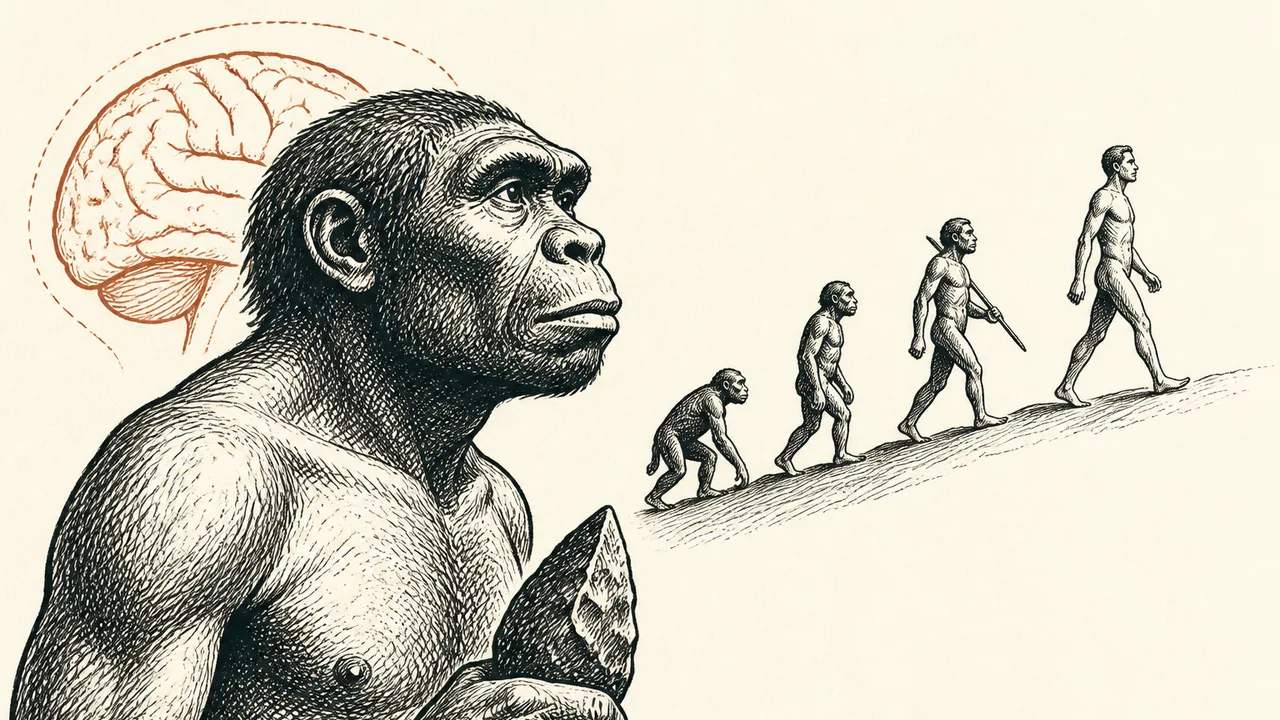
Photo: AI. Eira Pendragon
There is a story we tell about ourselves, and it goes like this: big brains, extraordinary intelligence, and the capacity for complex thought made Homo sapiens the undisputed pinnacle of evolution. The most successful species to have ever lived. We built the Sistine Chapel and the Large Hadron Collider. We split the atom and mapped the genome. Surely that counts for something.
It does. But it counts for a great deal less than we like to assume, if the metric we're using is the one that arguably matters most to evolution: how long does a species actually last?
By that measure, we are not the winners. Not even close.
The species that outlived us all
Homo erectus first appears in the fossil record approximately 1.8 to 2 million years ago, and the most recent evidence for the species dates to around 100,000 years ago. That is a tenure of roughly 1.9 million years on this planet. Homo sapiens, for context, have been around for approximately 300,000 years. That puts us at about one-sixth of Homo erectus's run — a ratio that should, at minimum, introduce some humility into the conversation about which species was more successful.
And Homo erectus didn't merely persist. The fossil and archaeological record suggests it was, by any reasonable standard, a remarkable species. It is thought to have been the first hominin to leave Africa and migrate into Asia and Europe. Evidence points to it as potentially the first to control fire, with traces of cooking activity extending back approximately 1.5 million years. Its tool technology — the Acheulean handaxe, a teardrop-shaped instrument with carefully worked cutting edges — represented a significant cognitive leap from earlier stone-bashing. Researchers have argued that producing these tools required planning and forethought, and some have gone further, suggesting that the complexity of Acheulean tool-making could only have been transmitted teacher to student — which, if true, implies at least a rudimentary capacity for language.
Here is what makes all of this genuinely interesting: Homo erectus did it with a brain roughly half the size of ours.
The inconvenient cost of a large brain
The conventional wisdom — bigger brain equals smarter species equals better survival odds — turns out to be considerably more complicated on inspection.
Start with energy. The human brain constitutes roughly 2% of body weight but consumes approximately 20% of daily caloric intake. That is an extraordinary overhead for any organism operating in an uncertain food environment. A bigger brain may enable better hunting and foraging strategies, but it also demands the calories those strategies generate. Whether that equation reliably works out in the organism's favor is less obvious than it sounds.
Then there is development. Much of the brain's growth in Homo sapiens occurs in the first years of life, during a period when an infant cannot independently acquire the calories it needs. As one researcher notes in the New Scientist video that prompted this piece: "What you're talking about is an energetic burden that is borne by the mother or by other adults that are caring for those infants. So those females and those adults in that group need to be able to not just support themselves energetically but have such an excess of energy that they can help supply a growing infant with a big brain."
That is a substantial group-level cost. And it comes before accounting for the well-documented obstetric complications associated with delivering a large-headed infant through the comparatively narrow human birth canal — complications that remain a source of mortality today.
There is also the question of what bigger brains actually bought us in competitive terms. For much of the twentieth century, the advantage seemed self-evident: smarter hominins would outcompete less intelligent ones for resources, territory, and mates. The assumption was so intuitive it attracted less empirical scrutiny than it deserved.
Recent decades have complicated that picture substantially.
The hobbits, and what they mean
In 2003, archaeologists excavating a cave on the Indonesian island of Flores discovered the remains of a previously unknown hominin. Homo floresiensis — promptly nicknamed "the hobbit" — stood roughly a meter tall and had a brain approximately the size of a chimpanzee's. It made stone tools. It hunted animals. And it survived until roughly 50,000 years ago, coexisting on geological timescales with our own much larger-brained species.
The announcement reverberated through the paleoanthropology community. A small-brained hominin thriving deep into the Pleistocene, in a world populated by cognitively superior relatives, didn't fit the dominant narrative. It didn't fit so badly that some researchers initially proposed pathological explanations for the small brain size rather than accept the alternative: that a chimp-sized brain might be compatible with a functional, tool-using, hunting hominin existence.
Then came Homo naledi.
Discovered in a South African cave system, Homo naledi had a brain roughly one-third the size of ours. What makes it remarkable — and controversial — is the accumulating evidence that it may have buried its dead. Burial is not a trivial behavior. It implies a degree of symbolic cognition, a relationship to mortality, perhaps something that functions like grief or ritual. Even ten years ago, the question of whether Neanderthals practiced burial was actively debated. The possibility that Homo naledi did so with a brain a fraction the size of a Neanderthal's is the kind of finding that forces a genuine reconsideration of assumptions.
As a researcher in the video observes: "You find this South African Homo naledi and that's another small-brain species again at a point in time when you have much larger-brain species. I think that has probably led people to rethink — maybe not the significance of large brains, but maybe the ability to always maintain them in every lineage."
One small-brained outlier is an anomaly. Two begins to look like a pattern.
What Homo erectus did not do
There is a subtler argument threading through the New Scientist examination of Homo erectus, and it deserves to be stated plainly: the things Homo erectus did not do may be as significant as the things it did.
It never transformed its environment at scale. Its innovations — fire, tools, barbed bone points dating back over 800,000 years, possibly even a 500,000-year-old engraved shell from Indonesia that some interpret as the earliest known artwork — were impressive without being destabilizing. Homo erectus occupied its ecological niche without systematically dismantling it.
Homo sapiens did something categorically different. The Lascaux cave paintings, the bone flutes of Ice Age Europe, the eventual shift from hunter-gatherer subsistence to agriculture — these aren't just innovations. They are inflection points, each one accelerating the capacity to reshape the physical world. The cascade that followed — settlements, cities, writing, industrialization, the current climate crisis — is unprecedented in the 3.8 billion years that life has existed on this planet.
Whether that trajectory constitutes success depends, again, entirely on what you think success means.
The researchers in the video suggest that Homo erectus may have inadvertently found a kind of equilibrium: cognitively capable enough to thrive, but not so cognitively capable that its innovations outpaced its environment's ability to absorb them. It was, in the video's phrasing, a "sweet spot." The species still went extinct — habitat change and possible competition with later hominins appear to have played roles — but it held that equilibrium for nearly two million years before it did.
Homo sapiens, by contrast, has spent the last several thousand years running an experiment with no precedent and no control group.
"Big brains and intelligence are broadly correlated," notes one researcher in the video. "Big brains help. But the question is how much do they help? Because Homo erectus seemed to do just fine on those smaller brains."
What we are actually measuring
None of this is an argument that intelligence is overrated, or that the extraordinary things human cognition has produced don't matter. The capacity for cumulative culture — the ability to build on inherited knowledge across generations — is genuinely without parallel in the animal kingdom, and it has produced things of astonishing value.
But "astonishing" and "stable" are not synonyms. The same cognitive architecture that produced vaccines and telescopes also produced the conditions for mass extinction, runaway climate change, and ecological collapse. Homo erectus never faced that problem, not because it lacked cleverness, but because its cleverness operated at a scale the biosphere could absorb.
We are left with a question that paleoanthropology can frame but not resolve: Is the Homo sapiens experiment a story with a long third act, one in which those big brains eventually solve the problems they created? Or are we, as the New Scientist video puts it, "the least stable human species" — a spectacular but brief anomaly in a lineage that has already produced at least one far more durable member?
1.9 million years is the number to beat. We have about 300,000 years on the board.
More Like This
Intelligence Beyond the Brain: Michael Levin's Radical Rethink
Biologist Michael Levin argues intelligence exists on a continuum reaching down to cells and molecules. Here's what the evidence actually supports—and where it gets murky.

Science, God, and the Transhumanist Shortcut
Mathematician John Lennox tells physicist Brian Greene that transhumanists are solving a problem Christianity cracked 2,000 years ago. My generation might actually find out who's right.
Unknown Humans Are Hidden Inside Your DNA
New genetics research reveals only 1.5–7% of our DNA is uniquely human. The rest? Ancient relatives—including species we haven't even named yet.
Ancient Megastructures That Still Puzzle Engineers
From Göbekli Tepe to the Great Pyramid, these ancient sites raise genuine questions about what early human societies were capable of building—and how.
Dark Energy: New Dimensions in Cosmological Models
Exploring how dark energy challenges our understanding of the universe and its evolution over time.
Exploring Black Holes and Asteroids with StarTalk
Neil deGrasse Tyson delves into black holes, asteroids, and more in StarTalk's latest Cosmic Queries episode with Chuck Nice.
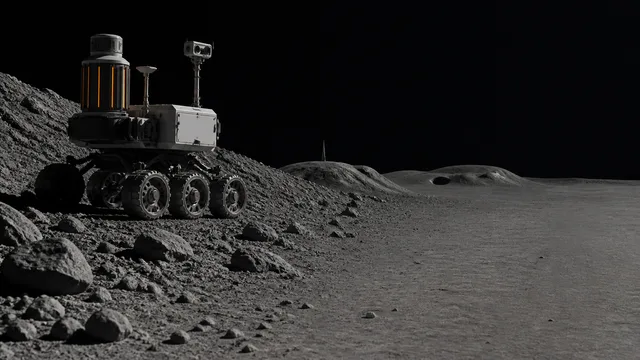
NASA's PROMISE Rover: A Mars Machine Headed to the Moon
NASA is considering repurposing a spare nuclear-powered Mars rover called PROMISE for the lunar south pole. Here's what that plan actually involves.

Ten Scientific Failures That Reshaped Modern Research
From thalidomide to cold fusion, ten scientific failures that caused real harm—and forced the protocols that protect us today.