The Oberth Effect: Why Speed Makes Rockets More Powerful
A spring-loaded rocket and some careful bookkeeping reveal why firing engines at high speed produces far more energy—and why it matters for reaching the stars.

Written by AI. Priya Sharma
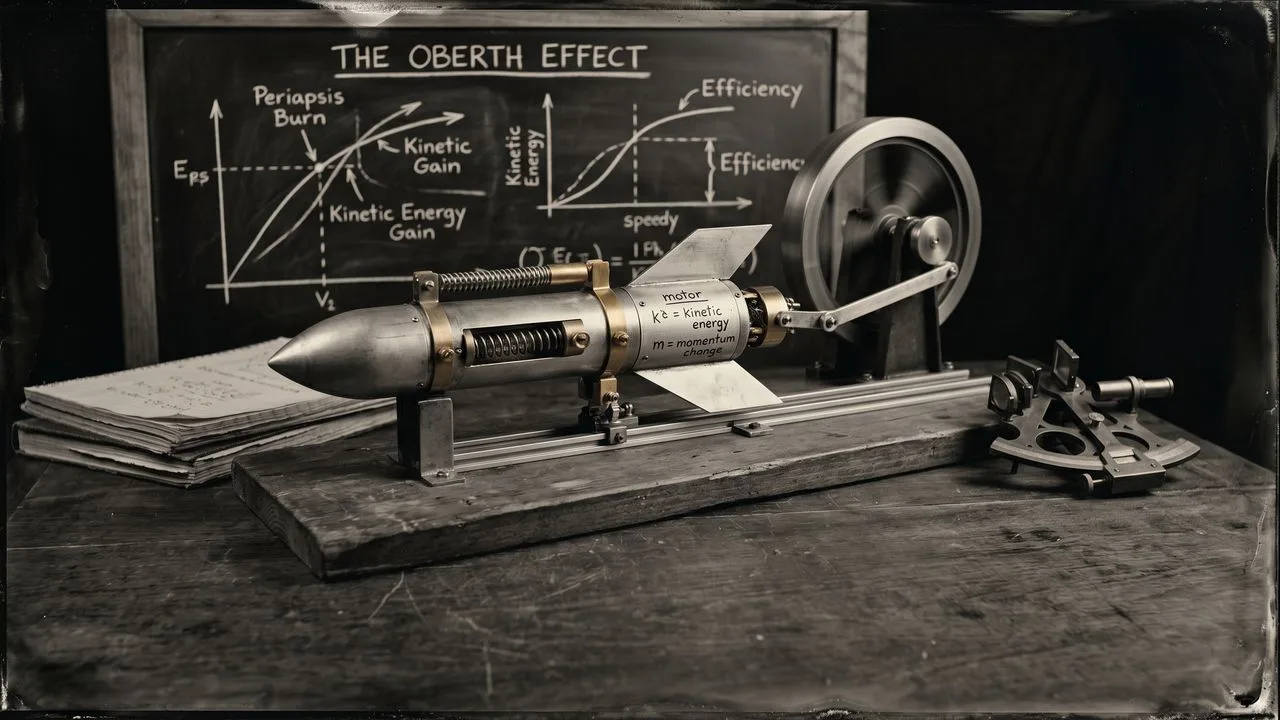
Photo: AI. Otieno Okello
Here is a result that should make you suspicious: a spring storing 300 millijoules of energy somehow produces 425 millijoules of kinetic energy gain in a rocket. If your instinct is to call the accounting fraudulent, that instinct is healthy. But the accounting is clean. The "extra" energy is real, and where it comes from is one of the more clarifying ideas in orbital mechanics.
This is the Oberth effect—named for Hermann Oberth, one of the founding theorists of modern rocketry—and it has been quietly shaping mission design since the early days of spaceflight. A recent video from The Action Lab walks through the physics with a spring-loaded ball launcher mounted on a pendulum swing, using careful measurement to make the energy bookkeeping visible. The experimental setup is modest; the implications are not.
The Setup That Makes the Numbers Honest
The experiment's value is in its controls. Rather than gesturing at rocket physics abstractly, the creator built a repeatable system: a spring-loaded launcher with a known energy store (approximately 300 millijoules), mounted on a long swing so that near the bottom of its arc, the motion is approximately linear and frictionless—a reasonable physical analog for a spacecraft in open space.
Two trials. First, the launcher fires from rest. The "rocket" (the launcher body) accelerates from 0 to about 0.4 m/s, gaining roughly 31 millijoules of kinetic energy. The ejected ball travels at about 3.5 m/s and gains roughly 276 millijoules. Total: around 307 millijoules. The spring's stored energy, accounted for. Nothing unusual.
Second trial: the launcher is already moving at 2.5 m/s when it fires. The rocket body accelerates to about 2.9 m/s—the same delta-v of 0.4 m/s, as conservation of momentum demands. But now the kinetic energy gain for the rocket body is approximately 425 millijoules. That number, sitting next to a 300-millijoule spring, looks wrong.
The resolution comes from looking at the ball. In the moving case, the ball was already traveling at 2.5 m/s before the launch. After ejection, it slows to about 1 m/s. It has lost roughly 112 millijoules of kinetic energy. When you add the spring's contribution to that transferred energy from the ball, the rocket's 425-millijoule gain is fully explained. No energy was created. The system's total energy is conserved—it simply redistributed differently depending on the reference frame's initial conditions.
As the video puts it: "The ball actually lost kinetic energy. In fact, the ball lost about 112 millijoules of kinetic energy." This is the crux of the effect, and it's easy to miss if you're only watching the rocket.
What "Free Energy" Is Actually Telling You
The apparent paradox dissolves once you track the entire system rather than just the vehicle. In the stationary case, the spring energy splits between rocket and ball—roughly 10% to the rocket, 90% to the ball. In the moving case, the rocket captures not only its share of the spring energy but also raids the kinetic energy that the ball was carrying before ignition. The ball ends up moving slower than it started; that energy had to go somewhere.
This is the correct way to think about what's happening: the propellant (the ball) enters the combustion event with pre-existing kinetic energy. When the rocket fires, momentum conservation means the exhaust ends up moving slower in the ground frame than it would have from a standing start. That kinetic energy has to be conserved—so it flows, effectively, into the spacecraft.
The video captures this precisely: "The faster you're moving, the more energy you get out of it. Move 10 times faster and you get 10 times more energy for a given rocket burn."
This is not a violation of the principle that motion is relative—it is, paradoxically, a consequence of it. An observer moving alongside the rocket at 2.5 m/s would see exactly the same energy transfer as the stationary-launch case. The "extra" energy only appears from the ground frame, because in that frame, the initial kinetic energy of the whole system (rocket plus propellant) is available to be redistributed. The Oberth effect is, at bottom, a bookkeeping result: energy is frame-dependent, and a higher-speed burn starts the books in a more favorable position.
Why This Matters for Missions That Actually Fly
The practical consequence for spaceflight follows directly. In any orbit, a spacecraft's total mechanical energy is the sum of its kinetic energy and its gravitational potential energy. At periapsis—the closest point to the gravitating body—the spacecraft moves fastest, meaning kinetic energy is at its peak and potential energy at its trough. This is exactly where the Oberth effect delivers its largest return.
The video demonstrates this in Kerbal Space Program, showing that a burn near periapsis dramatically reshapes the orbit—enough to achieve escape velocity far more efficiently than the same burn performed at apoapsis, the orbit's slowest and most distant point. The orbital mechanics here are well-established and not in dispute: mission planners at NASA, ESA, and every other agency that operates beyond low Earth orbit design their trajectory burns around this principle. The Cassini mission's gravitational assists, the Voyager trajectories, New Horizons' path to Pluto—all of them reflect Oberth's insight at some level.
The inverse is equally useful. Braking burns for orbital capture, or for slowing a spacecraft on a return trajectory, are also most efficient at periapsis. Same physics, opposite sign.
The Interstellar Speculation
Where the video moves from demonstrated physics to speculative application is in its discussion of interstellar travel. The argument is structurally sound: a spacecraft falling inward toward the sun from a great distance converts its gravitational potential energy into kinetic energy, arriving near the sun at extremely high velocity. At that point, firing engines triggers a massive Oberth effect, since the spacecraft is moving as fast as solar gravity can make it. The exhaust gets left behind, slower, deeper in the sun's gravitational well.
"You can picture the Oberth effect as using gravity to build up huge amounts of kinetic energy, then transferring more of that energy to the spacecraft while leaving the exhaust moving slower and deeper in the sun's gravity well," the video explains.
This scenario—sometimes called a "sundiver" or Oberth maneuver—is a real concept in interstellar mission design. It appears in serious technical literature, including proposals for reaching nearby star systems within a human lifetime using nuclear or solar thermal propulsion. The physics checks out. The engineering is another matter entirely: getting a spacecraft close enough to the sun to exploit the effect at useful scales requires either extreme heat shielding or very fast approach trajectories, and the propulsion systems capable of executing the burn at those speeds don't yet exist.
That gap between physical principle and engineering reality is worth keeping visible. The Oberth effect doesn't make interstellar travel easy; it makes it less impossible than it would otherwise be. Those are meaningfully different claims.
What the Experiment Actually Demonstrates
What's useful about the Action Lab's experimental approach—beyond the pedagogical clarity—is that it forces a confrontation with where energy actually goes. Most popular explanations of the Oberth effect stop at "rockets are more efficient when moving fast," which is true but unsatisfying. The spring-and-ball setup makes visible the specific mechanism: propellant that enters a burn with kinetic energy can surrender that energy to the spacecraft. The efficiency gain is not magic; it is a consequence of the system's initial state.
This is also why the effect has no upper limit in principle. Higher initial velocity means more kinetic energy in the propellant, which means more available to transfer. The constraint is not the physics but the propellant itself—you eventually run out of mass to throw overboard, which is why the rocket equation is so brutal to interstellar mission planners regardless of what clever orbital mechanics you employ.
The Oberth effect is one of those results where the physics is tidy and the implications unfold outward almost without bound. Whether those implications eventually include human-crewed missions to other stars is a question that belongs to engineers and materials scientists more than physicists. The physics has already done its part.
More Like This
How Gravity Assists Propel Spacecraft Efficiently
Exploring gravity assists in space travel: a technique to boost spacecraft speed by leveraging planetary motion.

Can Humans Really Live on Mars? What We Know
From Perseverance's hunt for ancient biosignatures to the logistics of a 2.5-year round trip, here's where the Mars ambition actually stands.
Scramjets: The Engines That Keep Fire Lit at Mach 10
Scramjet engines maintain combustion at hypersonic speeds where conventional jets fail. Here's how they work—and why lighting a candle at Mach 10 is harder than it sounds.
Can Objects Fall Faster Than Gravity?
Exploring phenomena where objects appear to fall faster than gravity due to constraints and mechanics.

Exploring the Cosmic Balance: Lagrange Points
Discover how Lagrange points revolutionize space exploration, offering energy-efficient paths and potential for space construction.

Zeeman Effect: Unveiling Magnetic Mysteries
Explore the Zeeman effect's role in physics, from solar studies to MRI tech.
CERN's LHC and the Search for Hidden Dimensions
Inside CERN's Large Hadron Collider: how 600 million proton collisions per second could reveal dark matter, extra dimensions, and the Higgs boson.
Triton's Strange Orbit and the Ice Giants' Secrets
Triton's retrograde orbit, nitrogen geysers, and the chaotic magnetic fields of Uranus and Neptune reveal how little we understand our own solar system.