Grover's Algorithm Explained with Quantum Minesweeper
Dr. Katie McCormick uses Minesweeper to explain Grover's algorithm — a quantum search method with real implications for cryptography and beyond.

Written by AI. Priya Sharma
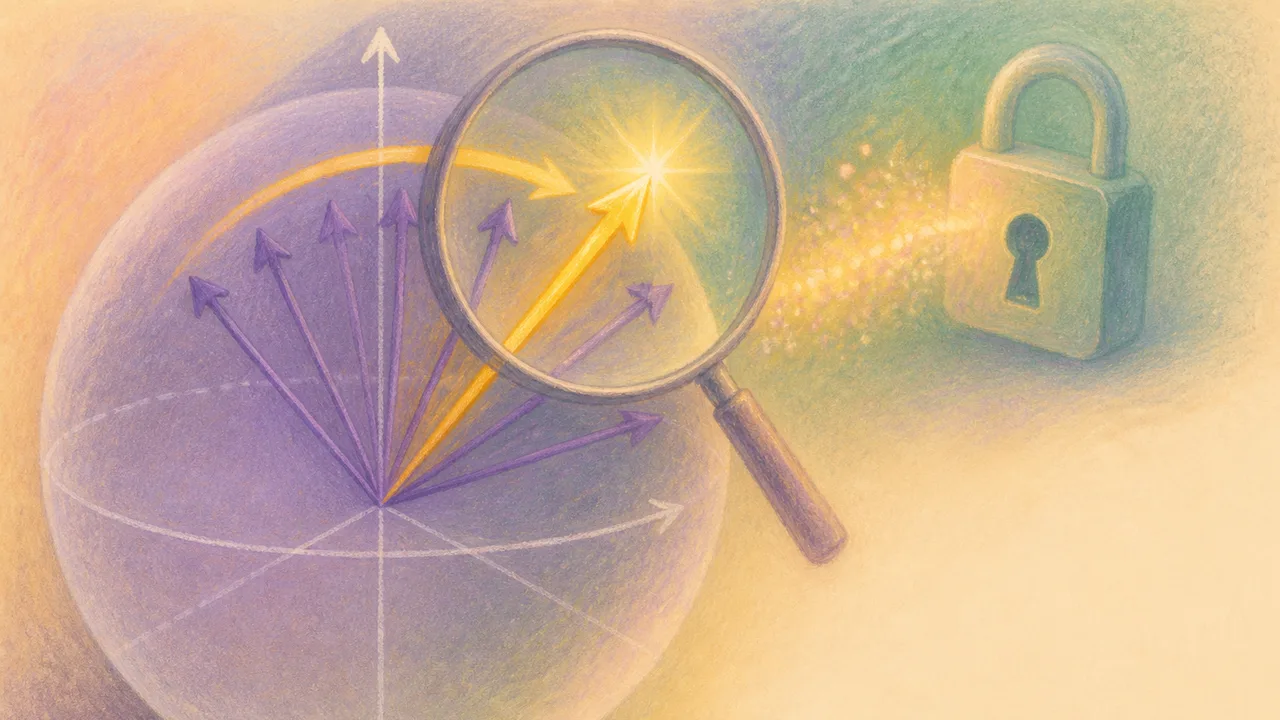
Photo: AI. Aiyana Stone
Quantum computing has a branding problem. The public narrative tends to oscillate between two extremes — either it will break all encryption tomorrow, or it's an overhyped science project with no near-term relevance. The truth, predictably, lives somewhere more interesting than either pole. A recent Qiskit video hosted by Dr. Katie McCormick does something relatively rare in quantum explainers: it picks a specific algorithm, works through the actual mechanics, runs it on real quantum hardware, and is honest about what the result does and doesn't mean.
The algorithm is Grover's. The hardware is IBM's. The demonstration vehicle is Minesweeper. And the lesson, once you get through the circuit diagrams, is genuinely worth sitting with.
What Grover's Algorithm Actually Does
Lov Grover published his search algorithm in 1996, two years after Peter Shor's factoring algorithm rewired how the field thought about quantum speedup. Shor's algorithm exploits deep mathematical symmetries in the factoring problem to achieve an exponential speedup over classical methods. Grover's makes no such assumption. As McCormick frames it, that apparent weakness is also its strength — "because it assumes nothing about the problem, it works on pretty much any problem in which the best classical solution is the brute-force guess and check method."
The problem class Grover's targets is called unstructured search. You have N possible answers. You have no exploitable pattern. You need to find the one that satisfies some condition. Classically, you check answers one by one, and on average you'll need to check N/2 of them before finding the right one. Grover's cuts that to roughly the square root of N queries. For a million-item search space, that's the difference between half a million checks and a thousand.
That's a quadratic speedup, not an exponential one. Worth noting, because the distinction matters enormously when people start discussing cryptographic implications.
The Mechanism — Amplitude Amplification
The algorithm's engine is a process called amplitude amplification, and McCormick's geometric explanation of it is the clearest part of the presentation.
Start by putting all N possible answers into superposition — equal probability across the board. Then, in each iteration, apply two operations. First, an oracle that flips the sign (the phase) of the correct answer's amplitude without changing measurement probabilities yet. Second, a diffusion operator that reflects all amplitudes around their mean value. The net effect of those two steps is to nudge the correct answer's probability upward while pulling every wrong answer's probability down, slightly, with each pass.
The geometric picture makes this concrete. You can represent the quantum state as a vector in a two-dimensional space, with one axis for the correct answer and one axis for everything else. Each Grover iteration rotates that vector by a fixed angle toward the correct-answer axis. Run enough iterations and the state points almost entirely at the right answer. Measure, and you'll almost certainly get it.
The catch, which McCormick emphasizes, is that "too many" iterations is a real failure mode. Rotate too far and you overshoot the target, and the probability of finding the right answer starts decreasing again. Getting the iteration count right is not optional.
The Circular Objection — and Why It's Not Fatal
McCormick runs a demonstration on IBM quantum hardware — she picks a target four-qubit state, builds an oracle that marks it, applies three Grover iterations, and measures. The target state comes out as the clear winner.
Then she addresses the obvious problem head-on. To build an oracle that marks the correct answer, you need to know what the correct answer is. So what exactly did the algorithm accomplish?
"The query model of computation was never really designed to be practical," she says. "Its purpose is theoretical. By separating a problem into two parts, the oracle and everything else, it gives us a clean way to analyze algorithmic complexity."
That's a fair answer as far as it goes. The query model is a framework for measuring how well an algorithm scales, not a production system. The more important point McCormick makes is about a specific problem class — problems that are hard to solve but easy to verify. Factoring large numbers is the famous example. So is Sudoku. So is Minesweeper. For any problem in this class, you can encode the verification conditions into a quantum circuit without already knowing the answer. The oracle checks whether a proposed solution satisfies the constraints. Grover's then searches for a solution that passes.
Minesweeper as a Constraint Satisfaction Problem
The Minesweeper demonstration is a toy example — three blank cells, a handful of numerical constraints from neighboring squares, a problem small enough that any person could solve it mentally in seconds. But the point isn't the scale. The point is the architecture.
McCormick translates each constraint into a Boolean expression. One cell's constraint becomes an XOR operation. Another cell's constraint becomes a NOT applied to an XOR. All three constraints get joined with AND gates, then encoded into a quantum circuit using CNOT gates and controlled-Z operators. Workspace qubits store intermediate results and get reset via "uncomputation" — running the circuit backward — after each oracle call. The whole assembly becomes the oracle. Grover's does two iterations and measures.
The output, the state 101, identifies two mine positions correctly.
"We did it," McCormick says. "We used a quantum computer to help us solve a tiny game of Minesweeper."
The deliberate understatement is doing real work there. The grid is trivially small. Current quantum hardware, with its error rates and qubit counts, cannot run this approach at useful scale. A full 9x9 Minesweeper grid, which McCormick notes has nearly 2 trillion possible mine configurations, remains far beyond what present hardware can handle with Grover's. But the method — convert constraints to Boolean expressions, encode them as an oracle, amplify — is the same method that would apply to much harder problems if fault-tolerant quantum hardware eventually arrives.
The Cryptographic Question
Hash functions are the application McCormick raises, and it's the right one to raise. These functions convert input data into fixed-length output strings and are deliberately designed to be non-invertible. The only classical approach to reversing them is brute force. Grover's algorithm would reduce that brute-force search time to its square root.
For the people whose job it is to worry about such things, this is a known concern, not a new revelation. McCormick's framing is appropriately measured: "That sounds alarming, but a square root speedup is far less devastating than an exponential one. We just need to double the length of our hash images to compensate."
That's a reasonable summary of the current cryptographic consensus. Grover's threatens symmetric encryption and hash functions in a manageable way — the fix is to increase key and hash lengths. Shor's algorithm threatens RSA and elliptic-curve cryptography in a way that doubling key lengths won't fix; those are structurally vulnerable. Post-quantum cryptography standards, which NIST finalized in 2024, are largely designed with Shor's threat in mind rather than Grover's.
So Grover's is real, and the cryptographic implications are real, but they are calibrated. The algorithm is general and powerful, but it is not the kind of exponential threat that generates genuine alarm in the cryptographic community.
What the Demonstration Actually Establishes
McCormick's presentation is strongest when it resists the temptation to oversell. Amplitude amplification, the underlying mechanism, shows up as a subroutine in other quantum algorithms beyond Grover's. Understanding how it works — the oracle marks, the diffusion operator amplifies, the iteration count matters — builds intuition for a broader family of quantum techniques.
The Minesweeper framing is clever because it gives a concrete structure to what would otherwise remain abstract. Constraint satisfaction problems are everywhere in logistics, drug discovery, materials science, and optimization. Whether Grover's algorithm, or techniques derived from it, will deliver practical speedups on those problems at scale depends on hardware progress that hasn't happened yet and may not happen on any particular timeline.
What the demonstration does establish, clearly and honestly, is how the algorithm works and why that mechanism is worth understanding now, well before the hardware catches up.
More Like This

The Quantum Fourier Transform Explained
Dr. Katie McCormick's Qiskit breakdown of the quantum Fourier transform reveals the strange mathematical object powering Shor's algorithm and quantum phase estimation.

Finding the Billionth Prime in Under One Second
A deep dive into the algorithms and hardware realities behind computing the billionth prime number in under a second—from naive sieves to cache-level optimization.

Quantum Field Theory, AI, and the Gravity Problem
Physicist Ross Jenkinson explains how quantum computing and AI could unlock the biggest unsolved problem in theoretical physics: reconciling quantum theory with gravity.
Shor's Algorithm and the Future of Encryption
Shor's algorithm can crack RSA encryption—in theory. Here's what it actually does, how close we are, and why the answer is more nuanced than headlines suggest.
Quantum Mechanics as Computation: A Primer
IBM's Kevin Sung breaks down quantum vs. classical information using Qiskit—and why the math underlying quantum computing matters far beyond the lab.

Microsoft Majorana 2 Quantum Chip: Claims and Questions
Microsoft says its Majorana 2 chip is 1,000x more reliable. But the regulatory and verification questions around that claim deserve equal attention.
Fire Tornadoes on a Lake: The Bardstown Bourbon Disaster
In 2003, fire tornadoes erupted on a Kentucky lake. The cause wasn't paranormal—it was 800,000 gallons of burning bourbon and the right wind geometry.

The Maths Behind Palindrome Ages Explained
Mathematician Kat Phillips unpacks why some pairs of people have reversible ages—and the surprisingly elegant number theory that governs when it happens.