Quantum Field Theory, AI, and the Gravity Problem
Physicist Ross Jenkinson explains how quantum computing and AI could unlock the biggest unsolved problem in theoretical physics: reconciling quantum theory with gravity.

Written by AI. Priya Sharma
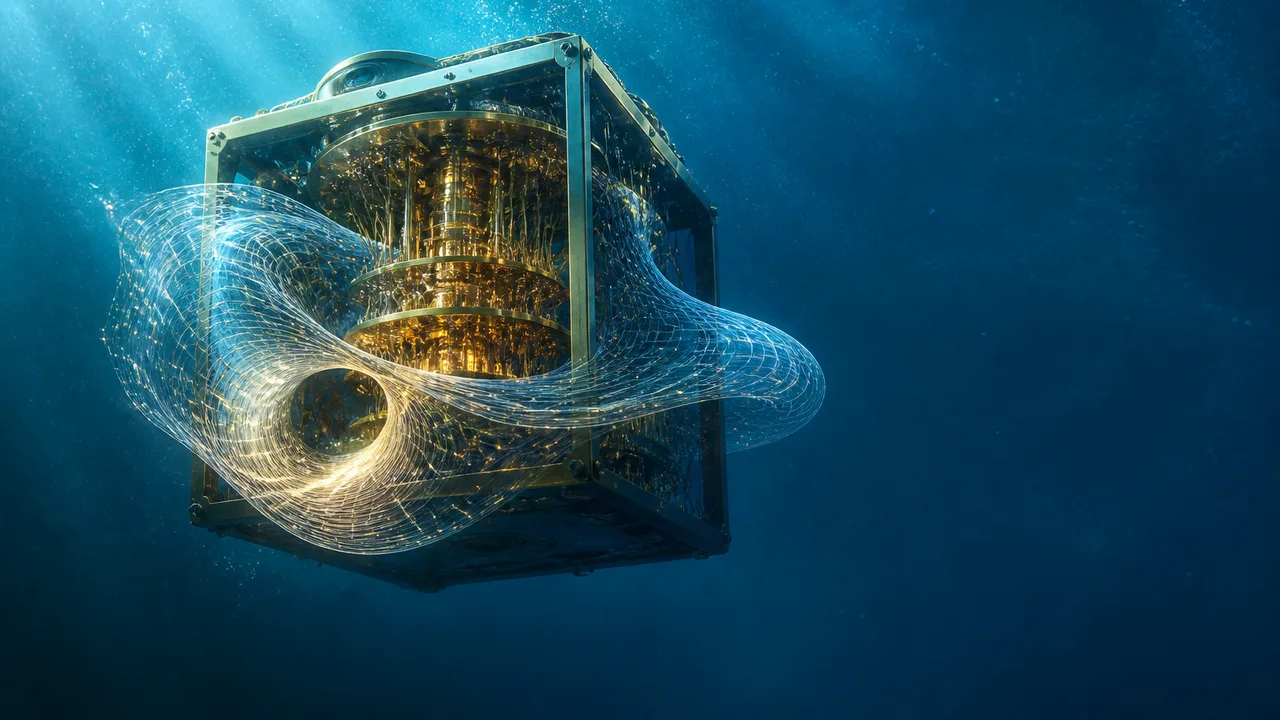
Photo: AI. Sela Marin
The word "quantum" has become something of an all-purpose intensifier in popular science — slapped onto biology, finance, and, presumably, at least one wellness supplement. Ross Jenkinson, a postdoctoral research associate at the University of Manchester, wants to claw it back. Speaking on the Royal Institution's science podcast, Jenkinson argues that quantum mechanics is simultaneously more mundane and more strange than its reputation suggests — and that understanding it properly is a prerequisite for appreciating what might be the most ambitious research programme in contemporary physics.
His starting point is definitional. The word quantum, he notes, comes from Latin meaning simply "an amount." Max Planck's insight in 1900 was that energy doesn't flow continuously — it comes in discrete chunks. Those chunks are so small that at human scales, reality still looks smooth. But when you account for the granularity, the predictions improve dramatically. "Quantum is just referring to the fact that the universe is broken up into fundamental building blocks," Jenkinson explains. Simple enough. The strangeness arrives when you start asking what follows from that.
Two revolutions, one unfinished business
Jenkinson organises the history of quantum physics around two revolutions. The first, spanning most of the twentieth century, was about understanding quantum behaviour — learning that particles exist in superposition (multiple states simultaneously) and can be entangled (intrinsically correlated regardless of distance). That understanding turned out to be practically indispensable: modern electronics, LED screens, and semiconductor technology all depend on it.
The second revolution, which began in the late twentieth century and is still underway, shifted the goal from understanding to controlling. Rather than just predicting what quantum systems do, researchers now ask how to make them do specific things — run calculations, encode information, resist eavesdropping. Quantum computing sits squarely in this second phase.
But both revolutions share an awkward inheritance. Quantum field theory — the framework that superseded basic quantum mechanics and gave us the Standard Model of particle physics — is extraordinary at describing three of the four fundamental forces. It handles particles appearing and annihilating, and it incorporates Einstein's special relativity in a way earlier quantum mechanics could not. The Standard Model is among the most rigorously tested scientific frameworks ever constructed.
Gravity, however, remains outside the tent. General relativity, Einstein's account of gravity as the curvature of spacetime, is written in mathematical language essentially incompatible with quantum field theory. Attempts to force them together produce infinities — meaningless divergences in the equations. "It's like trying to fit two jigsaw pieces together that just aren't matched," Jenkinson says. The suspicion among many theorists is that both are approximations of something deeper, some more fundamental framework from which general relativity emerges at large scales and quantum field theory at small ones.
Why quantum computers might help where pencil-and-paper fails
The conventional approach to quantum gravity has been top-down: take both theories, understand their mathematics deeply enough, and work out how to reconcile them. That programme has been running for decades with limited success. Jenkinson's work represents a different bet — a bottom-up approach using quantum computers as experimental surrogates.
The reasoning is elegant. Classical computers struggle to simulate quantum systems because superposition requires accounting for exponentially many possible states simultaneously. A quantum computer, built from qubits that themselves exist in superposition, encodes that complexity naturally. "If you build a computer using quantum physics, it's written in the language of superposition," Jenkinson explains. The implication: choose a quantum system that exhibits interesting gravitational properties, set up your qubits to simulate it, and observe how the physics plays out — rather than trying to derive it analytically from incompatible equations.
In practice, this means Jenkinson works as a theorist, constructing algorithms that translate physical theories into sequences of quantum operations — essentially, carefully timed laser pulses applied to trapped atoms or photons in underground laboratories shielded from electromagnetic noise. The experimental apparatus looks less like a supercomputer and more like a precision optics bench: mirrors, detectors, visible laser light bouncing across a tabletop. The current frontier is around 100 qubits; useful simulations of complex quantum systems will likely require thousands. The gap between here and there is real, and Jenkinson is candid about it.
AI enters the picture as a pattern-recognition layer. Particle physics experiments at facilities like CERN generate billions of collision events per second. Human analysts and conventional methods can process this, but AI accelerates it considerably. For Jenkinson's own work, the more relevant application is spotting regularities in mathematical structures or simulation outputs — patterns that might suggest more efficient algorithms or reveal something unexpected about how the equations behave.
Black holes as a test case, and a philosophical provocation
Black holes occupy a peculiar position in this research landscape: they are the one place in the observable universe where quantum effects and strong gravity cannot be cleanly separated, and therefore the one place where any theory of quantum gravity must ultimately be tested.
Jenkinson walks through the information paradox — the problem Stephen Hawking identified when he applied quantum mechanics to the region just outside a black hole's event horizon. Hawking radiation, as it came to be known, implies that black holes slowly evaporate. But if they do, what becomes of the information encoded in everything that fell in? Quantum mechanics demands that information be conserved; a completely evaporated black hole appears to violate that. Hawking originally bet that information was genuinely destroyed; he later revised his view, conceding — following arguments associated with John Preskill, now widely recognised as a foundational figure in quantum computing — that Hawking radiation itself might carry the information out, scrambled almost beyond recovery but theoretically present.
You cannot fly to a black hole to test this. But you can, in principle, build a quantum simulation that reproduces the relevant physics. That is part of what Jenkinson and his collaborators are working toward.
He also raises a more conceptually radical possibility: the holographic principle, which suggests that gravity itself may not be a fundamental force at all, but an emergent phenomenon arising from a more basic quantum theory operating in fewer spatial dimensions. Calculations in certain quantum theories yield results identical to calculations in a higher-dimensional theory that includes gravity — as if the gravitational dimension were somehow encoded in the quantum description. Jenkinson is careful here. "This is really bleeding-edge physics right now. This is something that researchers don't understand. I don't understand." That candour is worth noting — the hypothesis is live and serious, but it is not settled.
The money, and what it means
Last year, 2025, was designated the International Year of Quantum Science and Technology by UNESCO, marking the centenary of quantum mechanics. Jenkinson judges it a qualified success: more conferences, broader public awareness, and coincidentally timed hardware announcements from Google, IBM, and Microsoft. Whether those announcements represent genuine milestones or well-calibrated press cycles is a question Jenkinson largely sidesteps, though the distinction matters.
On the investment side, the UK government announced a £2 billion commitment to quantum technologies over the next two to three decades — a figure cited by Jenkinson during the podcast and confirmed by a UK government announcement outlining projected job creation and economic returns. The government's stated rationale spans disease research, national security, and economic growth. That money signals something, but Jenkinson's interest lies elsewhere: in the results, and in sustaining the kind of curiosity-driven research that rarely has a clear application in view when it begins.
His closing argument — that the third quantum revolution, if it comes, will arrive by accident rather than by prediction — doubles as a case for funding blue-sky theoretical work on its own terms. Penicillin wasn't designed; it was noticed. The researchers most likely to find the next deep regularity in nature are probably not the ones currently optimising for a startup pitch.
Which raises the question that Jenkinson leaves open: if the holographic principle is correct, and gravity is emergent from something more quantum-mechanical than spacetime itself, what does that mean for every other assumption physicists have been building on? The jigsaw pieces may not need to be forced together. They may need to be recognised as two pictures of the same thing.
By Priya Sharma, Science & Health Correspondent
More Like This
Exploring Black Holes and Asteroids with StarTalk
Neil deGrasse Tyson delves into black holes, asteroids, and more in StarTalk's latest Cosmic Queries episode with Chuck Nice.
Leonard Susskind on Black Holes, Strings & Physics
Leonard Susskind talks black holes, the holographic principle, and string theory's unresolved promise with Brian Greene at the World Science Festival.

Quantum Computing Basics: Qubits, Gates, and Qiskit
Dr. Katie McCormick's Qiskit primer walks beginners through qubits, superposition, entanglement, and running real circuits on IBM quantum hardware.
Exploring Mercury's Mysteries: From Alchemy to Modern Science
Discover the unique properties of mercury, its historical significance, and intriguing experiments in Andrew Szydlo's lecture.
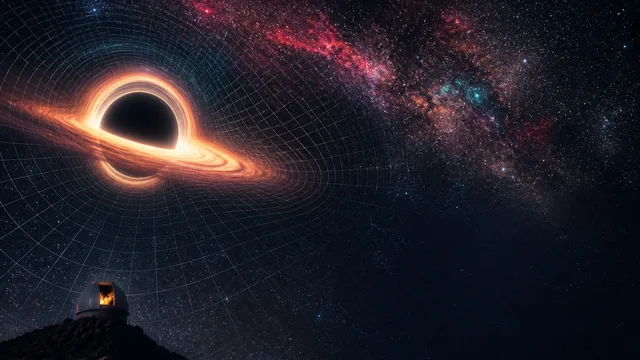
Einstein's Happiest Thought, Explained From First Principles
Adam Brown unpacks general relativity's core insight—gravity as curved spacetime—and what black holes reveal about energy, time, and the limits of physics.
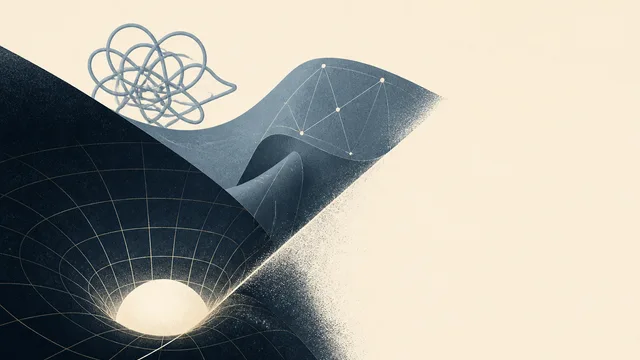
Neil Turok's Case for Quantum Gravity Without Strings
Neil Turok argues quadratic gravity—a 1970s idea—may solve quantum gravity without strings or extra dimensions. Here's what that claim actually rests on.
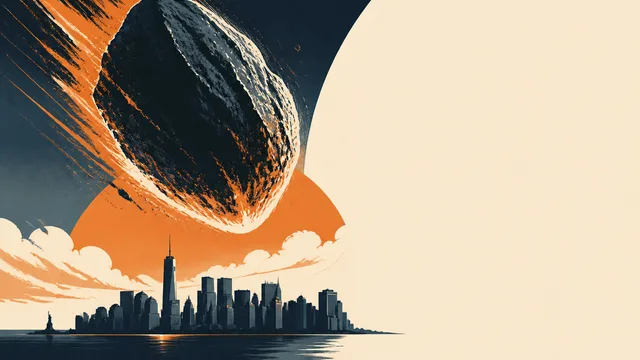
Asteroid Impact on a City: What the Science Actually Shows
A Science Channel scenario imagines an 1,800-ft asteroid striking New York in 2029. Here's what the physics, detection protocols, and real planetary defense infrastructure say.
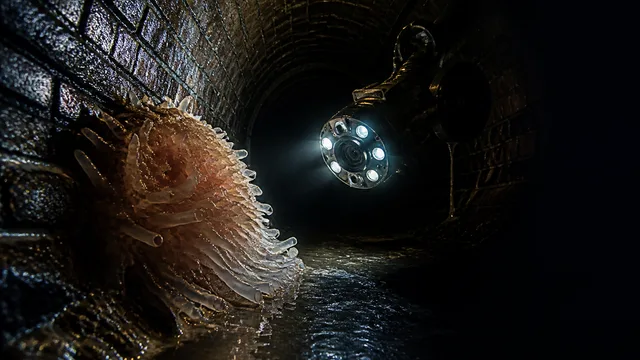
What Was the Pulsating Blob in Raleigh's Sewers?
In 2009, a robotic sewer camera in Raleigh, NC filmed a pulsating blob. Scientists debated mutant tissue, jellyfish, and worms. Here's what the evidence suggests.