Brian Keating on What Came Before the Big Bang
Cosmologist Brian Keating explains the multiverse, dark energy, string theory's fatal flaw, and why finding extraterrestrial wisdom matters more than finding aliens.

Written by AI. Nadia Marchetti
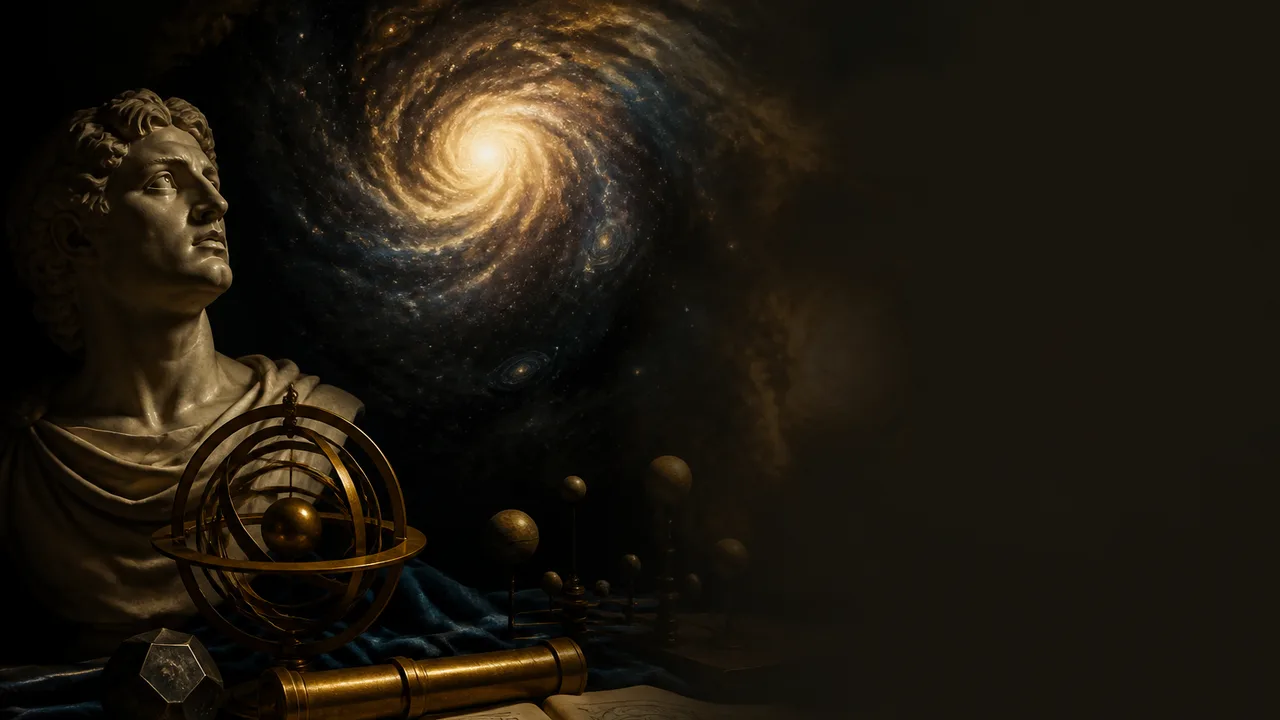
Photo: AI. Liora Goldstein
There's a version of this conversation that would have been a Nobel Prize acceptance speech.
In 2014, Brian Keating's team operating the BICEP telescope announced they had found it — the primordial gravitational wave signal imprinted on the cosmic microwave background, a literal echo of the universe's first moment. The discovery would have confirmed cosmic inflation, pointed toward a multiverse, and placed Keating alongside the names he invokes with obvious reverence: Einstein, Hawking, Gamow. Six months later, they had to retract the finding. Interstellar dust had contaminated the signal, mimicking exactly what they hoped to see.
Keating is now a professor at UC San Diego and leads the Simons Observatory, among the most ambitious ground-based cosmology experiments currently operating. He's also, by his own candid assessment, someone who knows firsthand what confirmation bias feels like from the inside.
"When you see something that you want to see," he told host Gleb Solomin in a recent conversation, "there's a bias to exclude things that would be arguing that you didn't see that. And you fall in love with the idea, the seduction that you may be the first person to ever discover something."
He says this not to embarrass himself but to make a methodological point that he returns to throughout the conversation: science's most dangerous enemy isn't ignorance, it's desire.
Keating opens with the question the video title promises — how does a universe come from nothing? — and immediately reframes it as the wrong question, or at least a premature one. The more tractable problem is the one he calls the most important in all of science: what happened right before the Big Bang?
The standard textbook answer is that there was no "before" — time itself began at the singularity. But several competing models challenge that framing. The steady-state universe posited by Fred Hoyle required matter to spontaneously generate at intervals, avoiding a beginning entirely. The "big crunch" model imagines our universe born from the collapse of a predecessor, like a cosmic supernova that births a new universe instead of just new iron. Roger Penrose's conformal cyclic cosmology cycles through eons, with primordial black holes as the only passengers that survive from one universe to the next.
Keating treats all of these seriously, and the reason is methodological rather than philosophical: several are falsifiable. If the Simons Observatory detects B-mode polarization in the CMB — the gravitational wave signature of an inflationary epoch — it would rule out big crunch and bouncing universe models that don't produce such waves. That's not proof of inflation, he's careful to note, but it carries real "informatic weight." It narrows the field.
The multiverse arrives here not as mysticism but as a logical extension of a pattern humans keep discovering about themselves. We thought we were at the center of the solar system. Then we weren't. We thought our sun was singular. Then we found a hundred billion more in our galaxy alone, and a trillion galaxies beyond that. Each demotion came with evidence. The multiverse, Keating argues, is simply the next iteration of that same deflationary logic — not a conclusion, but a serious hypothesis that deserves instruments rather than just metaphors.
He distinguishes sharply between the breathless multiverse of popular science books and the specific, testable versions physicists actually care about. Max Tegmark, a collaborator of Keating's, organizes them into four levels: a neighboring universe just beyond our observable horizon (the most mundane and arguably most plausible); the landscape of string theory's vacuum configurations; the Everett many-worlds interpretation of quantum mechanics, where every quantum event branches into separate outcomes; and finally the mathematical universe hypothesis, where any self-consistent mathematical structure corresponds to a real physical existence.
Keating finds the first level genuinely plausible and the last level genuinely interesting. The middle ones — particularly string theory's landscape — frustrate him in ways he doesn't try to conceal.
His critique of string theory is structural rather than personal. The theory predicts phenomena at scales permanently inaccessible to any conceivable experiment. After roughly six decades of development, it has produced beautiful mathematics and zero testable predictions. Keating draws a pointed historical parallel: Kepler once believed planetary orbits were determined by nested Platonic solids. The geometry was elegant. It was also wrong, and importantly, it was wrong in a way data could demonstrate. String theory can't even clear that bar.
"Beautiful math means nothing," he says flatly. "There's a lot more math than there is physics."
This is where the conversation gets philosophically interesting, because Keating doesn't think math is irrelevant — he thinks it's uncanny. Eugene Wigner's famous observation about the "unreasonable effectiveness of mathematics in the natural sciences" sits at the center of a puzzle Keating admits nobody has solved: why does the ratio of a circle's circumference to its diameter show up in quantum wave functions and forest tree height distributions? Why does adding the square root of negative one to Newtonian mechanics yield quantum mechanics? The correspondence is real and unexplained, which is different from math being physics.
The distinction matters when he turns to AI. Keating has been experimenting with something that sounds like a thought experiment but is apparently a real project: training a language model exclusively on Einstein's early works — deliberately cutting off any knowledge of subsequent physics — to see whether it could predict discoveries Einstein hadn't yet made. The cutoff he describes in the conversation is meant to replicate the conditions of Einstein's mind at a specific point, before general relativity and the developments that followed. The practical problem, Keating notes, is that every frontier model is saturated with all subsequent knowledge, making the lobotomy nearly impossible to perform cleanly.
His skepticism about AI as a physics engine runs deeper than logistics, though. Language models are extraordinarily good at language, he argues, because humans have been doing language for longer than we've been doing anything else. Physics isn't language. It's a description of physical reality that uses symbols but doesn't reduce to them. He's "not sanguine" about an LLM deriving the multiverse, and the reasoning is worth sitting with: these tools were built to predict the next token, not the next particle.
Dark energy threads through the conversation as its most urgent live question. When Einstein introduced the cosmological constant — a term he added to his equations to prevent a static universe from collapsing under its own gravity — he later called it his greatest blunder, after Hubble's observations confirmed the universe was expanding. Then, in the late 1990s, observations of distant supernovae revealed the expansion wasn't just continuing but accelerating. Einstein's "blunder" turned out to be a feature. Three scientists shared a Nobel Prize for that discovery, vindicating a term Einstein had abandoned.
Now the DESI telescope's measurements of galaxy positions and baryon acoustic oscillations suggest dark energy may be weakening. If it's not a constant but a dynamic field — one that could decay — the universe's fate gets genuinely uncertain. Keating doesn't dramatize this, but he doesn't dismiss it either. The data is real. What it means is not yet clear.
The conversation closes on UFOs, which Keating treats as a genuinely low-priority distraction compared to the questions he actually loses sleep over. He notes, without mockery, that we have no evidence of microbial life anywhere beyond Earth, let alone spacefaring civilizations. But the larger concern isn't extraterrestrial intelligence — it's extraterrestrial wisdom.
"We might be the only form of wisdom in the universe," he says. "That terrifies me."
It's a strange note for a cosmologist to end on, and a revealing one. Keating has spent his career chasing the universe's first moments with hardware deployed at the South Pole and the Atacama Desert, and the fear that keeps him up isn't that we'll never understand the cosmos. It's that we might understand it perfectly, and still not know what to do with what we find.
More Like This
Can We Go Back to Before Time Equals Zero?
Cosmologist Dr. Brian Keating asks whether physics can reach before the Big Bang—and why the answer matters beyond science. A look at the biggest question in cosmology.
The BOSS Great Wall: Anatomy of a Billion-Light-Year Structure
The BOSS Great Wall spans one billion light-years and shouldn't exist—at least not according to gravity alone. Here's what astronomers think is holding it together.
Ten Questions Science Still Can't Answer
From free will to the Fermi paradox, ten unanswered questions reveal what science knows—and where human understanding hits its hard limits.

Avi Loeb on Methane, Microbes, and Interstellar Objects
Avi Loeb tells Brian Keating that JWST methane data from 3I/ATLAS is puzzling enough to warrant a microbe hypothesis—and explains why a dark comet might be Soviet.
Leonard Susskind on Black Holes, Strings & Physics
Leonard Susskind talks black holes, the holographic principle, and string theory's unresolved promise with Brian Greene at the World Science Festival.
Did a Catholic Priest's Faith Corrupt the Big Bang?
Three cosmologists unpack whether Georges Lemaître's faith compromised his science—and why the real threat to cosmology is political, not theological.
Seven Proofs That the Harmonic Series Diverges
Michael Penn's 31-minute video walks through seven distinct proofs that the harmonic series diverges—from a 1350 grouping trick to a prime-number infinite product.
Artemis 2 Carried America's 250th Birthday to the Moon
NASA's Artemis 2 mission carried "America 250" markings to lunar orbit, blending national celebration with the next chapter of deep space exploration.