Can We Go Back to Before Time Equals Zero?
Cosmologist Dr. Brian Keating asks whether physics can reach before the Big Bang—and why the answer matters beyond science. A look at the biggest question in cosmology.

Written by AI. Nadia Marchetti
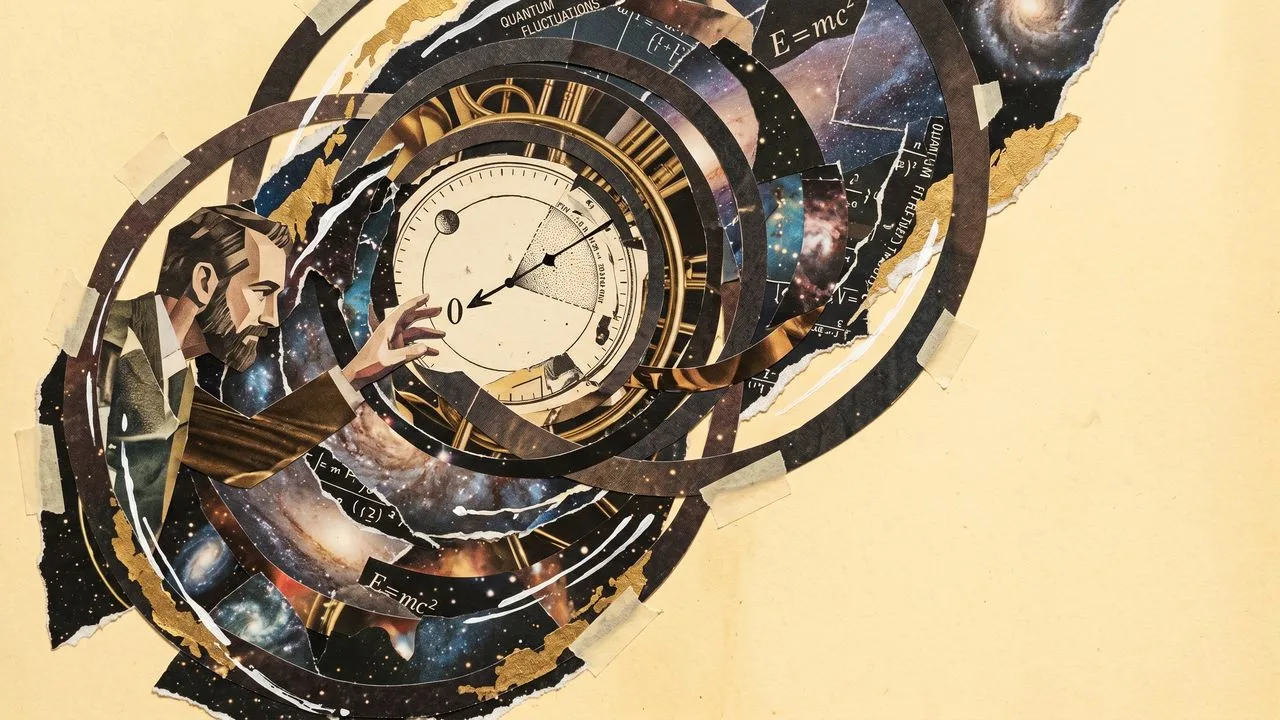
Photo: AI. Wren Sugimoto
There's a question that has been sitting at the edge of physics for decades, and it's not the kind of thing you can answer with a better telescope or a faster computer. It goes like this: what happened before time equals zero?
Not at zero. Not near zero. Before it. Which immediately raises the obvious problem: if time begins at the Big Bang, then "before" is a word that might not mean anything at all.
That's the hook cosmologist Dr. Brian Keating dangles at the start of his new introductory lecture series, and it's a good one—not because he answers it in nine minutes, but because he makes a convincing case that asking it seriously is itself a scientific act. The question isn't a mystical tangent. It's, arguably, the logical terminus of the entire project of cosmology.
The oldest science, now a precision one
Keating opens with a claim that sounds grandiose but holds up: cosmology is the oldest science humanity has practiced. Before agriculture, before writing, before metallurgy, humans were watching the sky and asking where everything came from. The questions haven't changed much. The tools have.
What has changed dramatically—and this is where the lecture gets genuinely interesting—is cosmology's precision. In the 1990s, astronomers couldn't pin down the age of the universe within a factor of two. The estimate ranged from roughly 10 to 20 billion years. That's not a measurement; that's an educated shrug.
Today, we know the universe is approximately 13.8 billion years old, and Keating frames the accuracy of that figure in a way that actually lands: "We know the age of the universe to within the equivalent of being able to look out at any one of you in the audience and say, 'I know within a few hours of when you were born.' Not just your age, but the day, the month, the year, the hour."
That's a remarkable leap. And it happened in roughly thirty years, which is why Wikipedia's main science page now leads with a diagram of the universe's evolution rather than a DNA strand or a T-Rex skeleton—both of which, Keating notes with some amusement, he'll also be discussing. Cosmology ate the other sciences. Or at least, it now contains them.
What cosmology actually is
The word "cosmology" shares a root with "cosmetology"—both come from the Greek cosmos, meaning beautiful or appearance. Keating makes this joke and then makes it mean something: the universe really is beautiful in the technical sense, and studying it aesthetically and scientifically aren't as different as academia likes to pretend.
His working definition is precise: cosmology is the laws of physics applied to the universe as a whole. Not just a star, not just a galaxy, not even just a galaxy cluster—the whole thing, as a single object of study. The four fundamental forces—electromagnetism, gravity, and the two nuclear forces—are the grammar of that study. Dark matter and dark energy are the sentences that still don't parse.
This framing matters because it sets up the central tension of the field. Physics works by isolating systems, controlling variables, running experiments. You can't do that with the universe. There's only one of it (allegedly), you can't run it twice, and you can't step outside it to check your work. Every cosmological conclusion is, in a deep sense, inferred rather than observed. That's not a criticism—inference done rigorously is science—but it's a constraint worth holding onto.
The question the diagram might get wrong
One of the more pointed moments in the lecture comes when Keating gestures at the NASA diagram that Wikipedia uses to depict cosmic history. It's the classic image: a cone expanding from a hot dense point, flaring outward through inflation, through the formation of atoms, stars, galaxies, eventually arriving at us. It's in textbooks. It's on the walls of planetariums.
Keating suggests it might be wrong—or at least incomplete—specifically around what it implies about the beginning. He doesn't spell out the flaw here (that's presumably for a later lecture), but the implication is that representing t = 0 as a clean starting point may be encoding assumptions that the physics doesn't actually support. He's apparently enthusiastic enough about this to propose a "letter-writing campaign" to get Wikipedia to update the image.
That's a real tension in modern cosmology. The standard model of the Big Bang describes the universe's evolution from an extremely early moment forward, but it doesn't—and arguably can't—describe the singularity itself. General relativity breaks down there. Quantum mechanics, as currently formulated, doesn't resolve the problem. String theory has proposals. Loop quantum cosmology has proposals. The cyclic model has proposals. None of them have evidence in the conventional sense.
When physics hands off to philosophy
The most interesting moment in Keating's lecture isn't the precision-science flex or the Wikipedia complaint. It's when he acknowledges, almost reluctantly, that the question of what came before the Big Bang—and particularly the related question of why the universe's fundamental constants are tuned to permit complexity and life—doesn't stay neatly inside the boundary of physics.
"It's impossible to ignore them," he says of questions about origins, fine-tuning, a creator, philosophy, theology. He's clear that his course won't become a theology seminar, but he's equally clear that pretending these questions aren't downstream of cosmology would be dishonest.
This is genuinely contested intellectual territory. Some physicists—Sean Carroll comes to mind, or Lawrence Krauss—argue that physics can, in principle, explain everything including its own starting conditions, and that importing philosophical or theological categories muddies the work. Others, like the cosmologist George Ellis or the physicist Paul Davies, maintain that the fine-tuning of physical constants and the existence of mathematical structure in nature raise questions that empirical science is structurally unable to close.
Keating doesn't take a side here—and for a first lecture, that's probably right. But it's worth flagging that "we'll encounter these questions but not dwell on them" is itself a methodological choice, and a debatable one.
What the curiosity argument is really doing
Running through the whole lecture is an appeal to curiosity as a kind of epistemological virtue. "It really takes formal education sometimes to beat that curiosity out of us," Keating says. "So I want to instill that curiosity back."
This is a familiar move in science communication—the reclamation-of-wonder pitch—and it's worth examining what it's actually asking. Keating isn't just saying be interested in cosmology. He's saying: bring your original, unschooled bewilderment to questions that have institutional gravity attached to them. Ask the dumb question. Ask the question that sounds like it belongs in a philosophy seminar, not a physics course.
That's actually a methodological stance. The history of cosmology is full of moments where the "obvious" interpretation of the evidence turned out to be wrong—where received wisdom calcified into obstacle. The discovery of the universe's accelerating expansion in 1998, which earned Saul Perlmutter, Brian Schmidt, and Adam Riess a Nobel Prize, upended what everyone thought they knew. Nobody expected it. The data required it.
So when Keating frames the question "can we go back to before time equals zero?" not as a rhetorical flourish but as a genuine research horizon, he's doing something more than inspiring. He's describing where the field's leading edge actually lives.
Whether the answer turns out to be yes, and here's the physics, or the question is malformed, or we genuinely don't know and may never know—all three would be significant. The question isn't the same as the answer.
More Like This
Are Subatomic Particles Just Convenient Fictions?
Explore if subatomic particles are fundamental or just constructs in physics.
Rethinking Inflation and the FLRW Model
Explore the complexities and challenges of cosmological models, including inflation theory and the FLRW model.
Verlinde vs. Jacobson: Does Gravity Emerge From Nothing?
Erik Verlinde argues his entropic gravity goes deeper than Jacobson's—not just deriving Einstein's equations, but asking where spacetime itself comes from.
Science Spent Millions on Blue Roses and Failed Spectacularly
Decades of genetic engineering haven't produced a true blue rose. The quest reveals fascinating limits of plant biology—and human obsession.
Hubble Tension: The Universe's Unsolved Mystery
Explore the Hubble tension and its implications for our cosmic understanding.
What Color Is Monday? Inside the Brain That Sees Time
Synaesthesia isn't imagination—it's perception. Cognitive psychologist Mary Jane Spiller explains how some brains create colors, tastes, and shapes most of us never see.
What the Dinosaur Asteroid Actually Did to Earth
New research reframes the Chicxulub impact—not just as a mass extinction event, but as a creative force that may have built the Amazon rainforest.
SpaceX Hits 600 Falcon 9 Booster Reuses
SpaceX reached 600 flight-proven Falcon 9 booster launches on July 13-14, 2026. Here's what that number actually means for spaceflight economics.