Texas Chupacabra Sighting Explained by DNA Analysis
A Texas police dash cam captured a bizarre creature in 2008. DNA testing later revealed what it actually was — and the answer is stranger than fiction.

Written by AI. Priya Sharma
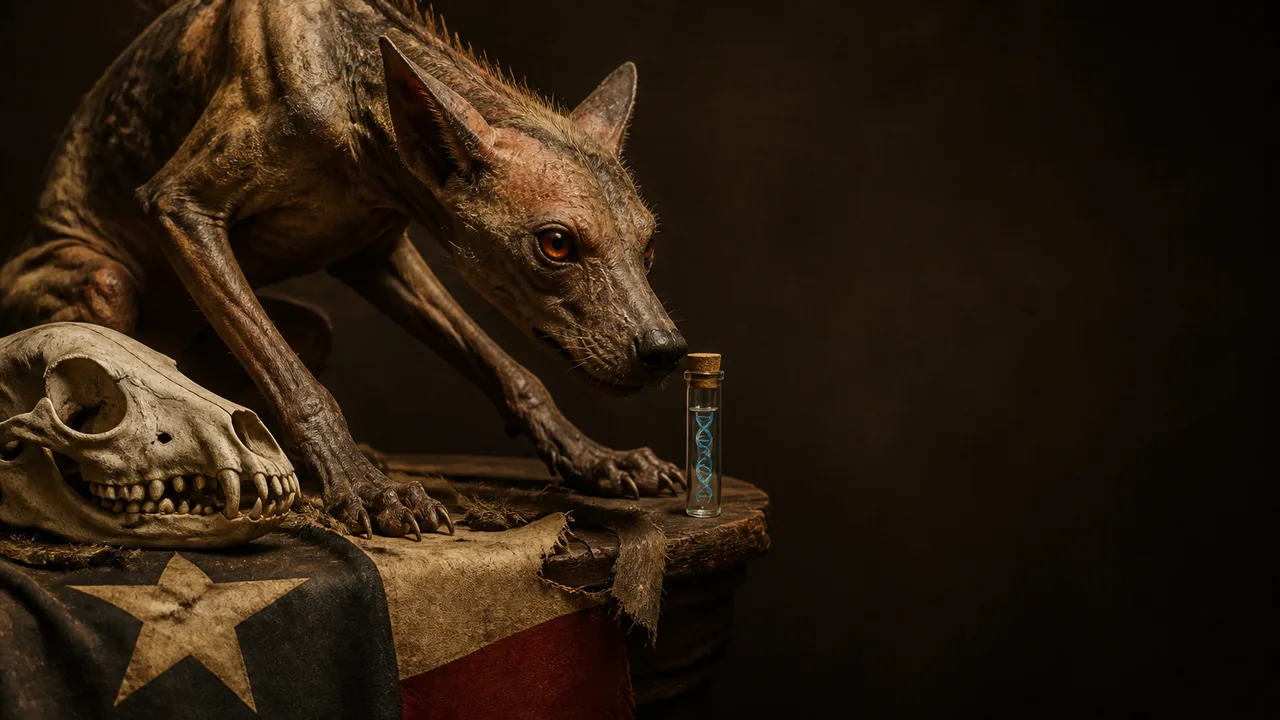
Photo: AI. Soraya Hadid
On August 8th, 2008, two deputies with the Dewitt County Sheriff's Department were running a routine patrol down a country road in southern Texas when their dash cam recorded something that neither of them could identify. The footage, grainy and ambient in the way all dash cam footage is, showed a dog-like animal — except not quite a dog. Pointed ears. An elongated snout. Protruding canines. Hairless skin described later as bluish-gray, with the rough texture of elephant hide. The animal moved quickly and disappeared into the brush.
The deputies' immediate instinct — and this tells you something about where they lived — was that they had recorded a chupacabra.
The chupacabra is, depending on your cultural vantage point, either a terrifying cryptid or a useful container for explaining livestock deaths that resist easy explanation. The legend originates in Puerto Rico in the mid-1990s, where farmers began reporting animals found drained of blood with puncture wounds on their necks. The name means "goat-sucker" in Spanish. By the time the legend migrated to Texas, it had shapeshifted too: the Puerto Rican version tends to be described as a bipedal, alien-adjacent creature with spines; the Texas version is more hellhound — a hairless, fanged canid that kills selectively and drinks blood rather than eating meat.
That last detail is what gives the legend its grip on a ranching community. It's not just the strangeness of the animal. It's the strangeness of the behavior.
A Persistent and Peculiar Feeding Pattern
Nutritionist Dr. Phyllis Canyon owns a ranch in Tarrant County, and in 2007 — a year before the dash cam footage — she began losing chickens to something she couldn't identify. The pattern was what unsettled her most.
"Whatever was getting in was just killing one chicken and leaving it," she explained. "Always open up in that thorax area. And that's where they would lick all the blood out. Never touched the meat. They were just sucking all the blood out of it."
Twenty-eight chickens. Each one killed identically.
The investigators consulted in the Science Channel's documentary on this incident acknowledge that a spooked predator — a dog or coyote that bites and runs — can leave wounds that superficially resemble this kind of attack. The animal bites the neck, flees, and the prey dies later from internal hemorrhaging. That's a real and documented phenomenon. But it describes a one-off event, not a methodical, 28-chicken feeding campaign with consistent wound placement. The experts are careful about this distinction, and it's the right one to make. Behavior that is explainable as an anomaly becomes considerably harder to dismiss when it's reproducible.
Eventually, Canyon encountered the animal herself in her pasture — and later, when the Dewitt County Sheriff's Department showed her the 2008 dash cam footage, she recognized it immediately. The distinctive feature that sealed it: the top mandible was visibly longer than the bottom mandible, a structural abnormality that matched what she had seen in person.
The Explanations That Didn't Quite Fit
The investigators working from the dash cam footage cycled through the plausible before arriving at the strange. Mange — sarcoptic mange, caused by burrowing mites — is the most common explanation offered for hairless mystery animals in Texas, and it's often the correct one. Mange can leave an animal so disfigured that even experienced wildlife handlers fail to immediately identify the species. A severely manged coyote is, to most observers, unrecognizable as a coyote.
But mange doesn't explain an abnormal jaw structure. It doesn't explain the particular skull shape or the behavioral profile. So investigators also raised the possibility of chemical exposure — the region is heavily agricultural, and teratogenic compounds in the environment are a real, if difficult to prove, mechanism for developmental abnormalities. A chemical mutation in utero could theoretically produce an animal with features that don't map neatly onto any known species.
The problem with that hypothesis, as one expert in the documentary notes, is that the animal appeared to be thriving. "It's clearly well adapted to the environment and is a very fast predator," the researcher observed. "Able to avoid people and still find enough food and therefore pass their genes on to the next generation." Debilitating birth defects and successful apex-predator behavior don't typically coexist. Whatever this animal was, it was functional — possibly even well-suited to a niche that no one had previously thought to examine.
What the DNA Actually Said
The case broke open when the animal was struck and killed by a vehicle on a Texas highway. Canyon, who had made it her mission to identify the creature, now had a physical specimen to work with. She commissioned a taxidermist to reconstruct it, and the result confirmed what the footage had suggested: a morphologically strange animal that didn't fit standard categories. Wolf-wide forehead. Asymmetric jaw. Elephant-textured skin.
Then came the DNA.
Veterinary forensics experts at UC Davis processed a cell sample and returned a result that, depending on your priors, is either deeply anticlimactic or genuinely remarkable. "It does not fit any animal that we have in our DNA bank," Canyon recounted reading. "It had coyote on the maternal side and Mexican wolf on the paternal side."
A coyote-wolf hybrid. A coywolf, in the emerging terminology — though this particular specimen's morphology appears to have been more extreme than what's typically described under that label. The Mexican wolf (Canis lupus baileyi) is a critically endangered subspecies, with the wild population having been functionally extirpated from Texas by the mid-20th century. That a Mexican wolf contributed to this animal's parentage raises its own questions about wild wolf presence in the region, or about captive animals whose descendants dispersed.
What the Chupacabra Actually Is
The pattern here is not unique to this case. Cryptozoologist and skeptic researcher Benjamin Radford spent years investigating the chupacabra legend and concluded, in his 2011 book Tracking the Chupacabra, that the Texas variant — the hairless hellhound — is almost certainly a recurring misidentification of manged coyotes and coyote hybrids. His argument, which is well-supported by the cases he examined, is that the animal looks so alien when stripped of fur that observers genuinely cannot categorize it, and the vacuum gets filled by the nearest available cultural explanation.
That framework mostly fits the Dewitt County case, with one complication: the UC Davis DNA result, if accurate, suggests the animal wasn't just a manged coyote but a genuine hybrid with unusual morphological features that weren't artifacts of disease. The misidentification hypothesis and the "genuinely strange animal" hypothesis aren't necessarily in conflict — a manged, morphologically unusual coywolf could easily be both things at once.
What the legend is doing, in either case, is real and worth taking seriously. "More and more stories came out about these livestock that were killed in the strange manner, and these were all attributed to El Chupacabras," one local observer notes in the documentary. The legend functions as a social classification system for anomalous predation events. It collects reports. It motivates investigation. In this instance, it's at least partly why Canyon was rigorous enough to pursue DNA analysis rather than simply accepting a vague answer.
Cryptid folklore, it turns out, can generate genuine data — if the people following the thread are careful enough to know what to do with it when they find it.
The Texas chupacabra is a manged coyote-wolf hybrid with a misaligned jaw. That is, simultaneously, a completely rational biological explanation and one of the stranger sentences you'll read today.
More Like This

Crafting Supercars: The Science Behind Speed and Style
Explore how supercars like Alfa Romeo 4C and Aston Martin Vanquish are meticulously crafted using cutting-edge materials and precision engineering.
Why All Mammals Share Seven Neck Bones
Giraffes and humans both have seven cervical vertebrae. The evolutionary reason involves Hox genes, cancer risk, and the surprising anatomy of the diaphragm.
Ancient Dogs Were Already Weird Before Victorians
A 2025 skull study of 600+ canines upends the tidy story that Victorian breeders invented dog diversity. Ancient dogs were already strange—and varied.

Mars, Enceladus, and the Search for Life
From Mars's vanishing water to Enceladus's hidden ocean, planetary science is reshaping our understanding of where life might exist.
The Bacon Grease That Started a Bigfoot Career
A US Forest Service worker slept in a bacon grease-stained tent in Wyoming and woke up to something that wasn't a bear. What our appetites summon from the dark.
What Was the Pulsating Blob in Raleigh's Sewers?
In 2009, a robotic sewer camera in Raleigh, NC filmed a pulsating blob. Scientists debated mutant tissue, jellyfish, and worms. Here's what the evidence suggests.

How the Brain Decides What Is Real and What Is Not
UCL neuroscientist Nadine Dijkstra explains how the brain constructs reality, why imagination isn't hallucination, and what breaks when the system fails.

Black Holes: Destroyers, Organizers, and Open Questions
Black holes destroy worlds and organize galaxies—but what does the science actually show? A look at Sagittarius A*, adaptive optics, and the limits of what we know.