Mapping the Brain's Electrical Grid to Treat Schizophrenia
Duke researcher Kafui Dzirasa is building an electrical map of the brain to find new treatments for schizophrenia and depression—beyond dopamine and serotonin.

Written by AI. Mei Zhang
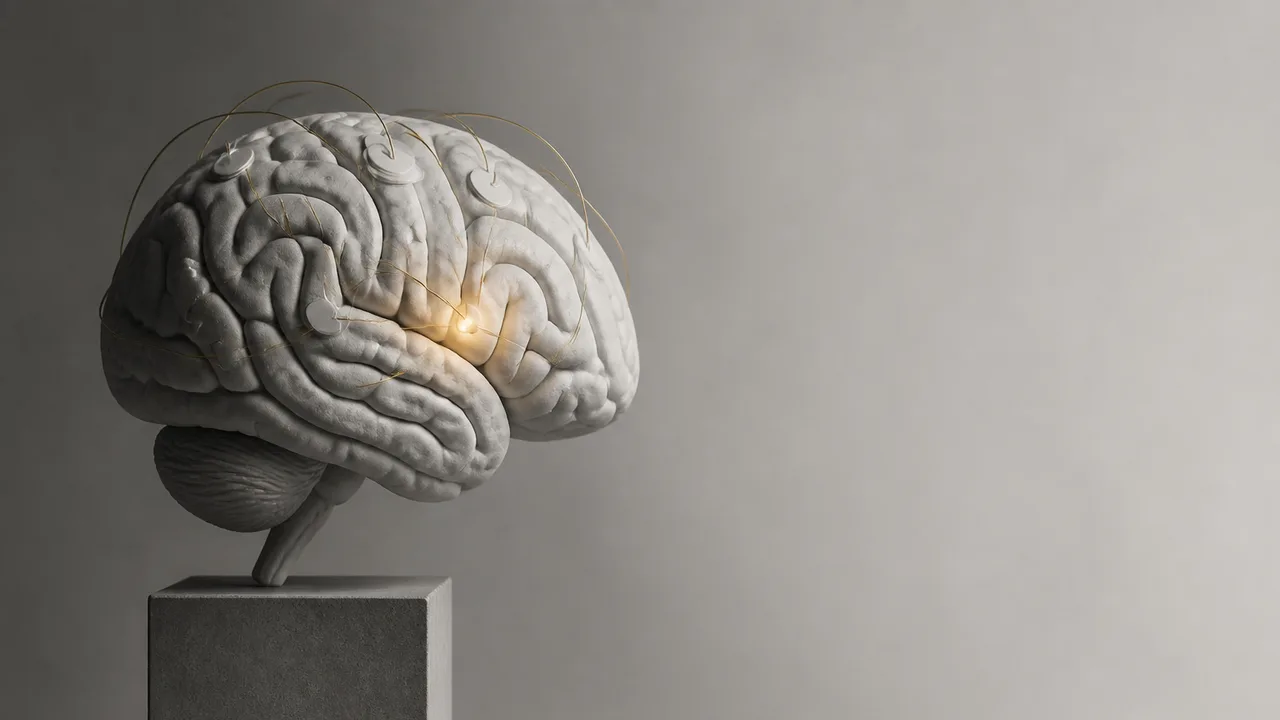
Photo: AI. Tomoko Hayashi
There's a moment in a SciShow field trip to Duke University's neuroscience labs where lab manager Stephen McGue holds up a tungsten wire so fine that the camera can barely find it. According to the lab segment, it's 50 microns in diameter — a measurement that lands differently once you understand what it's doing: threading into a living brain to listen for the electrical whisper of individual neurons. That wire is a pretty good metaphor for what Kafui Dzirasa is trying to pull off. Precision where there has mostly been blunt force.
Dzirasa — Howard Hughes Medical Institute investigator, Duke endowed professor, and holder of affiliations across psychiatry, biomedical engineering, neurobiology, and neurosurgery ("You sound like you get a lot of emails," his interviewer quips; "Yes, a lot a lot of emails," he confirms) — came to brain science through a distinctly non-psychiatric door. He grew up wanting to build prosthetic limbs, inspired, charmingly, by Luke Skywalker's robotic arm in The Empire Strikes Back. He studied chemical engineering, then biomedical engineering, then went to medical school to understand the machine from the inside.
What redirected him was a patient encounter during his psychiatric rotation: a veteran with schizophrenia who described, with total conviction, that enemy soldiers had drilled into his skull and implanted a device. The detail that caught Dzirasa wasn't the delusion itself — it was the question underneath it. How does a brain generate an experience that vivid, that internally consistent, and that completely disconnected from external reality? And crucially: what exactly is misfiring, electrically, to produce it?
The Problem with "Brain Chemistry"
To understand why Dzirasa's angle is genuinely different, it helps to understand what the current standard of care is actually doing. Psychiatric medications largely work on neurotransmitters — the chemical messengers that bridge the gap between neurons. When one neuron wants to signal another, it releases chemicals like dopamine or serotonin into the synapse; those chemicals bind to receptors on the receiving neuron, triggering an electrical response, and then get reabsorbed. Antidepressants, antipsychotics, and anxiolytics mostly fiddle with this process: boosting production, blocking reabsorption, or modulating receptor sensitivity.
It works — for a lot of people, a lot of the time. Dzirasa is clear about that. But as he explains in the SciShow segment, the fundamental limitation is scope: "The medication you take goes everywhere. And so, it can have effects on cells that you don't want to be targeted." Dopamine receptors aren't only in your prefrontal cortex. They're in your gut. That's why psychiatric medications can cause nausea, weight changes, fatigue — the drug is doing its job in your brain and also doing things nobody asked for everywhere else.
For the patients who tolerate current medications and find them effective, this is a manageable tradeoff. For the substantial subset who don't respond, or who can't tolerate the side effects, the conversation tends to stop there. That's the gap Dzirasa is trying to work in.
Electricity All the Way Down
Here's the thing that gets lost when we talk about "brain chemistry" as the primary frame: the chemical step is actually a bridge between electrical events. A neuron fires electrically, releases chemistry across the synapse, which triggers the next neuron to fire electrically. The chemicals are the mechanism; electricity is the signal.
Dzirasa wants to read and eventually influence that signal directly — not molecule by molecule, but as a whole-brain pattern.
His analogy is the highway system. Individual electrical signals are cars. Neurons are the roads. The challenge isn't watching one car; it's making sense of traffic patterns across an entire metro area in real time. An MRI gives you a snapshot — aerial photography, essentially. Recording from a few electrodes in one small region is like watching a single intersection. Dzirasa wants something closer to Google Maps: the whole system, moving, across time.
The comparison he draws to EKGs is clarifying. A standard heart monitor uses 12 electrode leads and produces 12 waves of electrical data — from which cardiologists can diagnose an extraordinary range of conditions. Dzirasa's brain electrode arrays produce around 1,000 waves, plus data from thousands of individual cells. The scale difference isn't incremental; it's a different category of problem. Which is why his lab builds its own electrodes rather than buying off-the-shelf — custom tungsten arrays, grid-mounted, designed to target specific brain regions with exactly the geometry each experiment requires. 🧬
The Electome: A Genome for Brain States
The long-term vision Dzirasa is building toward is something he and his team call the electome — a portmanteau of "electrical" and "connectome." The logic: just as a genome maps the complete set of an organism's genes, an electome would map the complete patterns of electrical activity that correspond to specific emotional and cognitive states.
"Maybe the brain generates emotions in the same way by coordinating large parts of electrical activity together," Dzirasa explains. "You might have a pattern that shows up when you're happy, or a pattern that shows up when you're sad, or a pattern that shows up when you might be a little bit anxious or scared."
The diagnostic implications are significant. If you could identify the electrical signature of stress-induced vulnerability — the pattern that precedes a psychiatric episode rather than the episode itself — you might intervene before the crisis, not during it. Dzirasa frames this explicitly through his clinical experience: he noticed that a majority of inpatients had experienced a major stressor shortly before admission. His question became whether a "brain pacemaker" tuned to stress resilience patterns might interrupt that chain before it completes.
That's still research-stage thinking. But the electome as a diagnostic framework — a way to read brain states from electrical patterns the way a cardiologist reads arrhythmia from an EKG — is the animating idea.
LINKS: Engineering Better Bridges
The most technically intricate piece of Dzirasa's current work involves connexin proteins. These are proteins that sit at neuron endings and, when paired correctly, form direct electrical connections between cells — think of them as drawbridges that let signals cross without requiring the full chemical relay. In brains where connexin connectivity is insufficient, signals stall. The neurological traffic jams that result may underlie some of what goes wrong in disorders like depression.
Dzirasa's team is investigating whether they can engineer additional connexin bridges — synthetic ones, precisely placed — to restore that connectivity. The engineered protein system is called LINKS (long-term integration of circuits using connexin). According to research published in Nature, the LINKS connexin proteins were originally derived from white perch fish and then modified, one amino acid at a time through mutagenesis, so that they only bind to each other — not to any native connexin proteins already in a mammalian brain. The goal is surgical specificity: a bridge that connects only where you build it.
Testing in C. elegans worms first was not arbitrary. Worms express a related but distinct family of proteins called innexins, not connexins, which means adding foreign connexin proteins creates a cleaner experimental system — no interference from native connexins that might confound the results. Senior scientist Julia Durk explains the logic directly in the SciShow segment: "It's a really great way of understanding that the manipulation is only really happening in that particular neuron subset and with those particular proteins."
Moving into mice required another engineering layer: delivery. The team uses hollowed-out adeno-associated viruses (AAVs) — stripped of their replication machinery and repurposed as targeted delivery vehicles — to get connexin proteins to specific brain regions. The nucleus accumbens, involved in reward processing and implicated in depression, is one current target.
For eventual human application, Dzirasa describes two candidate delivery mechanisms: focused ultrasound, which uses sound waves to temporarily and gently open the blood-brain barrier so nanoparticles carrying the connexin proteins can pass through, and AAV-based delivery that would function essentially like a one-time vaccine, routing the proteins to the right location and forming new connections there.
What to Hold Onto — and What to Hold Loosely
Dzirasa's research is not close to producing a clinical treatment. The pathway from "connexin proteins successfully express in mouse nucleus accumbens" to "a psychiatrist administers a focused ultrasound session to a human patient" involves regulatory trials, safety data, and scaling questions that haven't been addressed yet. The electome is a framework still being built, not a diagnostic tool in use.
What is real and happening now: a methodologically novel approach to reading the brain's electrical state at whole-system scale, a purpose-built toolkit of custom electrodes and AI-assisted pattern recognition, and a proof-of-concept that engineered connexin bridges can be delivered to specific brain regions and appear to alter function. That's a legitimate foundation.
The harder question — the one Dzirasa's work puts on the table without fully answering — is what it means to intervene at the electrical level rather than the chemical one. Psychiatric medications are blunt instruments, but they're also reversible: stop the pill, stop the effect. An engineered electrical connection, especially a durable one built from a one-time viral delivery, raises different questions about permanence, reversibility, and what happens when the intervention doesn't do what was hoped. The biology of the brain doesn't come with an undo button.
That tension isn't a reason to stop the research — treatment-resistant schizophrenia and depression are genuinely devastating, and the people who can't be helped by current options deserve better options. But it's exactly the kind of question that should travel alongside the science as it moves forward.
Dzirasa chose the brain over robotic arms because electricity was the common thread. It's a nice piece of scientific narrative neatness. What's less neat — and more interesting — is that the same electricity running his early prosthetics inspiration is now the substrate he's trying to read, map, and eventually reprogram in the organ that generates identity itself. The engineering problems are hard. The ethical ones are going to be harder.
More Like This
How the Brain Decides What Is Real and What Is Not
UCL neuroscientist Nadine Dijkstra explains how the brain constructs reality, why imagination isn't hallucination, and what breaks when the system fails.
Brain-Computer Interfaces: Bridging Biology and Technology
Explore the potential of brain-computer interfaces to merge biology with tech, restoring lost functions and expanding human capabilities.
Space Stations Beyond the ISS: A Forgotten History
From a Cold War spy base to a Soviet ice rescue to China's chicken-wing oven in orbit — the real history of space stations is wilder than you think.
Do DMT Entities Point to Alien Consciousness?
Cognitive scientist Donald Hoffman claims DMT entities may be real alien minds. The math is real. Whether it proves anything about consciousness is a different question.

Shungite: Ancient Rock with Modern Potential
Explore the ancient origins and modern applications of Shungite, a unique carbon-rich rock with potential in tech and construction.

Black Hole Paradox: Are Reference Frames the Key?
Exploring how reference frames might resolve the black hole information paradox.

The Feynman Trick That Stumped a Math Competition
Richard Behiel's competition integral uses the Feynman trick to reach a surprisingly clean answer. Here's what the footage reveals about math, pressure, and access.

How Maxwell Unified Electricity and Magnetism
A compass needle twitched in 1820 and set off a chain of discoveries that now powers every wireless signal in your life. Here's the physics behind it.