How the Brain Decides What Is Real and What Is Not
UCL neuroscientist Nadine Dijkstra explains how the brain constructs reality, why imagination isn't hallucination, and what breaks when the system fails.

Written by AI. Priya Sharma
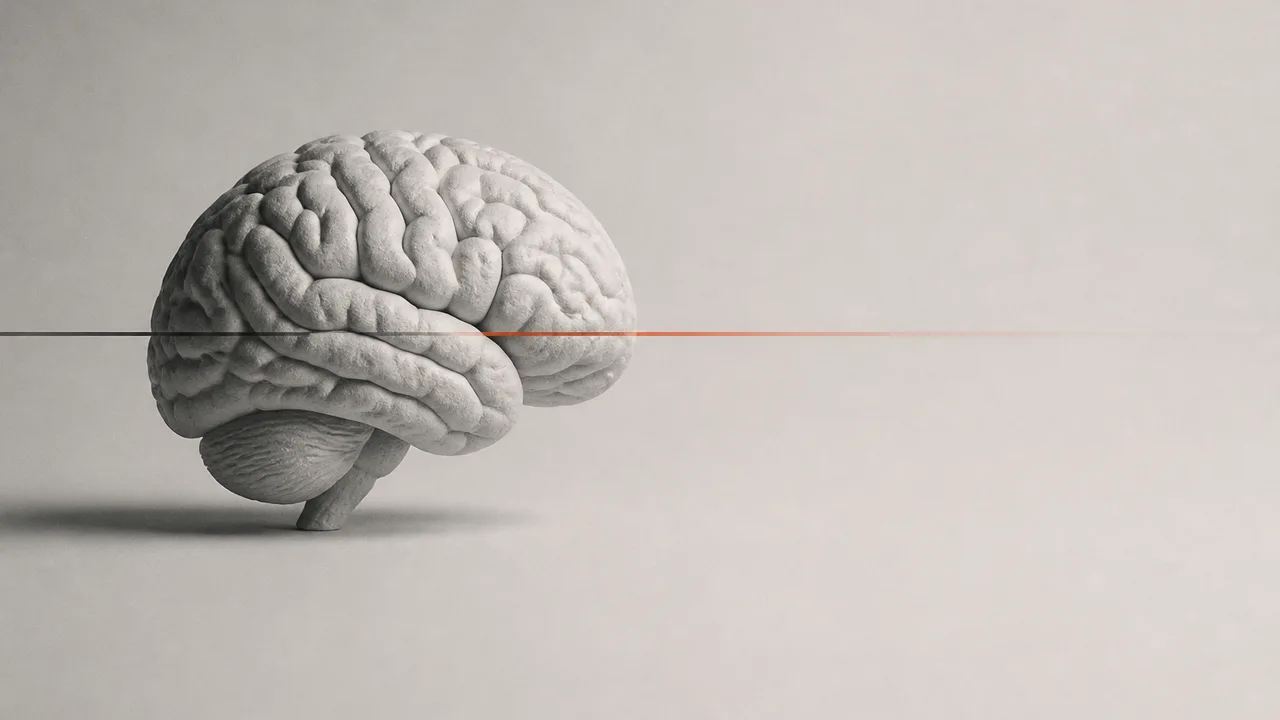
Photo: AI. Tomoko Hayashi
Your eyes have a blind spot — a small patch of the visual field where the optic nerve exits the retina and no photoreceptors exist. You have almost certainly never noticed it. That is not because the gap isn't there. It is because your brain fills it in, seamlessly and automatically, using context and expectation. You are, right now, looking at a partially invented picture of the world.
That example is Nadine Dijkstra's kind of territory. Dijkstra is a Principal Investigator at UCL's Institute of Neurology, where she leads the Imagine Reality Lab — a name that manages to be both precise and faintly unsettling. Her research centers on a deceptively simple question: how does the brain tell the difference between what's really out there and what it has generated itself? It turns out the answer involves a neural evaluation process, a developmental timeline, and a threshold that can, under the right circumstances, be crossed.
The distinction the word "hallucination" obscures
There is a fashionable claim in popular neuroscience — that perception is a "controlled hallucination." Dijkstra pushes back on the framing, not the underlying idea. "I think using the word hallucination is maybe a little bit... not helpful," she says, "because it makes it sound like something is wrong and it's something you have to do something about."
The distinction matters more than it might appear. Calling ordinary perception a hallucination collapses a meaningful clinical category. Hallucination, in the sense Dijkstra uses, is a specific failure state: a vivid mental image that the brain incorrectly classifies as external perception. Conflating that with the brain's normal predictive construction of experience obscures what researchers are actually trying to explain — and, frankly, what they are trying to treat.
What Dijkstra prefers to call "imagination" — the brain's continuous use of prior knowledge to anticipate and interpret sensory input — is not pathological at all. It is the mechanism that makes perception efficient. Rather than processing every incoming signal from scratch, the brain maintains a running model of the world and updates it when new data arrives. The blind spot gets filled. The half-seen object in your peripheral vision becomes recognizable. Context supplies what the senses leave ambiguous. This is a feature. It usually works. It works so well that most people never notice it is happening.
The question Dijkstra's lab actually investigates is what happens at the boundary — the neural moment when a brain decides whether a particular image originated outside or inside the skull. In research published as "Subjective signal strength distinguishes reality from imagination" in Nature Communications (Dijkstra et al., 2023), she and her colleagues found that the brain evaluates mental images against something like a reality threshold: a signal-strength check that determines whether an image is vivid and detailed enough to have come from the external world. Vivid enough, and the brain flags it as real. Not vivid enough, and it remains tagged as imagination. The study used neuroimaging to track this process in healthy participants — people with no diagnosed disorder — and found that under the right experimental conditions, those participants could be induced to misclassify their own mental imagery as genuine perception.
That is not a dysfunction. That is the system revealing its own architecture.
Reality as a social contract
One of the more philosophically productive moments in Dijkstra's conversation comes when the question of what "real" actually means gets pressed. She is admirably careful here — careful in the way scientists should be when a concept crosses from the empirical into the metaphysical.
"How do you decide whether something is real?" she says. "It's because it feels real." But that is a subjective criterion, and subjective criteria can be wrong. So she reaches for a social one: reality, in the working sense her research uses, is what people can agree on. It exists on a spectrum. Shared consensus anchors one end; private experience anchors the other. What falls off the far end of that spectrum — perceptions that diverge radically from what others can verify — is where the clinical territory begins.
This framing has genuine explanatory value for conditions like psychosis and schizophrenia, where the reality-monitoring system fails to sort internal from external in a way that the surrounding social world cannot confirm. The failure is not just experiential; it is relational. The person's individual perception has drifted outside the zone of shared agreement that allows functional participation in a collective reality.
Dijkstra is careful not to pathologize difference, and equally careful not to romanticize it. On the question of whether psychedelic hallucinations might be accessing a "more real" layer of experience, her answer is brief and unambiguous: she sees no scientific argument for it. Their brain is still interpreting sensory signals. The interpretation may feel more intense, more meaningful — but intensity and meaning are not the same as accuracy.
Children, prefrontal cortex, and the late development of "no"
The most generative thread in Dijkstra's discussion may be the developmental one, and it is where her lab's thinking gets genuinely interesting. Children, as any adult who has spent time around a four-year-old knows, operate with a much more porous border between imagined and real. The dragon is real. The imaginary friend is real. The dream feels like a memory.
The conventional explanation is that children simply haven't learned to distinguish. Dijkstra's lab is entertaining a more specific hypothesis: that reality monitoring is itself a function that develops — a neural capacity, not just a learned behavior. The candidate structure is the prefrontal cortex, which is among the last brain regions to mature, continuing to develop well into a person's twenties. The hypothesis is that children may not be failing to apply reality monitoring so much as they simply haven't built the mechanism yet.
"Maybe kids just don't have a reality to monitor yet," Dijkstra says. "For them, whether they are making it up or whether it's really there is kind of the same."
If that hypothesis holds — and it is, at this stage, explicitly a hypothesis — it reframes childhood imagination not as a surplus of creativity that adults lose, but as a pre-monitoring state that adults move past when the prefrontal architecture comes online. The adult brain did not become less imaginative. It acquired an editor.
Whether you find that melancholy or reassuring probably says something about your own relationship with consensus reality.
What Dijkstra is clear about is that ramping adult imagination back up toward childhood levels would not be a net gain. "I think that would lead to a lot of dysfunction," she says, "because we won't be able to keep it apart from reality." The useful imagination — the kind that lets a person envision futures that don't exist yet — is, in her framing, calibrated. "Pretty good but not too good." An optimum, not a maximum.
Neuroscience and AI: a more honest accounting
Dijkstra describes the relationship between neuroscience and artificial intelligence as one of mutual influence rather than one-way inspiration. The historical lineage is real: early AI and neural network research drew heavily on cognitive science, on theoretical models of how thinking might work before researchers had the imaging tools to directly observe it. That debt is well documented.
What is newer — and where Dijkstra sees the field heading — is AI being used to generate hypotheses about brain function. Researchers can now run simulations of specific neural processes and ask whether the simulated output matches observed brain behavior. That is a methodological shift with real implications: it means AI is not just being built to resemble the brain, but being used to reason backward about how the brain might implement particular cognitive functions. The arrow of influence now runs in both directions, and the field is finding that useful.
The question neuroscience cannot yet answer
Dijkstra is asked, somewhat inevitably, about the hard problem of consciousness — why physical processes in the brain give rise to subjective experience at all — and she handles it with the kind of intellectual honesty that is rarer in these conversations than it should be. She describes herself as operating from an implicit physicalist or materialist working assumption, looking for physical correlates of subjective experience. But she holds that assumption loosely. "It's not something I would defend until the end."
Her analogy for the simulation question is precise: if you simulate a rainstorm in a computer, the simulation is not wet. Even a perfect functional model of the brain would leave open the question of whether that model experiences anything. That is not a gap that more data alone will close.
What her research does contribute — and this is worth being clear about — is an empirical account of one specific piece of the puzzle: how the brain's reality-monitoring mechanism operates in healthy adults, how it can be experimentally perturbed, and what the failure modes look like when it breaks down pathologically. That is not a theory of consciousness. It is something more tractable, and in its way more immediately useful.
The larger question of what experience is, as distinct from what the brain does, remains open. Dijkstra would be the first to say so.
More Like This
How Opponent Recognition Unlocks Cooperation in Evolution
A Rutgers physicist argues that tailoring cooperation to specific opponents—not blanket strategies—may be evolution's simplest path out of the Prisoner's Dilemma trap.
Intelligence Beyond the Brain: Michael Levin's Radical Rethink
Biologist Michael Levin argues intelligence exists on a continuum reaching down to cells and molecules. Here's what the evidence actually supports—and where it gets murky.

Danny Goler's Laser Experiment and the Code of Reality
Danny Goler turned a cheap red laser and DMT into a years-long experiment on the nature of reality. Here's what he found—and what remains genuinely unresolved.
Unlocking New Skills After 50: The 'Pillar & Playground' Approach
Explore how the 'Pillar & Playground' method helps those over 50 learn efficiently, leveraging crystallized intelligence and cognitive flexibility.
Exploring Black Holes and Asteroids with StarTalk
Neil deGrasse Tyson delves into black holes, asteroids, and more in StarTalk's latest Cosmic Queries episode with Chuck Nice.
Have Astronomers Found the Universe's Missing Mass?
Astronomers may have discovered the universe's missing mass in cosmic filaments, a breakthrough in understanding cosmic evolution.

Texas Chupacabra Sighting Explained by DNA Analysis
A Texas police dash cam captured a bizarre creature in 2008. DNA testing later revealed what it actually was — and the answer is stranger than fiction.

Black Holes: Destroyers, Organizers, and Open Questions
Black holes destroy worlds and organize galaxies—but what does the science actually show? A look at Sagittarius A*, adaptive optics, and the limits of what we know.