How Opponent Recognition Unlocks Cooperation in Evolution
A Rutgers physicist argues that tailoring cooperation to specific opponents—not blanket strategies—may be evolution's simplest path out of the Prisoner's Dilemma trap.

Written by AI. Priya Sharma
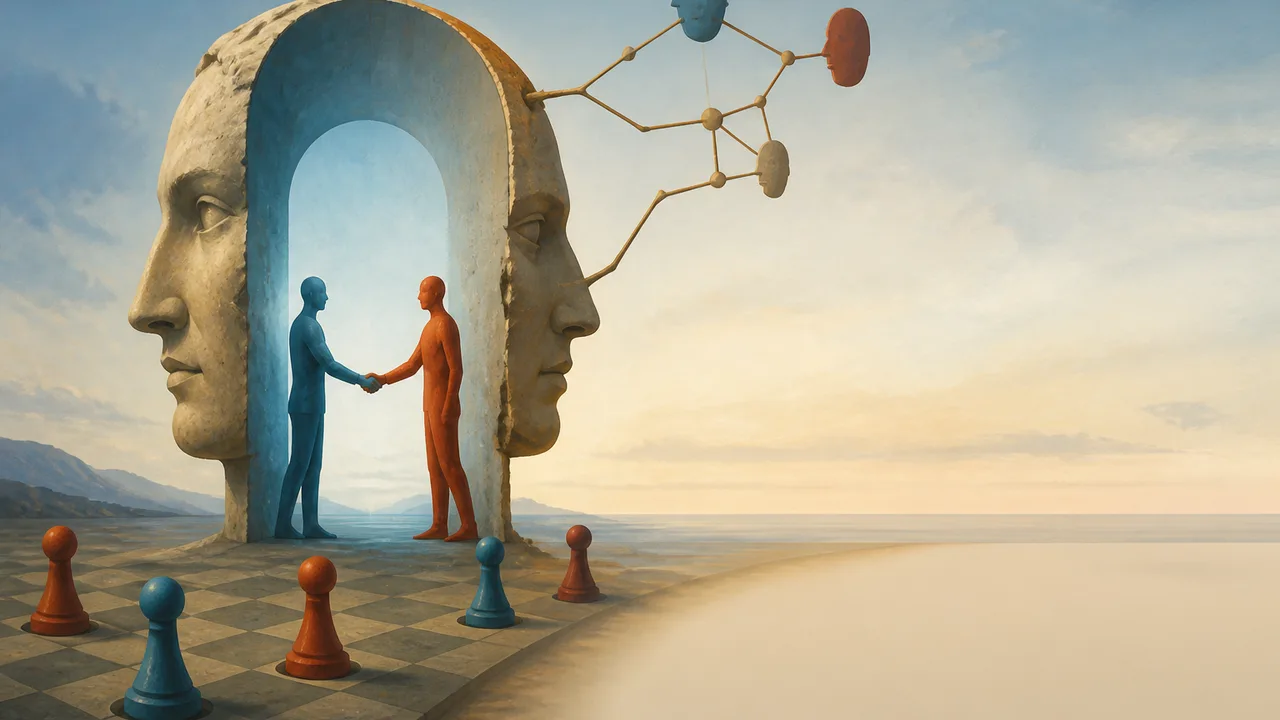
Photo: AI. Iolanthe Fenwick
The Prisoner's Dilemma has a way of making rationality look catastrophic. Two players, each acting in perfect self-interest, defect on each other and end up worse than if they'd both cooperated. It's been a conceptual thorn in evolutionary biology for decades: if defection is always the individually rational move, how did cooperation—the apparent prerequisite for everything from multicellular life to ecosystems—ever get off the ground?
Alexandre V. Morozov, a physicist at Rutgers University's Center for Quantitative Biology, thinks part of the answer has been hiding in an assumption so basic it's rarely examined. In a recent talk hosted by Michael Levin's Allen Discovery Center at Tufts, Morozov presented a model that breaks that assumption and, in doing so, produces cooperation as a natural emergent property rather than a phenomenon that requires special pleading.
The Flaw in the Standard Model
The traditional evolutionary formulation of the Prisoner's Dilemma assigns each individual a single cooperation probability—call it p—and applies it uniformly to every encounter. Individual 2 cooperates with Individual 1 and Individual 3 at the same rate. That's a significant constraint on behavior, and it's worth asking whether it's biologically realistic.
Morozov argues it isn't. "That's not what happens with animals. Certainly not what happens with humans," he says. An organism encountering a large, healthy conspecific might behave quite differently than when it encounters a weaker one. Humans do this constantly, often without thinking about it.
In the standard model, with this single-probability constraint in place, the math is unforgiving. Average fitness in a population is proportional to average cooperation—but the evolutionary dynamics drive cooperation down, reliably and persistently. Morozov describes this as "anti-Fisher behavior": whereas Fisher's fundamental theorem of natural selection predicts that average fitness rises over time, in the standard Prisoner's Dilemma it falls. Defectors crowd out cooperators, not because cooperation is inherently unfit, but because the fitness landscape is frequency-dependent—what works depends entirely on who else is in the population. As Morozov puts it, "frequency dependent selection is like trying to hit a moving target," because "by the time you try to improve, the landscape changed." Static fitness landscapes become, in the field's preferred metaphor, seascapes.
One Change, Entirely Different Dynamics
The modification Morozov's group introduces is straightforward to state and significant in implication: instead of a single cooperation probability, each individual has an opponent-specific cooperation probability. Individual 2's willingness to cooperate with Individual 1 can differ from its willingness to cooperate with Individual 3. This is what Morozov calls "opponent-specific recognition."
The fitness formula changes accordingly. A new term enters: the difference between how other individuals treat you and how you treat them. If a population generally likes you more than you like it back, that asymmetry confers a fitness advantage. This is structurally new—it doesn't appear in the standard model at all.
The behavioral consequences are striking. Where the standard model produces a monotonic slide toward defection, the opponent-recognition model generates what Morozov describes as "plateaus of partial cooperativity and then a period of upheaval, then another plateau of relative calm where one genotype is dominant, and then another upheaval and so on." The system doesn't settle into a cooperator's paradise—it's dynamic, sometimes turbulent—but cooperation persists rather than collapsing.
Crucially, this holds under mutations. When the team tested whether random genetic perturbations would destroy the effect, they found the opposite: in populations starting from near-total defection, cooperation mutants can invade and take over. "Defectors can be overcome by cooperator mutants," Morozov notes, "which is kind of the opposite of what the Prisoner's Dilemma wisdom is."
They also found that opponent-specific recognition can itself evolve. Starting from a population that's "opponent-blind"—everyone uses a single cooperation probability—mutations that introduce opponent-specific responses arise and spread, arresting what would otherwise be a collapse.
What Makes This Claim Worth Attention
Before assessing how significant this is, it helps to appreciate the existing landscape of cooperation-evolution research. Martin Nowak's influential 2006 Science review catalogued five mechanisms: kin selection, direct reciprocity, indirect reciprocity, network/spatial effects, and group selection. Each has solid theoretical grounding and empirical support in various organisms.
Morozov is not dismissing those mechanisms. He's making a different claim: that they're not basic enough. "A reputation score is hard to imagine in microorganisms," he observes. Kin selection requires genetic relatedness structures that don't always exist. Direct reciprocity requires repeated encounters with the same individual. Each mechanism carries preconditions. Morozov's proposal, by contrast, requires only that organisms can distinguish between different opponents—a minimal cognitive or biochemical capacity—and that they respond accordingly.
He frames this as "perhaps the simplest emergent mechanism, because we didn't put cooperativity into the fitness function. Cooperativity emerges by itself."
That framing deserves some scrutiny. The model does, after all, require opponent-specific recognition to exist—and while Morozov argues this can arise through mutation, the origin of the recognition mechanism itself is not trivial. Distinguishing one opponent from another requires some form of phenotypic signal and the ability to read it. In microbial populations, that's not impossible—cell-surface proteins can serve as identity markers—but the model as presented doesn't fully specify how recognition scales down to organisms without nervous systems.
The team's neural network experiments are interesting precisely here. They evolved populations of LSTM networks playing Prisoner's Dilemma, with networks reading each other's weights as a proxy for phenotypic characteristics. Those weights then fed into each network's own decision machinery to produce an opponent-specific cooperation probability. The result qualitatively resembled the analytic model: plateaus of high cooperativity, occasional collapses, recoveries. "These networks are actually computing PC of I given J—this is opponent-specific recognition exactly of the type we talked about before," Morozov notes. The neural network results don't validate the biological hypothesis directly, but they do suggest the mechanism is robust across different mathematical implementations of the same underlying idea.
The Populist Simulation, Taken Seriously
One of the talk's more arresting segments involves what Morozov carefully labels "the rise of a populist"—and immediately qualifies as a purely formal exercise, not a political one. The scenario: a single individual in a 500-agent population is universally liked by others but doesn't reciprocate. Its descendants, however, love each other intensely (cooperation probability near 1.0). Result: the populist's lineage rapidly takes over, fitness rises, population thrives.
Now vary one parameter: the descendants don't cooperate with each other either. Cooperation probability among them drops to 0.1. Same initial takeover dynamics, but the covariance term in the fitness equation flips sign. The population ends up entirely composed of the populist's descendants—who collectively cannot cooperate with anyone. Fitness collapses.
The mathematical point is real and interesting: whether an initial cooperative advantage translates into long-term population health depends critically on within-lineage cooperation norms among descendants. The evolutionary outcome is designed, in principle, by whoever sets those initial parameters. Whether that has meaningful implications beyond the model—for understanding how social movements, or microbial colonies, or cooperative hunting groups stabilize or collapse—is a question the paper opens rather than closes.
What Remains Open
This is theoretical and computational work. It hasn't been tested in a wet lab, and the authors make no claim otherwise. The existing empirical literature on microbial cooperation—including Jeff Gore's 2009 Nature paper on yeast sharing sucrose metabolism, which Morozov cites—identified coexistence mechanisms based on nonlinear fitness functions. Morozov's model explicitly does not rely on nonlinearity, which is interesting, but whether opponent-specific recognition actually operates in microbial populations, and how it would be measured, remains unspecified.
The model also works at the phenotype level—cooperation probabilities—rather than mapping directly onto genotypes. That's a common approach in evolutionary game theory, but it does mean the path from mathematical result to testable biological prediction requires additional scaffolding.
What the work does, at minimum, is demonstrate that the pessimistic math of the standard Prisoner's Dilemma is not the only math available. The defect-always conclusion depends on a modeling choice—that organisms cannot discriminate between opponents—that has no particular claim to biological necessity. Change that assumption, and cooperation becomes a possible outcome of ordinary evolutionary dynamics: no reputation systems required, no spatial clustering required, no genetic relatedness required.
Whether "possible" translates to "common" or even "important" in actual living systems is the question that now needs empirical contact. But the prior—that the Prisoner's Dilemma trap is iron and universal—turns out to have a hidden assumption load-bearing enough that, once removed, the trap opens.
More Like This
Intelligence Beyond the Brain: Michael Levin's Radical Rethink
Biologist Michael Levin argues intelligence exists on a continuum reaching down to cells and molecules. Here's what the evidence actually supports—and where it gets murky.

Nash Equilibrium Explained: The Logic of Locked-In Choices
MIT's Ian Ball breaks down Nash equilibrium—why being "rational" isn't enough, and what it really means when no one can gain by going it alone.
When Math Invents Reality: Imaginary Numbers & More
Neil deGrasse Tyson explains how imaginary numbers, non-Euclidean geometry, and white holes reveal math's uncanny habit of predicting reality before we can confirm it.

Unlocking New Skills After 50: The 'Pillar & Playground' Approach
Explore how the 'Pillar & Playground' method helps those over 50 learn efficiently, leveraging crystallized intelligence and cognitive flexibility.
Exploring Black Holes and Asteroids with StarTalk
Neil deGrasse Tyson delves into black holes, asteroids, and more in StarTalk's latest Cosmic Queries episode with Chuck Nice.
Have Astronomers Found the Universe's Missing Mass?
Astronomers may have discovered the universe's missing mass in cosmic filaments, a breakthrough in understanding cosmic evolution.

How Cruise Ships Stay Upright in Rough Seas
Cruise ships look impossibly top-heavy. The engineering that keeps them upright is layered, counterintuitive, and more fragile than the brochure suggests.

How Plate Tectonics Shapes Earth's Past and Future
From the Ring of Fire to future supercontinents, plate tectonics explains how Earth's surface has been reshaping itself for 3 billion years—and what comes next.