What "Fundamental" Actually Means in Science
Curt Jaimungal's latest video unpacks "the nature of reality" across physics, philosophy, and math — and the distinctions hit differently when you cover CRISPR for a living.

Written by AI. Mei Zhang
Photo: AI. Mika Sørensen
Here's a question that has been living rent-free in genomics Twitter for two years: is a genome just information?
Not metaphorically. Literally. Because if DNA is fundamentally just an information substrate — ones and zeros in biological drag — then editing it is no different from correcting a typo in a Google Doc. And if you believe that, the ethical weight of CRISPR starts to feel a little lighter than maybe it should. Companies have built entire valuation stories on exactly this framing. Regulators are still catching up.
So when I watched Curt Jaimungal's new Theories of Everything video breaking down what "the nature of reality" actually means as a philosophical term, I wasn't watching as a curious civilian. I was watching as someone who sees the downstream wreckage of sloppy metaphysics in the field I cover every single day. 🧬
The video is eight minutes of unusually clean philosophical housekeeping, and I mean that as a compliment. Jaimungal opens by noting that "the nature of reality" is "a notoriously vague phrase" — which is fair, and also the understatement of the century — and then does something most pop-philosophy content skips: he actually defines the words.
The thing everyone gets wrong about "fundamental"
Here's where it gets interesting, and where I started pausing and rewinding.
Jaimungal draws a hard line between reductionism and fundamentality, and these two concepts get collapsed into each other constantly — including in biology.
Reductionism is a method: you understand something by breaking it into parts and studying how those parts interact. It works extremely well. We mapped the human genome using it. Drug discovery runs on it. It has an almost embarrassing track record of practical success.
But "it works" doesn't make it a complete description of reality. Jaimungal is explicit: "reductionism may be incorrect as a guiding principle toward understanding the nature of reality, despite reductionism's clear practical success."
Fundamentality is a different claim entirely. Something is fundamental, in Jaimungal's framing, if "its existence isn't in virtue of anything else." The laws of physics might be fundamental. But they're not fundamental because they're small — you can't crack open the second law of thermodynamics and find tinier laws inside. They're fundamental because nothing else explains why they hold. They're ungrounded.
This is where his line about spacetime lands: "Fundamentality may seem like it's about the smallest part. However, you could be fundamental about spacetime and spacetime itself is decidedly not small. No one fat shames the bulk."
Okay, yes, I laughed. But also: this is exactly the move that gets made in genomics. Genes get treated as fundamental because they're small, because they're at the bottom of a reductive chain. But "small" and "fundamental" are not synonyms. Whether the sequence ATCG is fundamental to the organism that carries it — or whether the organism, or the cell, or the ecosystem is the thing that grounds everything else — is not a question reductionism can answer from the inside. It's a prior question about the shape of the explanation you're building.
The "it's all information" problem, specifically
Jaimungal calls out "it's all information" as a philosophical position that deserves scrutiny rather than applause. He invokes philosopher of physics John Norton in a related TOE episode to push back on the idea, though the specific argument Norton makes there lives in that conversation rather than this one.
But I want to linger here, because this debate is not abstract for genomics.
When biotech companies describe a genome as an "information system," they're not being poetic. They're making an ontological bet. If your genome is fundamentally information, then sequencing it is just reading. Storing it is just archiving. Selling access to it is just... a data licensing deal.
That framing slides past a question that hasn't been resolved: what grounds what? Is the information fundamental, and the biological organism just one way that information is instantiated? Or is the living body primary, and "information" just a useful model we overlay on top of it?
Your answer to that question shapes whether genetic data deserves the same protections as your body, or the same protections as your browser history. These are not the same protections. And right now, in the United States, in 2024, we're largely treating genomic data like the latter. Millions of people have handed their DNA to consumer testing companies under terms of service that would never survive if we treated biological information the way we treat, say, tissue samples in a hospital.
The metaphysics isn't decorative. It's load-bearing.
Grounding, translated
Jaimungal's central organizing concept for the video is grounding — a term metaphysicians use to describe when something is true in virtue of something else. X grounds Y means Y's truth depends on X's truth, but it's not the same as X causing Y, and it's not the same as X logically implying Y. It's its own distinct relationship.
His example: "The ball is colored" is grounded in "the ball is red." The redness is what makes the coloredness real. The coloredness doesn't explain itself.
Now scale that up. Is "the genome codes for a trait" grounded in molecular chemistry? Is molecular chemistry grounded in physics? Is physics grounded in... what, exactly?
That's the Münchhausen trilemma — a philosophical problem about justification that Jaimungal maps onto topology in a move he's careful to frame as metaphorical rather than rigorous. Think of it this way: every time you ask "but why?" about a foundational claim, you get one of three responses. Either the chain of explanation loops back on itself (circular). Or it keeps going forever with no end (infinite regress). Or it hits a floor someone just declares is the floor, unjustified (a base layer you simply accept).
Topology gives you a geometric way to picture those three options — a circle, an infinite line, or a bounded interval — but the mapping is Jaimungal's own creative frame, not a mathematical proof. The insight is the same either way: there's no clean exit from this problem. Every explanation system, scientific or otherwise, is sitting on one of those three structures. Scientists tend to prefer the "base layer we accept" option, and then quietly not look down.
The art thing, which I keep thinking about
Jaimungal mentions that his podcast, despite being aimed at researchers in physics, math, and cognitive science, has a large following among artists. He says artists at what he described as an Institute for Arts and Ideas event approached him to say they resonated with the show's focus on fundamentality and reality. (Note: The IAI is a real UK-based philosophy organization, but I can't verify the specific event from the video alone — Jaimungal tells this story in passing.)
His reading of that: art is doing something that empirical science isn't. Not replacing it. Not contradicting it. Approaching the same territory from an angle that formal methods can't fully reach.
I find this genuinely interesting, and also not surprising. What art often does — what good science communication tries to do, and mostly fails — is convey what it's like to be in the presence of a question you can't answer. Not the question's content. The texture of sitting with it.
Jaimungal's version of the nature of reality question includes a layer that most popular science content doesn't: the possibility that there is no single capital-R Reality, that the universe might be, as he puts it, "patchworked with consistency in overlapping regions, but yet inconsistent somehow globally." Meaning: our local physics works, your local physics works, but "physics" as a total unified system pointing at one coherent reality might be a story we're telling ourselves.
That's a disorienting possibility. Art is sometimes better than equations at making disorienting possibilities feel livable.
The question I keep bouncing back to — because it's the one that lands in my actual work — is whether "fundamental" will ever be a stable category, or whether it's always going to be a placeholder for wherever the current explanation runs out of steam.
In genomics, "the gene" was fundamental until epigenetics complicated it. "DNA sequence" was fundamental until we figured out that regulatory regions do more work than the genes themselves. Every time we find the bottom, there's more floor under the floor.
Maybe that's not a problem to solve. Maybe that's just what investigation looks like from the inside.
More Like This
Does AI Understand Things, or Just Predict Words?
The "AI just predicts tokens" argument is technically true—but is it the whole story? A murder mystery with fake physics might hold the answer.
The Limits of a Unified Theory of Everything
Exploring why a theory of everything might never encompass life's complexities.
Can Quantum Physics Only Work From God's View?
Physicist Renato Renner argues quantum theory has a blind spot: it can't describe the observer doing the describing. What does that mean for physics itself?

Harvey Friedman: Math's Foundations Are Shaking
Harvey Friedman spent 60 years proving that ordinary math can't be trusted. His work in reverse mathematics may be the most unsettling idea in modern logic.
Verlinde vs. Jacobson: Does Gravity Emerge From Nothing?
Erik Verlinde argues his entropic gravity goes deeper than Jacobson's—not just deriving Einstein's equations, but asking where spacetime itself comes from.
Black Hole Paradox: Are Reference Frames the Key?
Exploring how reference frames might resolve the black hole information paradox.
Zosurabalpin: A New Antibiotic Class Enters Phase 3 Trials
Zosurabalpin could be the first new antibiotic class targeting gram-negative superbugs in 50 years. Here's how it works—and how AI helped build it.
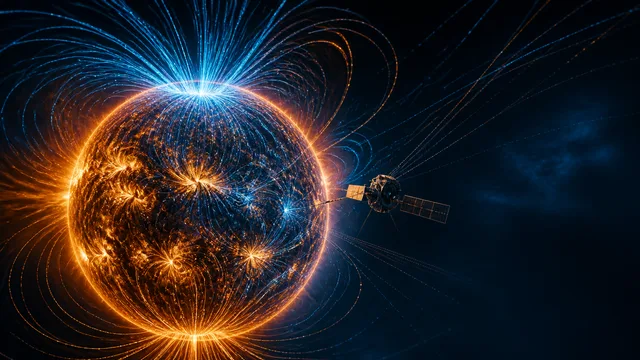
Solar Orbiter Captures First Direct View of the Sun's Poles
Solar Orbiter has captured the first direct images of the Sun's poles, revealing a chaotic magnetic field mid-reversal—and what it means for space weather forecasting.