Minoan Thera and the Archaeology Behind Atlantis
Was Plato's Atlantis rooted in real events? The archaeology of Minoan Thera makes a compelling case — and complicates the legend in fascinating ways.

Written by AI. Helen Papadopoulos
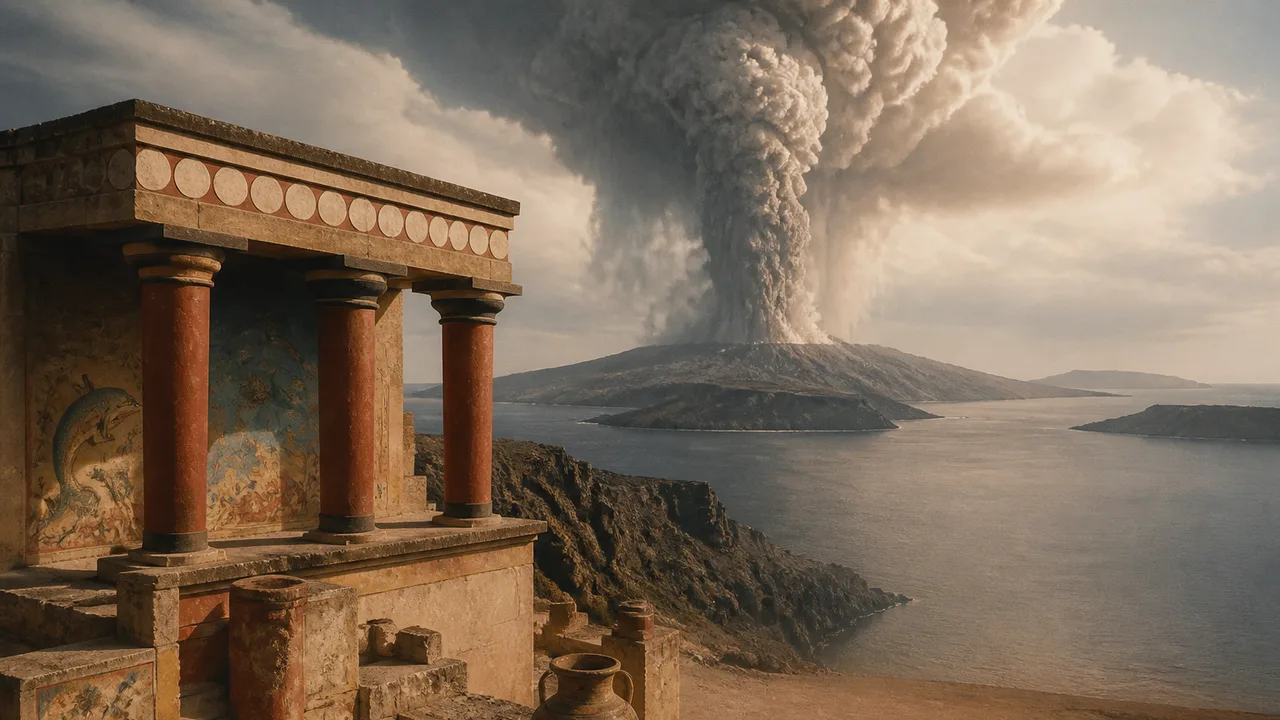
Photo: AI. Marcel Dubois
Plato was not a journalist. He was a philosopher with an argument to make, and Atlantis — the magnificent island civilization swallowed by the sea in "one grievous day and night" — was his instrument. Scholars have known this for centuries, which is precisely why the Atlantis question has been treated as somewhat embarrassing: the kind of thing serious classicists don't touch at cocktail parties, let alone in print.
And yet. The archaeology of the Greek island of Santorini — ancient Thera — keeps pulling the question back into respectable territory. A recent documentary from Odyssey Ancient History Documentaries makes the case that Plato's allegory had a factual skeleton, and that skeleton belonged to the Minoans.
The argument deserves a fair hearing, which means neither cheerleading it nor reflexively dismissing it.
What Thera Actually Was
Before the eruption, Thera was not a backwater. The documentary describes an island that, while too small to be agriculturally self-sufficient, had leveraged its position at the crossroads of Mediterranean trade into something genuinely remarkable: multi-story buildings decorated with elaborate frescoes, and — most striking of all — what appear to be the world's first indoor toilets connected to an underground sewage system. A Bronze Age civilization with functioning sanitation that most of Europe wouldn't match for another two millennia. If that detail doesn't reframe your mental image of the ancient Aegean, I'm not sure what will.
Thera sat seventy miles north of Crete, the strategic heartland of Minoan power. The Minoans — a name coined by the archaeologist Arthur Evans, who had his own complicated relationship with the civilization he "discovered" — built the palace at Knossos, a complex spanning roughly the area of four football fields, with some 1,300 rooms, corridors, and courtyards. At a moment when most of continental Europe was still organizing itself around mud-and-timber settlements, this was genuinely anomalous sophistication.
The documentary pays particular attention to Minoan women, and here the evidence is striking enough to warrant careful engagement. Minoan priestesses were not decorative figures: they presided over ritual ceremonies, managed inventories, and appear — from frescoes and figurines — to have occupied the apex of religious authority. A legal code discovered on Crete, the documentary notes, gave women more rights in marriage than virtually any contemporary society: divorced women could reclaim their dowry, and in cases of proven adultery, penalties fell on the husband. These are not the institutional arrangements of a society that thought of women as property.
The Eruption: Scale and Aftermath
Around 1620 BC, the volcano beneath Thera ruptured in a Plinian eruption — the most violent category of volcanic event, characterized by a superheated column of gas and rock blasting miles into the stratosphere. The documentary compares it to an atomic bomb's mushroom cloud, which is vivid if imprecise; more useful is the comparative scale: three times the magnitude of Krakatoa, and one hundred times that of Mount St. Helens.
The Krakatoa comparison carries independent weight. The 1883 eruption of Krakatoa holds the record as the loudest sound ever recorded, its shockwave audible approximately 4,800 kilometers away across the Indian Ocean. The Theran event dwarfed it. The documentary claims the explosion would have ruptured the eardrums of anyone within ten miles — a visceral measure of a pressure event that exceeds what acoustic science can neatly quantify.
Seabed investigations around the island have since revealed that pyroclastic flow deposits extend some twenty miles outward from the island, reaching thicknesses of 260 feet. Excavations at Akrotiri — the buried Bronze Age town on Thera, which the Greek archaeologist Spyridon Marinatos began excavating in 1967 — found that pyroclastic forces sheared off the upper stories of buildings before entombing what remained under sixty feet of ash and pumice. Unlike Pompeii, no human remains have been found at Akrotiri. The population appears to have evacuated — valuables stored under doorframes and beneath beds, entrances sealed — expecting to return. They did not.
The eruption's reach extended far past the island. Ash from Thera plunged the eastern Mediterranean into weeks of darkness. Global temperatures dropped measurably, affecting harvests as far as Britain. Tsunamis, generated as pyroclastic flows hit the sea, devastated the coastal settlements of neighboring islands and, research suggests, struck Crete's northern coastline with waves the documentary estimates at over sixty feet. The precise human cost remains genuinely contested among scholars — Bronze Age population figures are notoriously difficult to establish — and any specific death toll should be treated as an approximation, not a settled number.
What is clear from the archaeological record is that Minoan civilization did not simply absorb this blow. The documentary describes evidence of deep social unrest in its aftermath: towns and temple palaces sacked and burned, human sacrifice practiced. Within generations, a civilization that had sustained itself for over 1,300 years was overrun and absorbed by a mainland Greek culture archaeologists call the Mycenaeans. The Minoan-Atlantis connection thus rests not just on geographic resemblance but on a civilizational collapse dramatic enough to generate legend.
Plato's Debt to Disaster
The documentary quotes Plato directly, and the passages are hard to dismiss as coincidence. "The island consists of circular belts of sea and land enclosing one another," Plato wrote — a description that fits Thera's distinctive caldera topography with uncomfortable precision. The sacred precincts of Poseidon, he wrote, contained bulls at large, hunted by princes with staves and nooses. Bull-leaping — athletes vaulting over charging bulls in what appears to have been a ritual spectacle — is among the most extensively documented practices of Minoan culture, depicted in frescoes from Knossos to Akrotiri. Plato writes of merchants from "all quarters" filling harbors with immeasurable wealth. Minoan trade networks stretched from Egypt to the Levant to the British Isles.
Then, in Plato's telling: "one grievous day and night" and the island is gone.
Now, the honest complication. Plato wrote his Atlantis dialogues — Timaeus and Critias — in the fourth century BC, roughly 1,200 years after the Theran eruption. He attributed his account to an Egyptian priest who had told the story to the Athenian statesman Solon. That is a very long chain of transmission for a disaster narrative, and Plato was demonstrably shaping the story to serve a moral argument about hubris and imperial overreach. He also places Atlantis in the Atlantic Ocean, beyond the Pillars of Hercules — not in the Aegean.
So the question the documentary is really asking is not "was Atlantis Thera?" but something more tractable: could the memory of the Theran catastrophe, filtered through centuries of oral tradition and Egyptian record-keeping, have supplied the raw material Plato worked into his allegory? That is a different claim — more cautious, more defensible, and, I think, more genuinely interesting. Myths are rarely pure invention. They tend to be distilled extremity: the worst thing that ever happened, processed by the people who survived it and handed down until a philosopher could use it.
What the Archaeology Actually Settles
What the excavations at Akrotiri have settled — irrespective of any Atlantis question — is that a sophisticated Bronze Age civilization existed on Thera and was destroyed by volcanic catastrophe. The frescoes, the plumbing, the stored goods waiting for owners who never came back: these are not interpretations. They are objects. The Minoan civilization was real, was advanced by any reasonable measure, and was obliterated by a geological event of staggering scale.
Whether that event echoes in Plato is a question about the transmission of cultural memory — the kind of question that sits at the productive boundary between archaeology, literary history, and the study of how human beings process catastrophe. It cannot be definitively answered. What it can do is remind us that the line between myth and memory is rarely as clean as we'd like it to be, and that sometimes the legend points, however crookedly, at something that actually burned.
More Like This
Ancient Greek Myths as Warnings About AI and Automation
Historian Adrienne Mayor argues Greek myths about robots and AI aren't just stories—they're 2,500-year-old warnings we're actively ignoring. A closer look.
Ancient Greece: Democracy, Empire, and Extremes
From Homer's epics to Alexander's conquests, ancient Greece shaped the Western world through democracy, warfare, and cultural fusion. Here's what the evidence shows.
Pavlopetri: Inside the World's Oldest Sunken City
A Bronze Age city has sat submerged off southern Greece for 3,500 years. New technology is finally letting archaeologists read what it says about us.
Baiae: The Sunken Pleasure City of Ancient Rome
Beneath the Bay of Naples lie the ruins of Baiae, Rome's most scandalous resort. New 3D scanning reveals what volcanic geology buried and the sea swallowed.
Myth, Obsession, and the Men Who Dug for Troy
Arthur Evans and Heinrich Schliemann both found ancient civilizations while chasing myths. What does that tell us about archaeology—and obsession?
Belzoni's Tomb: The Strongman Who Found Seti I
Giovanni Belzoni was a circus strongman who became Egypt's greatest explorer. His 1817 discovery of Seti I's tomb rewrote what we knew about the ancient world.
Alexandria's Library Was More Than a Library
Dr. Roy Casagranda's lecture on the Great Library of Alexandria reveals a research institute, innovation hub, and the ancient world's most powerful idea engine.
Ancient Maps That Modern Archaeology Proved Accurate
From a Bronze Age rock carving to Ptolemy's coordinates, ten ancient maps have been verified by modern archaeology. What does that tell us about lost knowledge?