Baiae: The Sunken Pleasure City of Ancient Rome
Beneath the Bay of Naples lie the ruins of Baiae, Rome's most scandalous resort. New 3D scanning reveals what volcanic geology buried and the sea swallowed.

Written by AI. Helen Papadopoulos
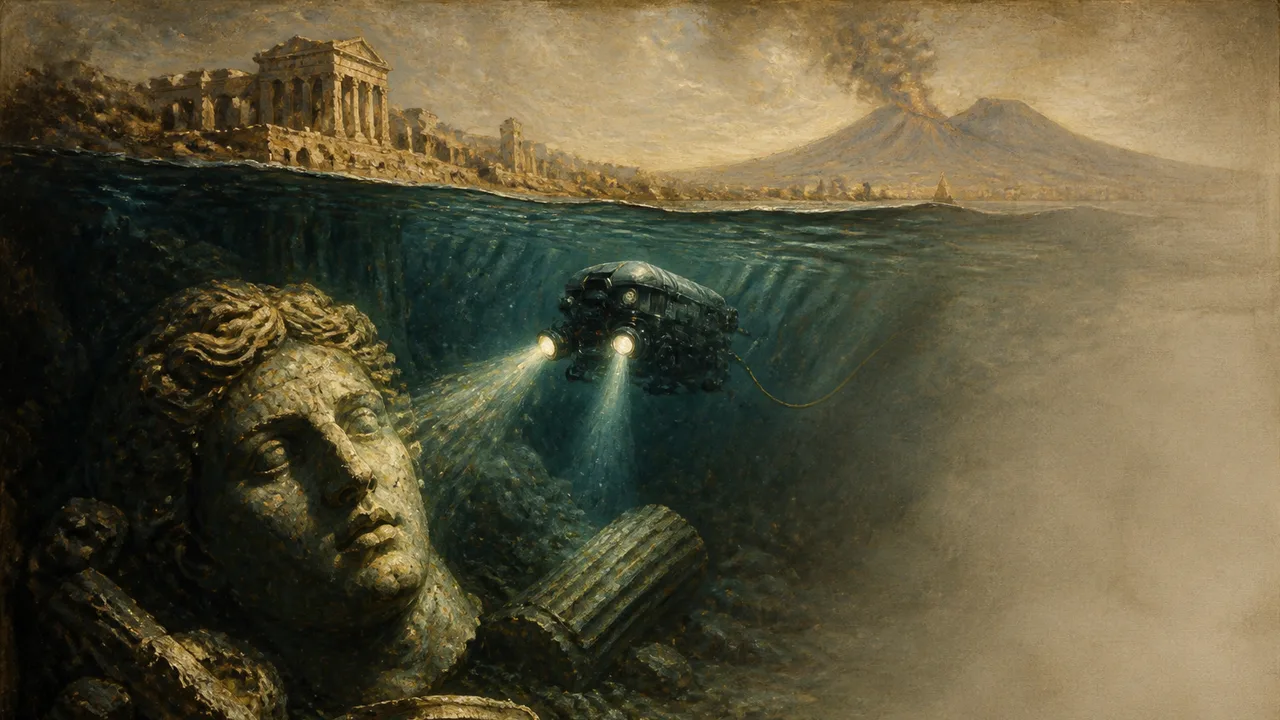
Photo: AI. Henrik Solberg
Naples has always conducted its life at the edge of catastrophe, and it knows it. That self-knowledge is baked into the urban fabric in ways that most cities reserve for religious iconography—which, here, amounts to the same thing. The city counts 448 historical and monumental churches within its limits, according to a detailed survey of its ecclesiastical heritage. It also sits atop a latticework of volcanic tunnels, Greek foundations, Roman aqueducts, Bourbon escape routes, and World War II bomb shelters, all stacked on top of each other like the most geologically anxious lasagna in culinary history.
A recent documentary from Odyssey Ancient History Documentaries, Archeologists Uncover the Sunken Ruins of Baiae: Rome's Most Scandalous City, takes this vertical city seriously. Working with historian Dr. Michael Scott and an archaeological scanning team, the film deploys 3D laser technology and virtual reality to map what lies beneath the Bay of Naples—not as spectacle, though there is plenty of that, but as a genuine act of historical reconstruction. The result is a portrait of a civilization that built its grandeur on geology it could never fully control, and knew it, and carried on anyway.
The Ground Beneath Your Feet
The film's central argument is architectural as much as historical: Naples is not one city but many, occupying the same coordinates across 2,500 years. Greek colonists laid the original grid in the fifth century BC. Romans built over it, preserving the street orientation so precisely that the modern city still runs on the same axes. The Bourbons, who ruled the kingdom until the mid-nineteenth century, drilled escape tunnels through the ancient tufa quarries when the French Revolution made dynastic longevity feel like a gamble. (It was.) Allied bombing in World War II drove hundreds of thousands of Neapolitans into those same tunnels; Wikipedia's account of the bombing of Naples records that the city sustained more raids than any other Italian urban center during the war.
What holds all of this together—literally, infrastructurally—is the Aqua Augusta, one of the longest Roman aqueducts in the world, which once fed the entire Bay of Naples. The scanning team traces it running nearly 100 kilometers from its source to the naval base at Misenum, passing beneath Naples, through Herculaneum, and out to Baiae. It is, as Dr. Scott observes in the film, the thread that stitches the whole 3D model together: a single piece of Roman engineering that connected an emperor's pleasure villa to a sailor's water ration.
The tufa itself deserves a mention, because it explains so much. Laid down approximately 15,000 years ago by Campi Flegrei—the Phlegraean Fields, one of only twenty active supervolcanoes on the planet—this volcanic rock is extraordinarily consistent in density, simultaneously hard and carvable. It built Naples. It was quarried for centuries from galleries that the documentary crew descends into with the Naples Fire Brigade in attendance, because sinkholes opening without warning are a routine enough occurrence that the city maintains its own underground emergency department. The same geology that threatens to swallow the city whole also provided the material that constructed it.
Baiae: Where the Republic Came to Misbehave
Of all the sites the documentary covers, it is Baiae that repays the most sustained attention, partly because it is the least visited and partly because its story is the most structurally interesting.
Baiae was Rome's premier seaside resort, positioned to exploit the geothermal waters of Campi Flegrei—the largest thermal mineral spring complex in the ancient world. Emperors, senators, poets, and the merely wealthy all came here. Virgil lived nearby and set the underworld entrance in the Aeneid somewhere in this landscape, which was not an accident: the sulfurous vents, the bubbling hot springs, the ground that literally rises and falls with subterranean magma, all made this place feel like the threshold of something else.
The Romans were quite clear-eyed about what else Baiae offered. Dr. Scott quotes the ancient sources with evident pleasure: Roman love poets, he notes, warned their girlfriends explicitly against visiting Baiae, because "the place is a crime against love. It's just about sex here." This was the Monte Carlo of the ancient Mediterranean, except that Monte Carlo does not have a dome—the so-called Temple of Mercury—that was the largest in the Roman world until the Pantheon's second-century reconstruction. The Romans apparently saw no contradiction between engineering grandeur and spectacular permissiveness. The bath complex alone, heated by geothermal tunnels that the documentary crew crawls through in considerable discomfort, tells you that this was not a modest operation.
What swallowed it was the same force that created it. Campi Flegrei's magma chambers cause the coastline around the bay to rise and fall in cycles—a process geologists call bradyseism. Over centuries, Baiae sank. The waterfront villas, the harbor walls, the mosaics, the amphora-laden roads: all of it went under. Today the site is an underwater archaeological park, and the scanning team becomes the first to produce a comprehensive 3D map of it, combining above-ground survey with underwater work to reconstruct what Baiae looked like two millennia ago. What the virtual reality rendering reveals—and this is genuinely interesting rather than merely technically impressive—is how carefully landscaped and spatially organized the whole complex was. It was not a random accumulation of villas; it was a designed environment for pleasure, dropped into one of the most volcanically active coastlines on Earth.
Herculaneum and the Cost of Staying
Twenty kilometers away, Herculaneum demonstrates what happened when the geology stopped accommodating human plans.
Professor Andrew Wallace-Hadrill, who has spent thirty years studying the site, walks through the sequence of events on August 24, 79 AD, with a precision that cuts through the usual Pompeii-centered mythology. Herculaneum was closer to Vesuvius. For the first twelve hours of the eruption, the wind blew the other way, and almost nothing fell on the town. The population largely evacuated. Then, at around midnight, the eruptive column collapsed, sending pyroclastic surges—superheated gas and ash—cascading down the mountainside at lethal speed. The city was buried under somewhere between twenty and thirty meters of solidified rock, nearly twice the depth that covered Pompeii.
Those who had gathered on the ancient shoreline, waiting for rescue boats that never came, died there. According to Encyclopaedia Britannica's account of Herculaneum, the town's population is estimated to have been around 4,000—which means the approximately 400 skeletons found in the waterfront boathouses represent something close to a tenth of the city's entire population. Wallace-Hadrill describes the skeletal evidence with clinical precision: the contracted limbs, the so-called pugilist pose caused by muscle shrinkage in extreme heat, the skulls that did not survive the thermal shock to the brain. "The brain down there boils," he says. "Blows the skull apart."
The theater they descend into—a 2,500-seat open-air venue, now accessible only through tunnels bored by eighteenth-century treasure hunters and now buried under thirty meters of volcanic tufa—may have been in use when the eruption began at midday. The political culture of Roman civic life meant that sponsors of public entertainment needed full houses as proof of status. As Dr. Scott observes, somewhat drily, they would have been quite keen that "come hell or high water or indeed an eruption, everyone should pretty much stay in their seats."
What the Scanning Actually Tells Us
The documentary is honest about the difference between technology as tool and technology as content. The 3D scanning serves a genuine intellectual purpose: it allows the team to visualize the spatial relationship between sites that are currently inaccessible—buried under thirty meters of rock, flooded by the sea, or sliced through by a 1990s metro project that was abandoned in 1994 when it became clear that every cut exposed another layer of antiquity the engineers were not prepared for. The modern metro's tunnel, the scanning reveals, cut directly through the Aqua Augusta. The Roman aqueduct and the failed Neapolitan metro now coexist underground in a tableau that says something true about infrastructure, ambition, and the persistence of the past.
What the scanning cannot do—and the documentary to its credit does not pretend otherwise—is restore the human texture of these places. The mosaic floors of the submerged Baiae villas are beautiful in the virtual reconstruction. They were also the floors of rooms where we have no idea what happened, whose stories we cannot recover, whose names were not Caligula or Virgil or Augustus. The documentary lingers on the skeletons at Herculaneum. It is right to do so. But two-thirds of Herculaneum remains entombed, and most of the people who lived there left no record that 3D scanning can retrieve.
Naples has survived Greeks, Romans, Goths, Byzantines, Normans, Bourbons, Allied bombing, and a supervolcano that last erupted seriously 15,000 years ago and is, by geological measure, well overdue. Its Cult of the Abandoned Souls—which until 1969 maintained a practice of adopting individual skeletons, praying for their purgatorial release, and expecting protection in return—understood something about reciprocity between the living and the dead that is not easily dismissed as superstition. You negotiate with what is under your feet, or you are undone by it.
The Aqua Augusta is still down there.
More Like This
California's Hidden Underground: Caves, Tunnels, and Buried History
From a buried Gold Rush city to survival tunnels built by Chinese immigrants, California's underground holds layers of geology, history, and forgotten infrastructure.
Digging for King John's Palace at Clipstone
Time Team excavates Clipstone, Nottinghamshire, hunting for King John's lost royal palace on the edge of Sherwood Forest. Here's what they found.
Ancient Greece: Democracy, Empire, and Extremes
From Homer's epics to Alexander's conquests, ancient Greece shaped the Western world through democracy, warfare, and cultural fusion. Here's what the evidence shows.
Pavlopetri: Inside the World's Oldest Sunken City
A Bronze Age city has sat submerged off southern Greece for 3,500 years. New technology is finally letting archaeologists read what it says about us.
New York City's Underground Infrastructure Explained
From gravity-fed water tunnels to steam pipes and subway lines, NYC's underground is a century-deep tangle of engineering decisions—brilliant, broken, and still evolving.
Myth, Obsession, and the Men Who Dug for Troy
Arthur Evans and Heinrich Schliemann both found ancient civilizations while chasing myths. What does that tell us about archaeology—and obsession?
Alexandria's Library Was More Than a Library
Dr. Roy Casagranda's lecture on the Great Library of Alexandria reveals a research institute, innovation hub, and the ancient world's most powerful idea engine.
Ancient Maps That Modern Archaeology Proved Accurate
From a Bronze Age rock carving to Ptolemy's coordinates, ten ancient maps have been verified by modern archaeology. What does that tell us about lost knowledge?