Ancient Greece: Democracy, Empire, and Extremes
From Homer's epics to Alexander's conquests, ancient Greece shaped the Western world through democracy, warfare, and cultural fusion. Here's what the evidence shows.

Written by AI. Helen Papadopoulos
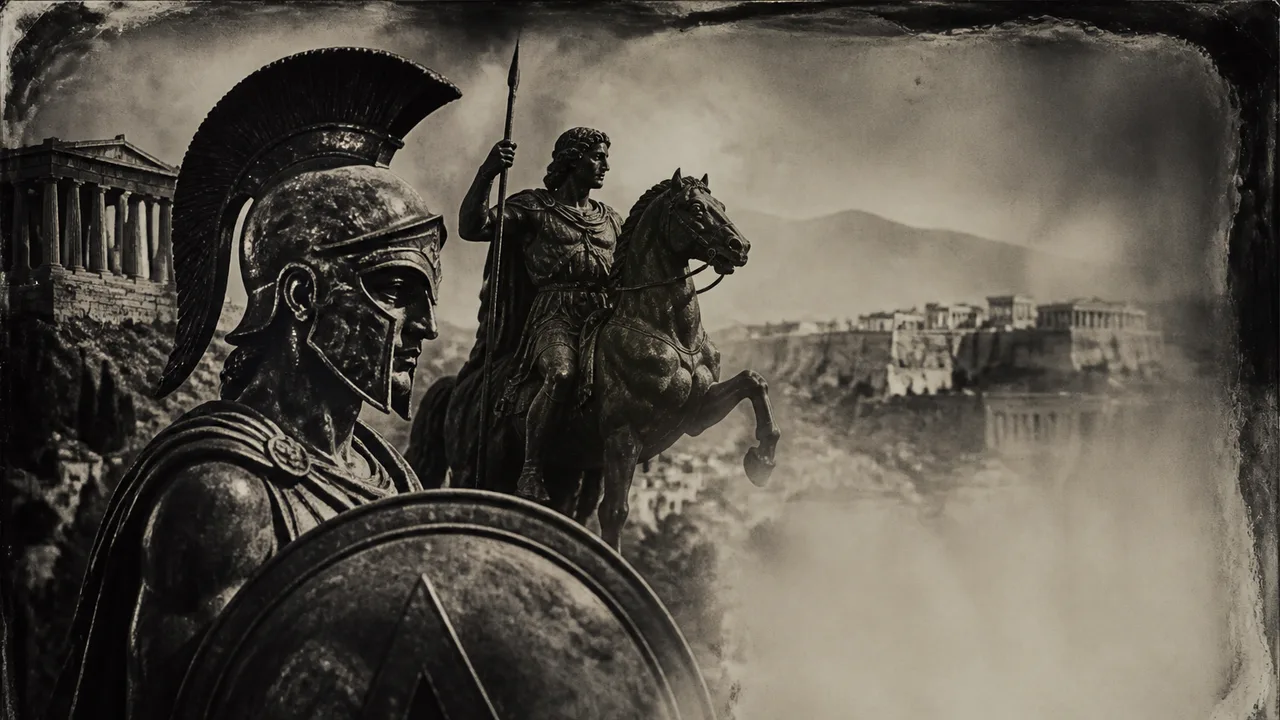
Photo: AI. Otieno Okello
There is a version of ancient Greek history that arrives pre-packaged: marble, philosophy, democracy, glory. Odyssey's recent documentary The Real History of Ancient Greece: Empire of Extremes is not quite that version, and the gap between the two is worth examining. The film moves briskly from Homer through Alexander, covering nearly four centuries of Mediterranean history in under an hour. What it offers is something useful — a reminder that the civilization we have been taught to admire was also one built on coercion, contradiction, and radical ideological ambition. Whether you find that disturbing or clarifying probably says something about what you were told in school.
The Poems That Made the Greeks
The documentary opens, sensibly, with Homer. Not because the epics are the oldest Greek texts — they are not — but because no other works so thoroughly colonized the Greek imagination. As one of the film's commentators explains: "For the Greeks, Homer was a poet with a capital P. He was the yardstick against which all subsequent writers, poets and philosophers were measured. His works also served as a sort of textbook, a type of school book for every Greek person."
That last phrase is the one worth sitting with. A school book. The Iliad and the Odyssey were not read as entertainment the way we read novels. They were how Greeks understood what it meant to be Greek — courageous, seagoing, destined for either glory or a meaningful death. Achilles, the film's commentators note, was not merely a character but an ideal, an archetype that would be consciously emulated by Alexander the Great and later by Roman emperors seeking Greek legitimacy.
What the film handles well here, without quite pressing on it, is the ideological function of myth. The Trojan War served as what one scholar in the documentary calls "a clash of civilizations" — Greeks as civilization, everyone else as barbarian. The barbarian, in Greek, simply meant one who did not speak Greek. It was a linguistic category that became a moral one, and the Iliad helped cement that transformation. That same us-and-them structure would be invoked centuries later to justify campaigns against Persia. Epic poetry as foreign policy: the Greeks understood the power of narrative in ways that should feel entirely familiar.
The Invention of Democracy (and What It Excluded)
By 510 BCE, the Athenian reformer Cleisthenes had done something genuinely radical: he dismantled the old tribal system based on birth and family lineage and reorganized Athenian citizens into ten artificial tribes drawn from different regions and classes. The documentary is right to call this foundational. What it is less forthcoming about — and this is a recurring omission in popular histories of Athens — is the hard boundary of the word "citizens." Women, enslaved people, and resident foreigners were outside it entirely. Athenian democracy was a revolution in governance for those it included. For the helots of Sparta — an enslaved agricultural population whose labor freed Spartan men to focus entirely on warfare — it was not a revolution at all.
The film describes Sparta's helot system plainly: "They had an entire region with the entire population working for them, producing agricultural product, supporting the Spartiates and allowing the Spartiates themselves to be free from these more manual or productive activities and instead focus on war." It presents this as context rather than indictment, which is a choice. The ancient world was not more brutal than ours in every respect, but the helot system — an entire population held in permanent, generational servitude by a neighbor state — deserves more than a paragraph of neutral description.
Marathon and the Limits of the Legend
In 490 BCE, Darius I sent a Persian fleet toward Athens, guided by the Athenian exile Hippias. The two armies met at Marathon. The Greek force, commanded by a rotating board of ten generals (strategoi) with Miltiades effectively directing the battle, faced a substantially larger Persian force. The Greeks won.
What the film does not finesse is the documentary impulse to make this victory feel inevitable and clean. The Persian army — described in the film as largely conscripted and therefore less motivated than Greeks fighting for their freedom — broke and fled. According to the ancient account recorded by Herodotus, the losses were severe on the Persian side and minimal for the Greeks, though modern military historians have questioned whether these figures can be taken at face value. The film's own commentators acknowledge the Herodotean numbers are likely propaganda as much as record-keeping, which is exactly right. Presenting them uncritically and then walking them back in the same breath is the kind of compromise popular history makes constantly. Better to note plainly that Herodotus is what we have — a brilliant, engaged, sometimes credulous source writing decades after events he did not witness.
The legend of the runner who carried word of victory from Marathon to Athens — dying on arrival — is addressed honestly: the documentary calls it a legend, not a fact. The distance of 26 miles, it notes, is the origin of the modern marathon race. This is about as much epistemological honesty as the genre typically offers, and it should be appreciated for what it is.
Thermopylae, and What the 300 Were Actually Doing
The Battle of Thermopylae (480 BCE) has attracted more mythos per square mile than perhaps any engagement in history. The documentary resists the full 300 treatment without entirely escaping it.
Leonidas and his Spartan contingent — accompanied, the film is careful to note, by roughly 7,000 allied Greek troops who are almost always forgotten in popular retellings — were not stationed at the pass to win. They were there to slow a Persian army while a coherent defense was organized to the south. The documentary's more interesting observation is that Sparta's stand at Thermopylae may have been partly motivated by institutional shame: the Spartans had famously cited a religious festival as their reason for missing Marathon entirely, and this perception of dereliction shadowed their reputation. Thermopylae, on this reading, was also an act of narrative repair.
When a traitor revealed a mountain path that allowed Persian forces to flank the Greek position, Leonidas dismissed most of the allied troops and held the pass with his personal guard until they were killed. The Simonides epitaph carved at the site — "Go tell the Spartans, passer-by, that here, obedient to their laws, we lie" — remains one of the most compressed and devastating sentences in any language. The film quotes it without embellishment. That restraint is the right call.
Alexander's Contradiction
The documentary's final movement covers Alexander of Macedon, and here the tension between myth and evidence becomes most visible. Alexander consciously modeled himself on Achilles — the film's commentators are explicit that this was not accidental but strategic self-presentation. He carried a copy of the Iliad, annotated by Aristotle, on campaign. He visited Troy before crossing into Asia. The warrior poet had, two centuries later, become the warrior king's instruction manual.
What Alexander did with the Persian Empire after conquering it is the more interesting story. In 324 BCE at Susa, he staged a mass wedding. According to Wikipedia's account of the Susa weddings, Alexander himself married a daughter of Darius III, while his closest companion Hephaestion received another daughter. W.W. Tarn's scholarship on the Susa wedding, published by Taylor & Francis, records that the ancient sources vary on how many of Alexander's officers married alongside him — ranging from 80 to 92 depending on the account — with the ceremonies conducted according to Persian custom.
His Macedonian generals were not pleased. The documentary quotes one commentator's summary of their objection: "They would like to marry between aristocrats and Macedonians with aristocratic women." This resistance is important. Alexander's vision of cultural fusion — what the film calls "a revolutionary idea for the ancient world, to purposely mix two cultures and forge a wholly new identity" — was not universally shared by the men who had fought to make it possible. Empire as multicultural experiment, imposed from the top down on subordinates who wanted their spoils and their familiar hierarchies: this is a tension recognizable across centuries.
Alexander died in Babylon in 323 BCE, eleven days after falling ill, having made no arrangements for succession. When asked who should inherit his empire, he reportedly said "the strongest." His generals spent the next decades trying to prove he meant each of them specifically.
What Carries Forward
The documentary closes with the observation that Greece, absorbed eventually into Rome, mattered to its conquerors more than its size warranted. Roman religion, science, and literature drew from Greek models so heavily that the Romans themselves described it: Graecia capta ferum victorem cepit — "Captive Greece captured its fierce conqueror," as Horace put it. The Greeks had, in a real sense, colonized the imagination of the civilization that conquered them.
That is the through-line the film is reaching for, and it is not wrong. But the story it tells — from Homer's construction of Greek identity against a barbarian other, through Athenian democracy's revolutionary reach and stark exclusions, through Alexander's failed attempt to fuse two imperial cultures by fiat — is not a story of foundation so much as a story of tension that was never resolved. The democracy that inspired Enlightenment thinkers excluded most of the people living under it. The conqueror who dreamed of cultural synthesis killed a friend in a drunken rage and died before he could rule the empire he had won. The poems that unified a civilization also told the Greeks they were better than everyone else.
Whether that tension is a flaw in the Greek legacy or the source of its enduring fascination is a question the evidence cannot answer for you.
More Like This
Roman Empire History With Anthony Kaldellis
Anthony Kaldellis joins Lex Fridman to argue the Byzantine Empire never existed—it was Rome all along. A historian makes the case across 2,200 years.
WW1 Trench Life: What the Western Front Was Really Like
From Pals' Battalions to the Vickers gun, a new documentary unpacks the grim machinery of survival on the WW1 Western Front in unflinching detail.
Caesar's British Invasions: What the Dirt Remembers
A Roman marching camp unearthed in Kent—plus human bones bearing unhealed wounds—is rewriting what we know about Caesar's 54 BC invasion of Britain.
The Crusades: Two Centuries of Holy War Explained
From Pope Urban II's 1095 call to arms to the fall of Acre in 1291, the Crusades reshaped Christianity, Islam, and the medieval world permanently.
Pavlopetri: Inside the World's Oldest Sunken City
A Bronze Age city has sat submerged off southern Greece for 3,500 years. New technology is finally letting archaeologists read what it says about us.
Homer's Odyssey and Mycenaean Religion: Fact vs. Myth
Homer set the Odyssey in the Bronze Age but wrote it 500 years later. How accurate is his religion? Linear B tablets reveal a startling gap.
Troy Was Real — But Not How Homer Told It
Hittite cuneiform tablets and Bronze Age archaeology suggest a real conflict at Troy — one far stranger and more geopolitically tangled than the Iliad admits.
Pliny the Younger's Letters on the Eruption of Vesuvius
Pliny the Younger's two letters to Tacitus remain the only eyewitness account of Vesuvius's eruption in 79 AD — and they still read like dispatches from the end of the world.