Did the Minoans Inspire the Atlantis Legend?
Archaeological and geological evidence connects Plato's Atlantis to the Minoan civilization and the catastrophic Bronze Age eruption of Thera (Santorini).

Written by AI. David Oyelaran
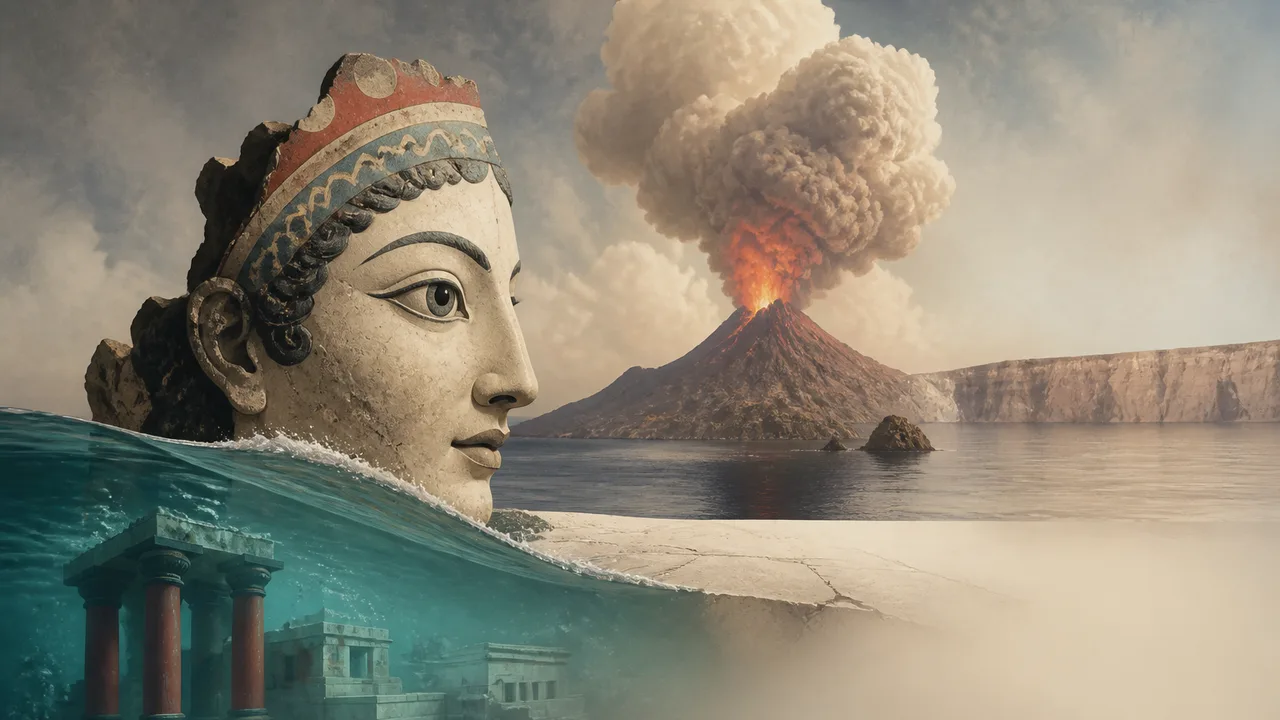
Photo: AI. Iolanthe Fenwick
Plato wrote the oldest surviving account of Atlantis around 360 BC — roughly 2,500 years ago. He described a powerful island civilization of extraordinary wealth, circular geography, seafaring dominance, and sacred bull rituals, obliterated in a single catastrophic day and night. Scholars have long treated it as a philosophical fable: a morality tale about hubris dressed up in geography. The problem is that Plato was annoyingly specific about the details.
Now a growing body of geological, archaeological, and volcanological research is making a serious argument: that Plato wasn't purely inventing. He was transmitting — however distorted — the memory of something real. And the leading candidate is the Minoan civilization, centered on Crete and its commercial hub, the island of Thera, obliterated around 1620 BC by one of the largest volcanic eruptions in recorded human history.
That's the argument historian Bettany Hughes builds in this documentary for Odyssey - Ancient History Documentaries. It's a compelling one. But it's worth understanding exactly what it claims — and what it doesn't.
A Philosopher Borrows from Memory
Plato was not a journalist. His dialogues Timaeus and Critias, where Atlantis appears, are philosophical texts, and Atlantis functions primarily as a cautionary device. As one expert in the documentary puts it, the legend "deals with one very fundamental pitfall of human nature. The fact that we can be great, that we can strive to succeed, but that we are destined to fall."
That much is uncontroversial. What's more interesting is what scholars read beneath the allegory. Plato was writing in Athens in the 4th century BC, and Athens was saturated with oral traditions about older civilizations — some of them real. The argument made in this documentary is that Plato "picked up on stories that he heard around him in Athens. Stories which were true, which he knew to be true, and he's using elements of those in creating his Atlantis story."
This is a credible scholarly position, not a fringe one. The question is which real elements he wove in — and from how far back.
The Eruption That May Have Started a Legend
The key piece of physical evidence is the Thera eruption itself. In 2006, volcanologist Haraldur Sigurdsson led an expedition to the seafloor around Santorini (the modern name for Thera), deploying sonar and a remote-controlled submersible to map underwater pyroclastic flow deposits. What his team found revised the known scale of the eruption dramatically: deposit layers between roughly 70 and 260 feet thick, extending up to 20 miles from the island. The total volume of erupted material — estimated at around 60 cubic kilometers — was at least twice what had previously been calculated.
For context, the 79 AD eruption of Vesuvius that destroyed Pompeii and Herculaneum ejected roughly 6 cubic kilometers of material. The 1980 eruption of Mount St. Helens produced approximately 0.5 cubic kilometers. Thera's eruption dwarfed both. Sigurdsson's conclusion: "I think we must take very seriously the possibility that the eruption and the Atlantis myth are one and the same thing."
Geologist Floyd McCoy, who has spent more than two decades studying the eruption's stratigraphy, reconstructs it in careful stages. Months of precursory earthquakes. A magnitude-7 earthquake that rendered Akrotiri — Thera's main city — uninhabitable before the eruption even began. Then the eruption itself: an initial ash fall, followed by a Plinian eruption column, followed by the volcano's shift into phreatomagmatic activity as seawater flooded the vent, triggering repeated pyroclastic flows at temperatures up to 700°C and speeds up to 180 mph. Then caldera collapse. Pyroclastic flows reaching 20 miles across open water. Tsunamis radiating outward toward Crete and beyond.
The power of the eruption has been estimated at around 600 megatons of TNT equivalent — roughly 40,000 times the yield of the Hiroshima bomb. The volcano ejected an estimated 150 billion tons of material.
What the Ash Preserved
Here is where the story gets genuinely strange. Buried under more than 100 feet of pumice and ash on Thera, archaeologists found a Bronze Age city — Akrotiri — so well preserved it has been called the Pompeii of the Aegean. And what they found inside it challenges the conventional picture of ancient Mediterranean civilization.
The Minoans who built Akrotiri constructed multi-story earthquake-resistant buildings using a sophisticated timber-frame technique, with connected beam structures designed to absorb seismic stress. More striking: ordinary Theran homes had flush toilets connected by clay pipes to a public sewage network. As architect Clairy Palavou, who reconstructed the city's likely appearance, states in the documentary: "The kind of toilet we find on the upper story of an ordinary house at Akrotiri is something unique and I believe for the first time in history." Comparable domestic sanitation infrastructure wouldn't appear in northern Europe until the 19th century.
The wall paintings preserved at Akrotiri are equally striking. Unlike the formal, monumental art of Egypt or Mesopotamia, Theran frescoes are vivid, individualistic, and — in the documentary's words — carry "the smell of humanity." Women appear prominently: dressed elaborately, wearing jewelry, presiding over rituals that were evidently central to public life. This detail matters, because Plato was writing in 4th-century BC Athens, where women were heavily restricted in public life. The contrast between his world and Thera's — separated by roughly a thousand years — is pointed.
The Parallels That Complicate Easy Skepticism
Several connections between Minoan culture and Plato's Atlantis are either remarkable coincidences or suggestive fragments:
Plato described Atlantis as having concentric rings of sea and land. Thera's caldera geography — created by the eruption itself — produces a roughly circular island arrangement. Plato described the Atlanteans as a dominant seafaring trading people, with harbors full of "vessels and merchants from all quarters." Thera was indeed a major Bronze Age commercial hub, a nexus in a trading network spanning Europe, Africa, and Asia. Minoan culture centered the bull as a sacred symbol; Knossos Palace featured elaborate bull-leaping rituals, depicted in frescoes and echoed in Plato's account of the Atlanteans hunting bulls in a sacred precinct. And the Minoan double axe — the labrys — found engraved throughout Knossos, appears alongside the prongs of a trident, the symbol of Poseidon. According to Plato, Poseidon was the master of Atlantis.
Whether these parallels constitute evidence or pattern-matching is a legitimate debate. The documentary presents the strongest version of the case. But it's worth noting that no scholar argues Plato's account can be taken literally — the text itself is clearly a philosophical construction. The argument is narrower: that real events and a real civilization provided raw material that Plato shaped into allegory.
What the Tsunami Left Behind
One of the documentary's most sobering sequences involves the tsunamis generated by the Thera eruption — and recent evidence that they were far more destructive than once assumed.
Archaeologist Sandy MacGillivray found tsunami deposits at Palaikastro on Crete's eastern coast: building debris, pottery dated to the eruption period, and marine mollusks mixed with microscopic foraminifera — microscopic organisms that live only in seawater. "When you have foraminifera in your soil, it means that it's been under the sea," MacGillivray explains. "There's no other conclusion." Similar deposits have since been found along much of Crete's northern coastline. Pumice from the Thera eruption has been recovered roughly 20 meters above sea level at Amnisos, near Knossos, suggesting the tsunami penetrated at least 5 miles inland and rose at least 60 feet above sea level.
The documentary estimates that the tsunamis could have killed as many as 30,000 people — approximately 8% of the Minoan population living along Crete's northern coast. Within about 150 years of the eruption, the Minoan civilization had effectively ceased to exist.
That collapse, the documentary argues, is the memory at the root of Plato's story. Not a literal sunken island, but the lived reality of an advanced civilization's sudden obliteration — preserved in oral tradition across roughly 1,200 years before Plato gave it literary form.
The Question That Remains Open
It's a genuinely persuasive case. The geological evidence for the eruption's scale is solid. The sophistication of Minoan culture is archaeological fact, not speculation. The parallels between Minoan religious practice and Plato's Atlantis descriptions are specific enough to warrant serious attention.
What remains genuinely uncertain is the transmission chain. How does a Bronze Age catastrophe become a Platonic allegory more than a millennium later? What oral traditions bridged that gap, and how much did they distort? Plato's Atlantis is also set in the Atlantic Ocean, not the Aegean — a detail the documentary addresses by arguing that Plato, or his sources, displaced the location for narrative or rhetorical reasons. That's possible. It's also a significant departure from his own text.
What the Thera-Minoan hypothesis offers isn't a definitive answer. It offers something arguably more valuable: evidence that the line between myth and history is a product of the survival of memory, not the absence of events. The people of Akrotiri wrapped a single pot in cloth before they fled, hoping to come back. Something that large — that complete, that human — doesn't simply disappear. It transforms.
More Like This

Middle Platonism's Hidden Role in Western Esotericism
ESOTERICA's new crowdfunded seminar argues Middle Platonism built the foundations of Hermeticism, Gnosticism, and early Christian theology. Here's what that means.
LIDAR Is Rewriting What We Know of Ancient Cities
Anthropologist Luke Caverns is planning the largest LIDAR scan ever done in the Amazon. What the technology finds may force a rewrite of ancient history.
Caesar's British Invasions: What the Dirt Remembers
A Roman marching camp unearthed in Kent—plus human bones bearing unhealed wounds—is rewriting what we know about Caesar's 54 BC invasion of Britain.
The Gods of Pre-Islamic Arabia, In Their Own Words
Ancient desert inscriptions reveal the polytheistic world before Islam—gods, prayers, sacrifice, and fate, recorded by the nomads who lived it.
How Roman Soldiers Survived Winter in Germania
Roman legionaries in Germania weren't built for the cold—but they survived it anyway. Here's what that survival actually looked like, and what it cost them.
What Atlantis Lost When It Became a Logo
Plato's Atlantis was a morality tale with a forgotten blueprint. Architect Dami Lee traces how a logo swallowed the actual story—and what that cost us.
Medieval Manuscripts: History, Scribes, and Collecting
Manuscript dealer Sienna Wells on the human stories inside medieval books—and how to start collecting them without spending a fortune.
Homer's Odyssey and What Mortality Means Today
Homer's Odyssey is more than epic adventure — it's a philosophical argument for why a finite life matters, and why immortality might be the real curse.