Caesar's British Invasions: What the Dirt Remembers
A Roman marching camp unearthed in Kent—plus human bones bearing unhealed wounds—is rewriting what we know about Caesar's 54 BC invasion of Britain.

Written by AI. David Oyelaran
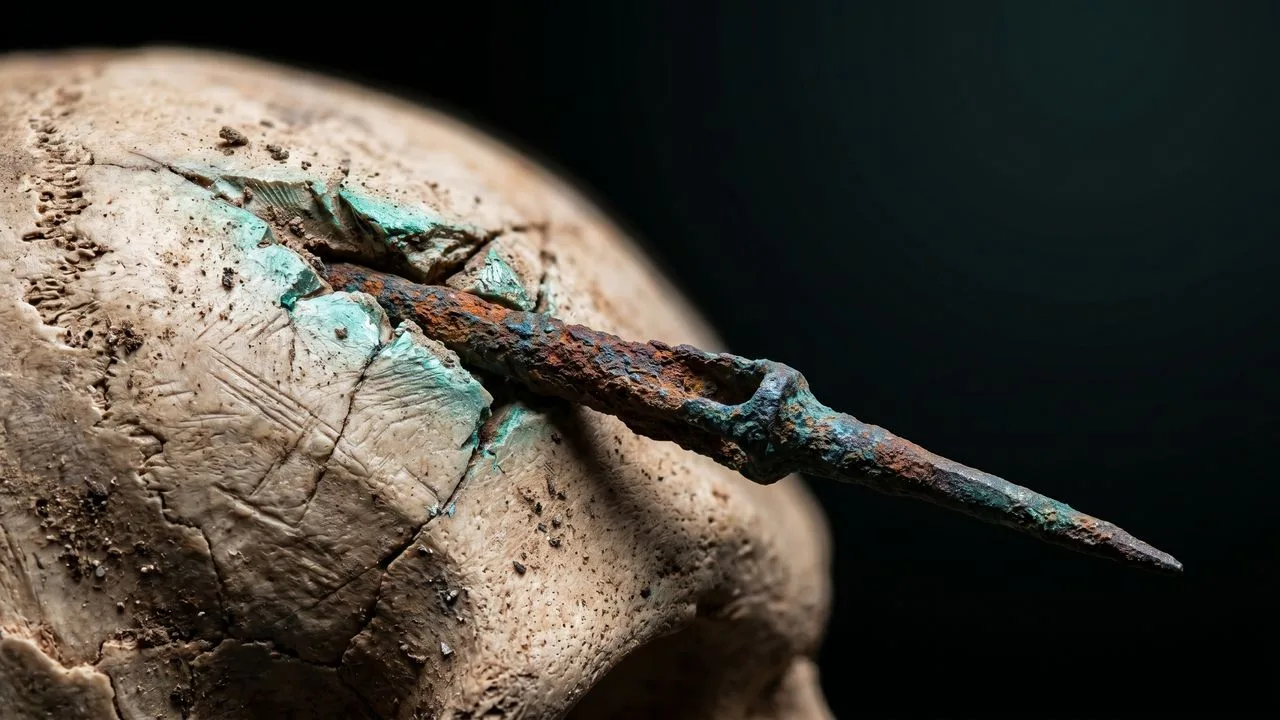
Photo: AI. Pippa Whitfield
There's a moment in a recent Odyssey documentary where bushcraft expert Ray Mears stands on a stretch of unremarkable agricultural land in Kent—next to a noisy road, of all things—and historian Dr. Simon Elliott tells him he's standing inside a Roman marching camp built during Julius Caesar's second invasion of Britain in 54 BC. The ground looks like nothing. Flat, green, forgettable. And then Elliott explains that in the Roman period, as far as the eye could see in every direction, it was water.
That gap between what we see and what was actually there is the whole problem with trying to recover these events. For nearly two millennia, Caesar's invasions of Britain existed primarily in a single place: Caesar's own writing. De Bello Gallico is brilliant, indispensable, and written by a man with every reason to shape the story to his advantage. What the documentary captures—and what makes it genuinely interesting—is the slow, imperfect, occasionally spectacular process of finding physical evidence that either confirms, complicates, or quietly contradicts what he told us.
What Caesar Didn't Tell You About His First Try
The 55 BC invasion is a story of compounding failure dressed up as audacity. Caesar's intelligence on Britain was nearly useless—traders who crossed the Channel apparently told him very little, and the documentary suggests this was deliberate, a kind of protective silence around a land they didn't want Rome to reach. His diplomatic envoy, a man named Commius, was captured the moment he arrived. His cavalry, departing from a different point in Gaul, missed the tide and never made it across.
And then Caesar sailed toward Dover, looked up at the white cliffs lined with hostile tribesmen, and apparently thought this was a reasonable landing spot. It wasn't. Dr. Elliott doesn't soften the assessment: "The fact that Caesar thought this cliff-lined coast was a good landing point shows just how poor his information was."
So he moved along the coast—to somewhere north of Deal, the evidence suggests, though no one can say exactly where—and found that the Britons were already waiting there too. What followed was, according to Elliott, "the Romans' most difficult invasion of Britain," fought against a defended shoreline, with Iron Age warriors wading into the surf to meet them.
What turned it was a single act of deliberate drama. Caesar describes it himself in terms that still land hard: the aquilifer—the eagle-bearer of the Tenth Legion, his own legion—leaped from the ship and began carrying the sacred standard toward the enemy. "Jump down, soldiers," he reportedly cried, "unless you want to betray our eagle to the enemy." The men followed. The battle, which lasted the entire day, ended with Roman troops on British soil.
Whether you read that as genuine inspiration or as Caesar constructing a legend in real time is a question the documentary doesn't fully press. But it's worth sitting with. The Tenth Legion was Caesar's favored unit. The eagle had profound religious significance. The whole scene, preserved only through Caesar's pen, arrives perfectly shaped—the moment of hesitation, the lone hero, the rallying cry, the victory. It's a remarkable piece of writing. Whether it happened exactly like that is a different question.
The Camp Next to the Road
For all the drama of 55 BC, it's the second invasion—54 BC, 800 ships, five legions, cavalry this time—that has just produced the most significant physical find. A few years ago, what the documentary calls "rescue archaeology" ahead of a road construction project in Kent turned up the ditches of a Roman beachhead marching camp. Ditches are what you look for; they're the defining feature of these temporary fortifications, built to last days rather than decades, which is exactly why they're so hard to find.
In the base of one of those ditches: a Roman pilum head. And bones.
Human bones. With unhealed trauma.
Dr. Elliott walks through what that means: "They died of the trauma, but then were chucked just like that into the bottom of a ditch." Not buried—discarded. Which tells archaeologists something about whose bones these likely were. Roman soldiers received formal burial. These didn't. So the working interpretation is that these were British dead—possibly warriors killed trying to infiltrate the camp, possibly prisoners executed after interrogation.
That second possibility is the one that sits with you. It's not shocking in any historical sense; Roman warfare involved exactly this kind of violence. But there's a difference between knowing that intellectually and standing over a ditch where someone was thrown two thousand years ago, their wounds still readable in bone.
The location of the camp adds another layer. The Isle of Thanet—the area we still call that even though it hasn't been an island for centuries—was, in 54 BC, genuinely cut off from mainland Kent by the Wantsum Channel. The camp sat on a promontory on that island's southern edge. You couldn't attack it with chariots. You couldn't reach it without crossing a major waterway. Elliott's read: this is Caesar having learned from the year before, when his exposed position left him vulnerable. The geography was a weapon.
The Problem With Caesar's Account
This is where the documentary is most interesting to me, even if it doesn't always press the point explicitly. Caesar is essentially our only written source for these events. He was also a politician constructing a public image, a general justifying his campaigns to Rome, and a writer talented enough to make all of that invisible. When he tells us his soldiers hesitated in the surf, that's a "rare criticism," as Elliott notes—which means it's probably there because it makes the eagle-bearer's intervention more dramatic, not because Caesar was committed to balanced reporting.
The traders' silence, Commius's capture, the cavalry missing the tide, the poor landing intelligence—none of these appear in Caesar's account as failures of planning. They appear as obstacles his genius overcame. That framing deserves scrutiny, and the archaeology, when it exists, offers a different kind of testimony: mute, partial, but unbeholden to anyone's reputation.
The bones in the ditch don't care about Caesar's narrative. Neither do the ditches themselves, slowly yielding their shape back to researchers working ahead of road construction. There's something almost pointed about that—the physical record of a war emerging not through deliberate excavation but through the routine, bureaucratic process of checking whether it's safe to build a road.
Archaeologist Dr. Steve Willis, standing on the earthworks of Bigbury Hillfort near Canterbury—the site where Caesar likely fought his first major inland battle of the second campaign—describes a place that was simultaneously a defensive stronghold, a trade hub, a tax point, and a traditional gathering space. It was, in other words, a community. The Romans reduced it to a tactical problem to be solved.
That reduction is also part of what the documentary, in its focus on Roman military ingenuity, occasionally risks performing rather than examining. Re-enactor David Richardson's demonstration of the pilum's design—weighted to bend on impact, impossible to pull free from a shield, guaranteed to cause chaos in charging formations—is genuinely illuminating. The Roman war machine was extraordinarily sophisticated. But the sophistication ran in one direction.
The bones in the ditch were someone's kin. Two thousand years of changed coastline sit between us and knowing whose.
More Like This

Can Directed Heat Beams Help Reverse Global Warming?
Caltech researcher Yae-Chen Lim thinks we can engineer thermal radiation into directed beams—and aim our waste heat straight into outer space.
WW1 Trench Life: What the Western Front Was Really Like
From Pals' Battalions to the Vickers gun, a new documentary unpacks the grim machinery of survival on the WW1 Western Front in unflinching detail.
Unraveling Rome's Dodecahedron Mystery
Exploring the enigmatic Roman dodecahedron, its theories, and historical significance in modern archaeology.

Unveiling Rome's Gladiator Underworld
Explore the hidden world beneath ancient Rome's arenas, unveiling gladiator training, underground tunnels, and cultural practices.
San Francisco 1906: The Disaster That Was Built
The 1906 San Francisco earthquake wasn't just an act of nature—it was the bill coming due on decades of willful ignorance. Here's what actually happened.

Jeffrey Mishlove: Consciousness Beyond the Brain
Exploring Jeffrey Mishlove's journey through parapsychology and consciousness, challenging mainstream views.
DNA Names a Revolutionary War Teen Soldier After 245 Years
Genetic genealogy has identified Private John Pumphrey, a Maryland teen who died at the Battle of Camden in 1780 — one of America's oldest John Doe cases.
Cicero and the Fall of the Roman Republic
Marcus Tullius Cicero defended Rome's Republic with words alone—and paid with his life. A look at history's most consequential orator and his impossible political moment.