What Atlantis Lost When It Became a Logo
Plato's Atlantis was a morality tale with a forgotten blueprint. Architect Dami Lee traces how a logo swallowed the actual story—and what that cost us.

Written by AI. Helen Papadopoulos
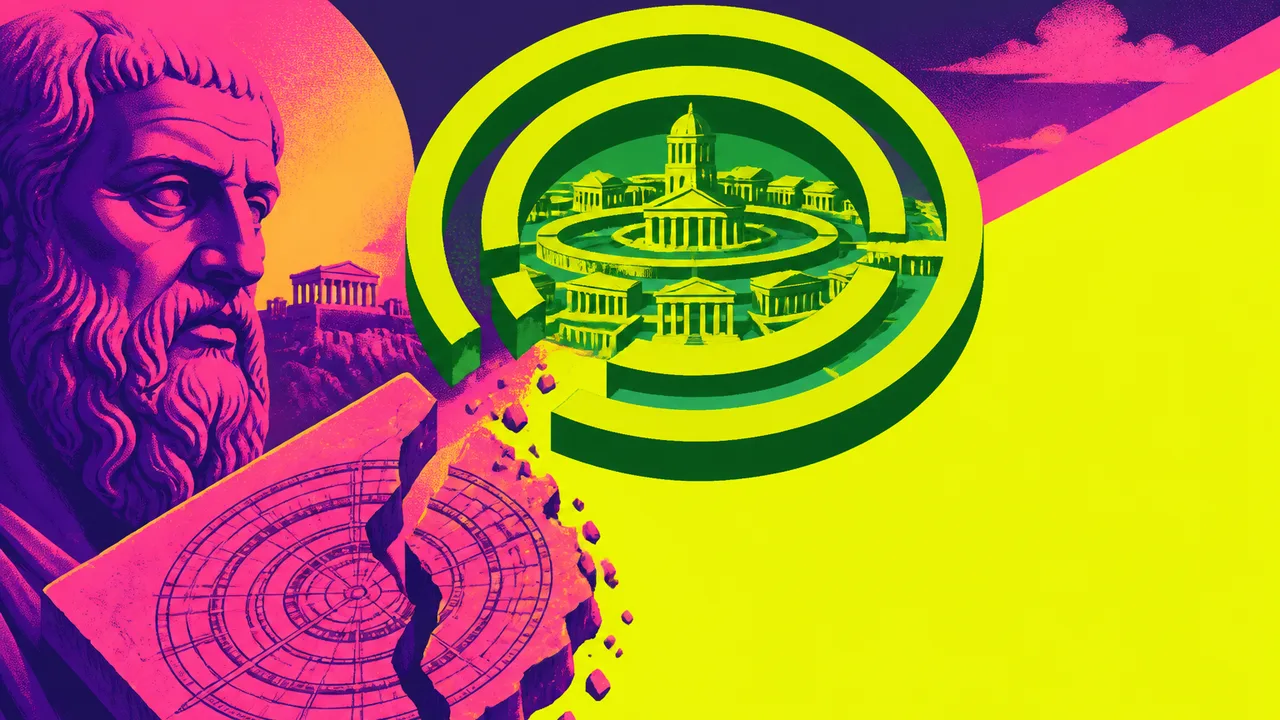
Photo: AI. Zephyr Cole
R.G. Bury was not a mystic. He was not a congressman with a theory, not an occultist with a map drawn by psychic powers, not an SS officer hunting for racial origins in the North Sea. He was a classicist, and in 1928 he published the first English translation of Plato's Timaeus and Critias for the Loeb Classical Library—the sober, bilingual series that still lines the shelves of university libraries in that distinctive red-and-green binding. To supplement his translation, he included diagrams. Three of them. The first showed the famous concentric rings of water and land. The second zoomed out to the outer city walls, roughly nine kilometers from the center. The third zoomed out further still, to a vast rectangular agricultural plain—2,000 by 3,000 stadia, enclosed by a great canal, crosshatched by 29 vertical and 19 horizontal irrigation trenches.
That third diagram has essentially vanished from the cultural record. The first one became Atlantis.
This is the quiet provocation at the center of a recent video by Dami Lee, a Vancouver-based architect whose YouTube channel covers architecture and design with genuine intellectual care. Lee traces the full genealogy of the Atlantis myth—from Plato's 360 BC dialogues through Renaissance urban theory, Athanasius Kircher's Jesuit cartography, Ignatius Donnelly's pseudoscientific bestseller, Helena Blavatsky's Theosophy, and Heinrich Himmler's expedition-funding obsession—and arrives at a diagnosis that I find compelling enough to examine more carefully: we replaced a blueprint with a logo, and in doing so, we lost the point.
The Original Story Plato Told
Plato's Atlantis is, by scholarly consensus, a morality tale. The city is lavishly described: built on a hill, carved into concentric rings of land and water, rich in orichalcum (that strange metal whose identification still vexes philologists), fed by hot and cold springs, defended by impressive infrastructure. Its rulers are descended from Poseidon. For generations they govern wisely. Then, as rulers tend to do, they become corrupt, launch a war against Athens, lose, and the gods—disgusted by their hubris—sink the island.
The structure is classically Platonic. Power corrupts; hubris invites divine retribution; Athens, representing justice and moderation, prevails. You don't need to hunt for submerged ruins to understand what Plato was doing.
And yet Plato does something odd. He doesn't present the story as allegory. He routes it through a specific, named chain of transmission: an Egyptian priest to Solon, Solon to his grandson, the grandson to Critias, Critias to Socrates. Lee notes this precisely: "He goes out of his way to make it sound like a real account." Then he leaves the dialogue unfinished. Nobody knows why. The combination—insistent historicity, meticulous technical detail, abrupt abandonment—has been generating interpretive anxiety for two millennia, and Plato, who was fully capable of finishing things he started, appears to have known exactly what he was doing.
What Each Age Needed Atlantis to Be
Lee's most useful analytical move is this: every era in the Atlantis tradition approaches the story with whatever tools and obsessions it happens to have at the time. The Renaissance had Platonic philosophy and ambitious patrons. The Jesuit Age had the impulse to catalog and systematize everything. The nineteenth century had evolutionary anxiety and the spectacular, disorienting discovery that Troy was real. Each of these moments produced a different Atlantis.
The Renaissance version is the one I find most genuinely interesting. When Plato's texts circulated back into Italy in the fifteenth century, they didn't enter a scholarly vacuum—they entered a competitive cultural arms race between the Medici, the Sforza, and the Montefeltro, each family trying to outshine the others in architecture and civic prestige. Suddenly there were private clients with money and ambition, and architects who were, as Lee puts it, no longer medieval craftsmen working on church commissions but polymaths selling themselves to design entire civilizations. Leonardo da Vinci's famous letter to Ludovico Sforza—"I can design bridges light and strong that can be carried with ease... I can design buildings public and private and conduct water from one place to another"—reads less like a job application than a manifesto. He didn't get the commission. Antonio Filarete did, and Filarete designed Sforzinda: a perfect star-shaped city with radial streets and concentric rings.
The concentric rings. Already the image was detaching from the warning.
Palmanova, the actually-built garrison city in Friuli, completed in 1593, offers the cautionary data point. Nine-pointed star, central piazza, perfect radial symmetry. Militarily defensible. Functionally miserable. "The first real residents of this ideal city are prisoners," Lee observes, and this is historically accurate—the Republic of Venice eventually had to offer free land and pardons to criminals to populate the place. The geometry that looked like perfection from above was, at street level, a place where every direction looked the same. Ideal cities have a persistent tendency to privilege the plan over the inhabitant.
Ignatius Donnelly's 1882 Atlantis: The Antediluvian World represents a different kind of seduction. Written by an American congressman and treating Atlantis as literal history—the origin point of every civilization on earth—it was a bestseller partly because it arrived in the wake of genuine archaeological shock. Schliemann had found Troy. Darwin had published the Origin of Species. The category of "things everyone assumed were myths but turned out to be real" had just expanded dramatically, and Donnelly exploited that epistemic vertigo with apparent rigor: diagrams, comparisons, cross-cultural parallels. It looked like science because it dressed like science. From Donnelly it was not a long journey to Helena Blavatsky's Theosophical "root races" or, eventually, to Himmler's SS research institute and its North Sea diving expeditions. Lee's summary is terse and accurate: "a morality tale turned into a map, turned into a history, turned into a religion, and then turned into a weird racial theory."
The Logo Problem
Here is where Lee's architectural training produces an insight that a historian might miss. He argues that the concentric-rings image of Atlantis has ceased to function as a depiction and now functions as a logo—and that the properties that make it work as a logo are precisely what erase its meaning as a city.
"A circle is not really a layout for a city, but it's something much more powerful. There's no beginning or end. It's perfectly symmetrical and it references the cosmic order." This is correct, and it explains something that purely textual analysis of the Atlantis tradition tends to underweight: the image became autonomous. You can put three concentric rings on a YouTube thumbnail and viewers recognize Atlantis without needing the word. The Richat Structure in Mauritania—a geological formation produced by magma intrusion and differential erosion, sitting 400 meters above sea level in a region that hasn't been underwater in 99 million years—went viral as "real Atlantis" because it looks, from satellite, like the rings. Scale irrelevant. Artifacts absent. Geology unambiguous. The logo overrides the evidence.
Meanwhile, Pavlopetri sits in four meters of water off the Laconian coast, about 5,000 years old, with intact street plans, building foundations, a central square, and sophisticated water management infrastructure. Thonis-Heracleion—the great Egyptian port that every foreign ship entering Egypt passed through, roughly contemporary with Plato—lies in Abu Qir Bay, and archaeologists have excavated approximately five percent of it. These are real submerged cities, ancient and sophisticated and demonstrably there. They receive a fraction of the attention that a Mauritanian rock formation gets, because they don't look like the logo.
What Bury's Third Diagram Actually Shows
The question Lee leaves hanging—deliberately, it seems, as a setup for a follow-up video—is what the complete image of Atlantis reveals that the cropped, logo-fied version conceals. Bury's third diagram, the one with the vast rectangular irrigation plain and its 29 vertical and 19 horizontal cross-channels, transforms the city from a cosmic symbol into an economic and agricultural system. The rings are not floating in mythic space; they are embedded in a working landscape, fed by canals, surrounded by mountains and rivers and productive fields. This is, incidentally, precisely the kind of infrastructure Plato cared about when thinking about what makes a just and sustainable society—not the elegance of the plan from above, but the mechanisms that sustain it from below.
"We kept the logo and threw away the blueprint," Lee argues, and what's lost in that transaction is the part of Plato's text that was never really about cosmic order at all—the part about what it actually takes to build something that lasts, and what happens when rulers stop paying attention to that and start believing the geometry is enough.
Palmanova's prisoners might have had something to say about that.
More Like This

Anthropic's Mythos Launch: Security Theater or IPO Theater?
Anthropic's Project Glasswing positions Mythos as too dangerous to release. The timing before a $380B IPO raises questions about the narrative's purpose.
Unraveling Rome's Dodecahedron Mystery
Exploring the enigmatic Roman dodecahedron, its theories, and historical significance in modern archaeology.

Unraveling the Mysteries of Magic in Middle-earth
Explore how magic in Middle-earth defies traditional spells, rooted in nature, craft, and intent.

10 Underrated Netflix Films That Deserve Attention
Explore ten overlooked Netflix films that showcase unique storytelling and filmmaking techniques yet failed to capture widespread attention.

Is Nature Good? Harari and Žižek Say No
Yuval Noah Harari and Slavoj Žižek agree: nature isn't inherently good. Their debate reveals why "natural" is almost always a political argument in disguise.

Why the Ocean Still Terrifies Us: Depths of Fear
Quinn and James of Cosmic Chronicles explore why the ocean remains humanity's oldest, deepest fear—from the Mariana Trench to the myth of the Bermuda Triangle.
Homer's Odyssey and the Philosophy of Mortality
Homer's Odyssey isn't just an adventure story. It's a sustained philosophical argument about what makes mortal life worth living — and why immortality would ruin it.
Myth, Obsession, and the Men Who Dug for Troy
Arthur Evans and Heinrich Schliemann both found ancient civilizations while chasing myths. What does that tell us about archaeology—and obsession?