What Amsterdam Remembers That New York Forgot
A YouTube urbanist's first trip to Amsterdam raises older questions: what does a city actually owe its citizens, and did American cities ever mean to answer them?

Written by AI. Helen Papadopoulos
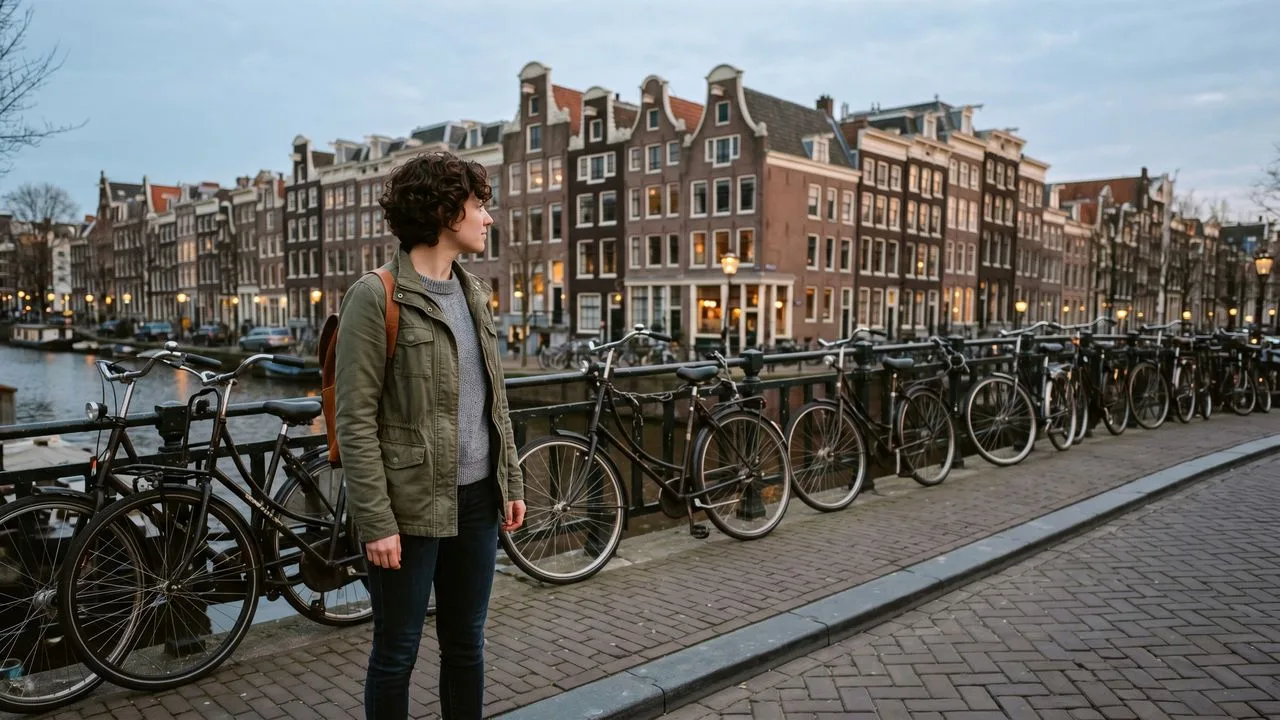
Photo: AI. Marcel Dubois
New Amsterdam was founded in 1626. The Dutch West India Company built it on the southern tip of Manhattan with a recognizable urban logic: canals, a grid, a market, a fort. Warehouses fronted the waterfront. Streets followed the lines of trade. Forty years later, the English took it and renamed it New York, and within a generation most of the canals had been filled in. This is where I would normally say the rest is history, but that's precisely the problem—it isn't history at all. It's the founding condition of the American city, and we're still living inside it.
I mention this because a 26-year-old YouTuber named Fourth Place just returned from his first trip outside the United States, spent eight days in Amsterdam, and produced a seven-minute video that is ostensibly a teaser for a longer series. It is also, without quite meaning to be, a dispatch from someone who has just discovered that a city can be organized around its inhabitants rather than around their automobiles. He calls this discovery a "new perspective." I would call it a very old argument.
None of which is to diminish what he's done. Fourth Place has spent two and a half years—137 consecutive weeks of uploads, by his own account—making videos about American urbanism, transportation, and city planning. He knows what he's looking at. And when he describes Amsterdam's tram network as "the best transit system I've ever ridden," or notes that staying in the Zuidoost neighborhood, nearly a kilometer from the city center by his own reckoning, "never felt all that far at all" because he never once needed a car, he is reporting genuine observations with genuine precision. The step count he cites—over 180,000 steps in eight days, his own figure—is an endearingly data-driven way to say that the city invited walking and he accepted.
What interests me is the layer of the argument he reaches for and then doesn't quite grab.
The Romans had a useful distinction, one that classical scholars have been arguing about for centuries and that nobody in urbanism discourse seems to have imported: urbs versus civitas. The urbs is the physical city—the walls, the streets, the buildings, the infrastructure. The civitas is the community of people who give it meaning and to whom it belongs. Roman writers understood that you could have one without the other. A destroyed city is still a urbs in the archaeological sense; a community in exile still carries its civitas. The two terms travel together but are not the same thing, and their relationship is never guaranteed.
Amsterdam's canal ring, a UNESCO World Heritage Site, was built primarily in the seventeenth century according to a city plan of near-extraordinary ambition—a series of concentric semicircular canals radiating from the original medieval core, designed not just for commerce but for a specific vision of what Amsterdam was supposed to be. The hooks on the canal house facades (which Fourth Place promises to explain in a future video) are there because the staircases inside were too narrow to move furniture; the houses were built tall and narrow because property was taxed by canal frontage. Every visible quirk of Amsterdam's architecture encodes a decision someone once made about how to organize collective life. That is civitas expressing itself in urbs. The physical form is not incidental to the civic identity—it is its written record.
This is what makes the New Amsterdam comparison more than trivia. When the English filled in the Dutch canals and eventually dismantled the Dutch urban template, they weren't just making aesthetic choices. They were overwriting a particular model of what a city was for. American cities then spent the next three centuries improvising alternatives, most of which culminated in the mid-twentieth century decision to engineer them around the private automobile—a choice so total and so rapid that we now tend to treat it as natural law rather than policy. Fourth Place gestures at this when he asks, "Tell me where you can still do that in the US—wake up in a streetcar suburb and actually take the streetcar into town safely, reliably, and efficiently." The answer is: almost nowhere. But the follow-up worth pressing is whether American cities lost this or whether most of them simply never built it in the first place. Loss implies prior possession. The history is messier than that.
The most precise thing Fourth Place says in the video is also the most compressed: "There was a certain standard to public behavior that most American cities that used to be part of Europe once upon a time have since just lost."
This sentence carries a considerable amount of freight. It locates the problem in historical rupture—something was present and is now absent. It attributes the rupture to Americanization. And it implies that the standard is recoverable, which is the operating assumption of most urbanist content and probably has to be, because the alternative is a kind of civic nihilism that doesn't make for compelling YouTube. What it doesn't do is specify the mechanism of loss, or ask whether "public behavior" is a cause or a symptom, or reckon with the enormous variation among American cities that nominally share this condition.
I am not raising these objections to be tiresome. I raise them because Fourth Place has explicitly promised to raise them himself—he acknowledges Amsterdam "has its faults" and commits to covering them—and the gap between this seven-minute teaser and the series he's promising is the gap between a reaction and an argument. He's earned the reaction. The argument is what we're waiting for.
There is also the cycling question, which he drops in almost as a joke: why, in a city with world-class cycling infrastructure, do Amsterdam's cyclists "actually kind of suck?" Read enough about cities built around two wheels—and enough about the behavioral norms of ancient agora users who also, by all accounts, treated shared public space as their personal property—and the parallel is genuinely funny and genuinely diagnostic. Infrastructure shapes incentive. It does not install virtue. Amsterdam's cyclists have apparently absorbed the city's confidence in their own right-of-way and expressed it as something closely resembling aggression. The urbs did its job. The civitas remains human.
What Fourth Place has actually produced, in eight days and 180,000 steps (his figure), is something classical historians would recognize: an ekphrasis interrupted. He arrived, he saw, he began to understand—and then he had to leave. "By the time I had to leave, I was just feeling like I was beginning to understand how important getting to experience this city really is." There is something genuinely melancholy in that sentence, and something true: cities reward duration. A week is enough to feel the difference. It is not enough to explain it.
The longer series he's promising—on the tram network, the park system, the neighborhoods, the architecture, the history—is where the real test comes. Reaction is easy. The harder work is tracing the difference back to its roots, which in Amsterdam's case run through the seventeenth century, through the Dutch Republic's particular experiment in civic organization, through the specific decisions encoded in every canal house facade and every tram line. It runs, in a longer view, through the whole question of what European cities preserved and what American cities chose—or were made—to abandon.
New Amsterdam lasted forty years before it became New York. The canals were filled in shortly after. Somewhere in that sequence is the founding argument of American urban life, and it hasn't been resolved yet.
More Like This

Unraveling the Mysteries of Magic in Middle-earth
Explore how magic in Middle-earth defies traditional spells, rooted in nature, craft, and intent.

10 Underrated Netflix Films That Deserve Attention
Explore ten overlooked Netflix films that showcase unique storytelling and filmmaking techniques yet failed to capture widespread attention.

Is Nature Good? Harari and Žižek Say No
Yuval Noah Harari and Slavoj Žižek agree: nature isn't inherently good. Their debate reveals why "natural" is almost always a political argument in disguise.

What a Victorian Ghost Says About the Afterlife
In a 1963 Leslie Flint séance, a voice claiming to be Elizabeth Fry described the afterlife as a thought-built world. Here's what that cosmology actually says.

Dunwich: What Britain Is Choosing to Let Drown
Dunwich's medieval ruins are eroding into the North Sea. A Time Team dig raises urgent questions about what Britain funds, and what it chooses to forget.
Why Americans Travel Differently—And Who's Really to Blame
Mark Wolters and Shebz tackle overtourism, EES border chaos, and why U.S. vacation policy shapes how Americans see the world—for better and worse.

Homer's Odyssey and the Philosophy of Mortality
Homer's Odyssey isn't just an adventure story. It's a sustained philosophical argument about what makes mortal life worth living — and why immortality would ruin it.

Myth, Obsession, and the Men Who Dug for Troy
Arthur Evans and Heinrich Schliemann both found ancient civilizations while chasing myths. What does that tell us about archaeology—and obsession?