Why Americans Travel Differently—And Who's Really to Blame
Mark Wolters and Shebz tackle overtourism, EES border chaos, and why U.S. vacation policy shapes how Americans see the world—for better and worse.

Written by AI. Mariel Fontaine
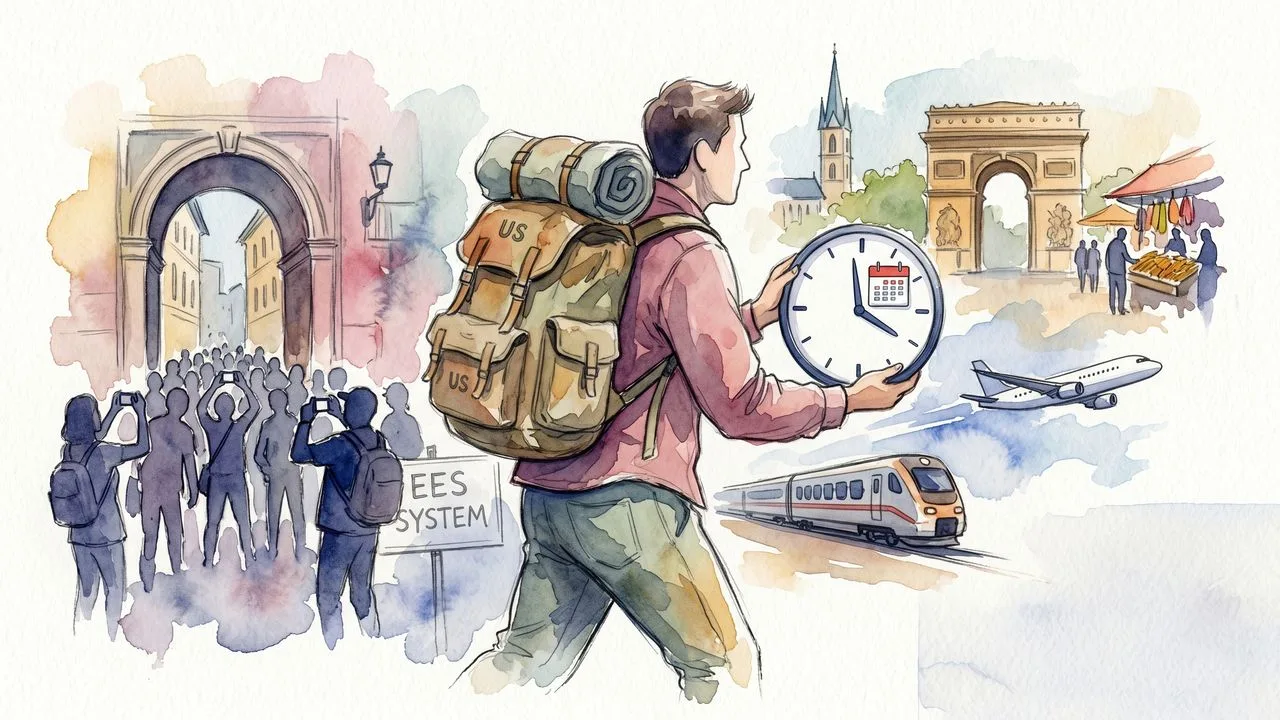
Photo: AI. Júlia Almeida
There is a conversation that repeats itself endlessly in travel media, and it goes something like this: tourists are the problem, travelers are the solution. Go deeper. Go slower. Skip the Acropolis, find the taverna. The sentiment is not wrong, exactly, but it tends to arrive without asking why the crowding exists in the first place—and who is actually positioned to do anything about it.
Episode 6 of the Honest Travel Podcast, hosted by Mark Wolters and co-host Shebz, is a Q&A format that surfaces this exact tension. The episode ranges across the EES border system rollout in Europe, the subdued mood at American airports right now, and the structural conditions that funnel millions of U.S. travelers toward the same dozen landmarks every year. What makes it worth engaging with is that Wolters—a veteran travel YouTuber who has spent twenty-plus years building Wolters World—is willing to complicate the "just be a better traveler" narrative rather than simply sell it.
The Airport as Mood Ring
Wolters opens by noting something qualitative and hard to quantify: the buzz is off. He has been traveling domestically across California, Ohio, and Georgia in recent months, and the airport energy that typically builds toward the end of the school year—the backpackers, the families, the particular kinetic relief of people escaping—is not there in the same way.
"It wasn't scared trepidation," he says. "It's more like... I saw a lot more business travel than I usually do."
Shebz, who just returned from Cyprus on a destination-promotion trip, offers a parallel data point from the other side of the Atlantic. Cyprus is geographically proximate to ongoing regional conflict, and the tourism impact is visible: quiet airports, nearly empty hotels. He found it a smooth visit—five minutes through the EES biometric system, no queues—but acknowledged that smooth and economically viable are different things. "I would love to see more people go out there," he said, with the particular pragmatism of someone who just watched an entire hotel operate around a handful of guests.
This is not yet a crisis story, but it is a signal worth paying attention to. When consumer confidence softens—whether from geopolitical anxiety, economic pressure, or simply the ambient noise of bad headlines—the places that lose visitors first are rarely the ones with institutional muscle. It is not Paris that empties out.
The EES Question, Partially Answered
The European Entry/Exit System—biometric registration for non-EU travelers, similar in concept to what non-U.S. citizens face at American ports of entry—has been a rolling story since its phased introduction. The narrative that has dominated coverage focuses on Lisbon and Faro, where queues have stretched to several hours and Ryanair memorably posted that a ninety-minute flight required a two-and-a-half-hour border wait.
Wolters and Shebz push back on the totality of that picture. Their experiences at Amsterdam, Paris Charles de Gaulle, and Larnaca in Cyprus were unremarkable. "It literally only takes... 30 seconds," Wolters notes. The EU is now allowing member states to suspend EES during peak morning departure windows—Vienna has apparently been considering exactly that—which suggests the system's administrators know the bottlenecks are real even where the process itself is not.
The gap between the horror-story airport and the routine airport is a media-coverage problem as much as an infrastructure one. Lisbon's struggles are news. Amsterdam's functional queues are not. The risk is that prospective travelers calibrate their decisions based on the exception rather than the pattern. That is genuinely useful context, and it is the kind of granular, airport-specific information that travel outlets—including this one—should be more rigorous about providing.
The Structural Case for American Crowding
The more substantive thread in this episode concerns overtourism, and specifically whether the standard prescription—be more intentional, seek second cities, resist the checklist—is accessible advice for the audience it purports to help.
A viewer named Connor framed it clearly: "So many jobs in the US, you get such limited time off in the year. Our vacation times per year feel pressured to go to certain places."
This is the thing the "slow travel" conversation tends to elide. The United States has no federal minimum paid vacation entitlement. The UK statutory minimum sits at 28 days. Much of continental Europe operates similarly. When Shebz mentions that British workers can spread their travel across four or five weeks annually, that is not a personality difference or a cultural sophistication gap—it is a policy difference with direct consequences for where people go and how they move when they get there.
Wolters engages this directly, which is to his credit. He notes that the European habit of gently mocking Americans for cramming four countries into ten days overlooks the basic arithmetic: if you have one international trip per decade, you are going to try to see everything. "Americans we get made fun of for a lot of things," he says, "and one of the things we have earned is the limited vacation time."
The structural argument has a reasonable counter: it does not fully explain why, within whatever time Americans have, they concentrate so heavily on a narrow list of destinations. Flight economics matter here—nonstop routes to secondary cities cost more, involve connections, and require more planning time that time-poor travelers do not have. Paris is easier to book, easier to navigate, and better documented than Lyon. That is not a character flaw. It is friction.
Checklist Versus Memory: A Real Distinction With Limits
Wolters is at his most animated when discussing what he calls the "bucket list" problem—travel organized around documentation rather than experience. "I've been to Paris a number of times, but what I remember is, oh, the Louvre—that's where my son learned how to walk." He describes a former apartment operator in Crete who told him tourists were bypassing the island entirely in favor of Athens, Mykonos, and Santorini, hitting the iconic shots and leaving.
The instinct to prioritize memory over checklist is sound. But Wolters also makes the more defensible point that the tourist/traveler binary is a false one. He pushes back gently on a viewer's suggestion that travelers should "live as though they were a native": "I think it's totally okay to be a tourist. But if you want to get more out of it, just that little change in mentality can do something."
That is a more honest position than the usual formulation. Wanting a photograph of the Eiffel Tower is not a moral failure. Structuring an entire trip around acquiring photographs at the expense of any other experience is a different thing—but the line between them is personal, and policing it from the outside tends to generate more condescension than behavior change.
The practical advice that follows is more useful than the philosophy: go to the second city. Mark mentions Lyon's standing as a gastronomic capital—arguably more interesting for food than Paris, and considerably less crowded. He talks about Brooklyn versus Times Square, Crete versus Santorini. The argument is not "be a better person." It is "the less obvious choice is often the more rewarding one, and it also happens to spread tourism revenue more equitably." That is a case you can make without requiring anyone to feel bad about their Instagram feed.
What Remains Unresolved
The episode touches on—without fully resolving—a tension that runs through the entire overtourism debate: the solutions most commonly prescribed (slow travel, second cities, extended immersion) tend to favor travelers with the most resources and flexibility. The person with two weeks off and a transatlantic flight budget that required months of saving is not the one who needs to hear that they should have booked Lyon instead of Paris.
The travelers who can genuinely redistribute their footprint are precisely the ones who already have enough time and money to choose differently. That does not make the advice wrong. It does suggest that the problem is at least partly structural—in U.S. labor policy, in airline route economics, in the way tourism infrastructure concentrates investment around marquee sites—rather than primarily a matter of individual mindset.
That structural dimension is what gets interesting when you follow it forward. If the overtourism conversation never gets there, it stays a lifestyle sermon. And lifestyle sermons, as Wolters would probably agree, are not the same as actually useful travel journalism.
More Like This
Luxury Train Journey Across Australia: Worth the Cost?
Explore a luxurious 80-hour train journey across Australia and its opulent offerings.

Fitness Is Tracking the Wrong Scoreboard
The wellness industry optimizes for calories and scale weight—not health. A climate entrepreneur's insight about broken metrics applies directly to your body.

Inside Argentina's 7-Generation Working Estancia
Estancia La Tomasa near Buenos Aires has welcomed guests since 2023. Here's what a weekend on this 140-year-old working ranch actually looks like.
What Poles Actually Want Tourists to Know
From geography to drinking etiquette, here's what Polish locals wish visitors understood before arriving—and why it matters more than you think.
Unpacking Social Media Censorship and Squatting Laws
Explore social media's role in public discourse and the quirks of squatting laws.
Airport Secrets Frequent Flyers Already Know
From cleaner restrooms to cancellation rights, here's what airports and airlines quietly rely on you not knowing—until now.
Airport Behavior That Makes Flying Worse for Everyone
From gate lice to baggage claim crowding, Mark Wolters of Wolters World maps the airport habits that slow everyone down—and why they persist.
Basic French Phrases That Help Tourists in France
A handful of French words can shift how locals treat you in France. Here's what actually matters, and why the effort carries more weight than fluency.